What you should expect
Chipping at the edges, a shell coming loose, discoloration at the margins, temporary temperature sensitivity, and color differences from adjacent teeth that change over the years.
Aesthetic dentistry · Berlin-Mitte
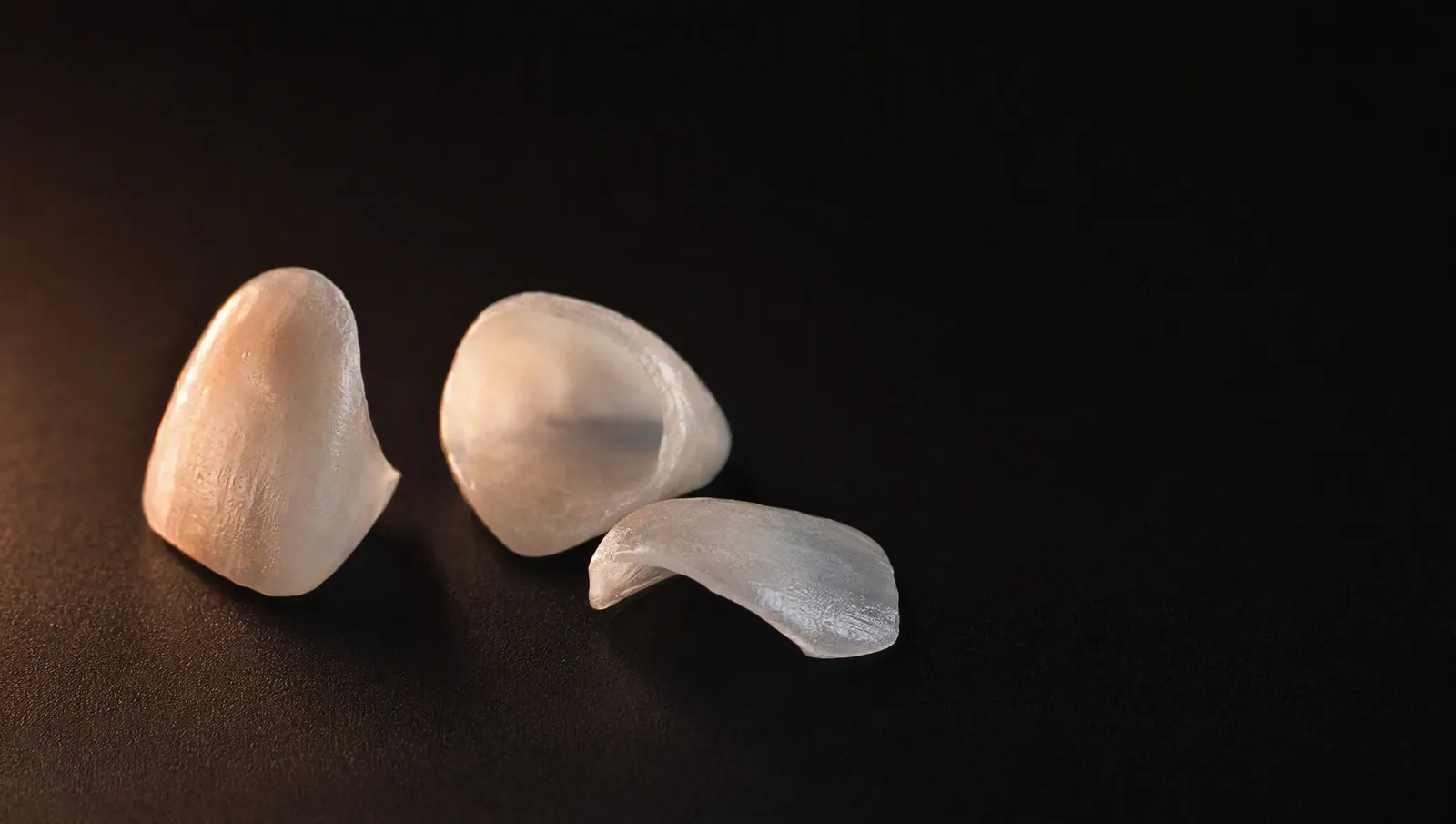
Ultra-thin ceramic shells for the visible front teeth – planned to suit your face and shown in a mock-up before any tooth is touched.
Suitability
A veneer is a thin ceramic shell bonded to the visible front surface of a tooth. It changes the tooth's shape, color, length, and position – but it is a restoration, not a cosmetic product that can be removed at night. This is why we begin every treatment plan by asking whether there is an option that preserves more tooth structure.
There often is: professional teeth whitening can address color alone without removing any tooth structure. Small defects along the edges can be built up directly with composite material. If teeth are markedly misaligned, orthodontic correction is the more honest approach than eight shells that merely conceal the misalignment.
A ceramic shell is bonded to the enamel. The bond holds only if the underlying structure is healthy and stable. This is why any underlying issues are treated before aesthetic planning begins:

If we conclude that veneers are not the right choice in your case, we will tell you – and show you what may be possible instead.
Guidance
Color, shape, position, and function do not require the same treatment. These three questions indicate what we are likely to discuss during the initial consultation and what we assess before aesthetic planning.
What would you most like to change?
What is known about your teeth, gums, and bite?
Which next step aligns with your goal?
If color and shape are to be changed together, ceramic shells may be one option to consider. The mock-up makes the planned shape visible before tooth preparation. First, we assess the enamel, gums, bite, and existing fillings.
Only then can we determine whether ceramic, composite, or a smaller correction suits your concern.
If tooth color is the main concern, whitening is the first step that preserves more tooth structure. After whitening, the tooth color is reassessed before planning the ceramic restorations. Fillings, crowns, and veneers do not whiten along with the teeth.
After whitening, we assess together whether shape or position still needs to be changed at all.
Grinding, marked misalignment, or teeth requiring treatment change the plan. Reliable clinical findings come before aesthetics. Depending on the issue, a functional analysis, orthodontics, or preliminary dental treatment may need to be discussed first.
After that, we can assess whether veneers are still appropriate or whether another option would require less tooth structure.
These questions are not a substitute for an examination, diagnosis, or consultation. They only help identify which topics we should discuss first. What is possible and appropriate for your front teeth depends on the clinical findings.
Options
Which option may be suitable depends on the available space, the existing enamel, and how much the shape and color are to change.
| Option | Suitable for | Tooth structure | Appointments |
|---|---|---|---|
| Feldspathic ceramic | the highest requirements for light behavior and a natural appearance in the front teeth | minimal preparation within the enamel, individually layered | Planning + 2 appointments |
| Lithium disilicate | somewhat greater loading, larger changes in shape | minimal preparation, more dimensionally stable pressed ceramic | Planning + 2 appointments |
| Non-prep veneer | when shape and position allow a purely additive shell | little or no reduction – only with a suitable initial shape | Planning + 2 appointments |
| Composite veneer | minor corrections, repairs, first step | usually additive, can be adjusted later | often one appointment |
“No-prep veneers for everyone” is an advertising promise, not a dental one. Whether a shell can be added without making the teeth look too bulky depends on their initial shape.
Process
We examine your teeth, gums, bite, and existing fillings and listen to what concerns you. This results in a recommendation – which may be that whitening or composite is the better option for your concern.
Digital photographs and an intraoral scan record the initial condition. For larger changes, we plan your smile using Digital Smile Design – a digital preview of the planned tooth shape shown on an image of your own face.
The laboratory first models the planned shape in wax. Using a template, we transfer it to your mouth as a resin trial: you see the new shape, speak and laugh with it – and tell us what you would still like to change.
Cavities, leaking margins, and inflamed gums are treated first. If the overall color is to be lighter, we whiten the teeth before the final shade is selected – ceramic cannot be lightened later.
We remove only as much enamel as clinically necessary, usually under local anesthesia, and scan the prepared teeth. You wear a temporary restoration until the ceramic restorations arrive from the laboratory.
Each shell is checked individually for fit, contact points, and color. Adhesive bonding follows only after you approve – this permanently bonds the ceramic to the enamel. Polishing and a bite check follow.
After a short time, we check the margins, gums, and bite again. If you grind your teeth at night, you will also receive a protective night guard – it is the least expensive part of the treatment and the most effective protection.
Costs
There is no reputable flat-rate price for “one veneer”: the Gebührenordnung für Zahnärzte (German dental fee schedule) requires fees to be determined according to the effort and difficulty of each individual case. The cost of your treatment can therefore only be established after the examination – but you will then receive it in writing and in full before we begin.
Veneers provided solely for aesthetic reasons are a privately paid service; the gesetzliche Krankenkasse (German statutory health insurance fund) generally does not cover them. An individual case may be different if a tooth requires restoration after an accident or because of a larger defect. Private insurance and supplemental plans provide benefits according to the contract – submit our Heil- und Kostenplan (the written treatment and cost plan required before treatment) for review before treatment begins.
Durability
In a meta-analysis of 1,688 ceramic veneers, the survival rate after an average of 10.4 years was 96.05 percent.
Meta-analysis of ceramic laminate veneers, 2025 – PMC12076113. An average from a study is not a promise for your tooth: oral hygiene, bite, grinding and the quality of the adhesive bond affect the outcome.
Chipping at the edges, a shell coming loose, discoloration at the margins, temporary temperature sensitivity, and color differences from adjacent teeth that change over the years.
If enamel has been removed for conventional veneers, it cannot be restored. The tooth will then require a restoration permanently. We discuss this decision before the first preparation, not afterward.
Treatment

Dentist
Lead dentist at F80 and an expert in aesthetic dentistry and Digital Smile Design. She studied dentistry at Charité Berlin, completed the DGP postgraduate curriculum in periodontology, and earned a Dr. med. dent. degree. She provides treatment in German, English, and Bulgarian.
Questions
For conventional ceramic veneers, a thin layer is removed, usually within the enamel. Non-prep veneers require little or no reduction – but only if the shape of the teeth and the available space allow it. A blanket claim of “always without reduction” would not be reputable.
Once enamel has been removed, it cannot be restored; the tooth will then require a permanent restoration. Purely additive composite veneers and some non-prep restorations can be adjusted more readily. Before treatment begins, we will tell you which approach applies to your teeth.
This depends on how many teeth are visible when you smile and how much their color and shape differ. Sometimes two shells on the central incisors are enough. The mock-up lets you see both options before you decide.
They can if all teeth are given the same shape and made extremely light. The result looks natural when color, translucency, tooth shape, the appearance of the lips, and adjacent teeth are planned together. This is precisely what the mock-up is for.
Often yes – but not without a plan. We analyze function, check your bite, and include a protective night guard in the plan. Untreated severe grinding is the most common reason for chipped ceramic.
If you want your teeth to be lighter overall: yes. Ceramic does not change color, so we determine the final tooth shade only after whitening. Fillings and crowns do not whiten along with the teeth either.
For laboratory-made ceramic veneers, we generally plan one consultation and two clinical appointments about one week apart. Composite veneers are often completed in a single appointment. If preliminary treatments are needed, the schedule shifts accordingly.
Depending on the damage, rebonding, repair, or replacement may be possible. Contact us promptly in this situation – an unprotected prepared tooth is sensitive and can be damaged.
Generally not when the reason is purely aesthetic. An individual case may be different when there is a medical indication, such as after an accident or for a larger defect. The relevant document is the Heil- und Kostenplan (the written treatment and cost plan required before treatment), which you receive before treatment begins.
Schedule a consultation at Friedrichstraße 80. We will examine your teeth and show you the options – and you can decide without pressure whether and how to proceed.
Or call: 030 436665501