What treatment can achieve
Bring the inflammation under control, make pockets shallower, arrest further bone loss and thereby help preserve teeth that might otherwise be lost.
Gum care · Berlin-Mitte
Gum inflammation that damages the bone—usually without pain. Treatment follows a defined sequence: non-surgical care first, with surgery only where it is still needed afterwards.
Findings
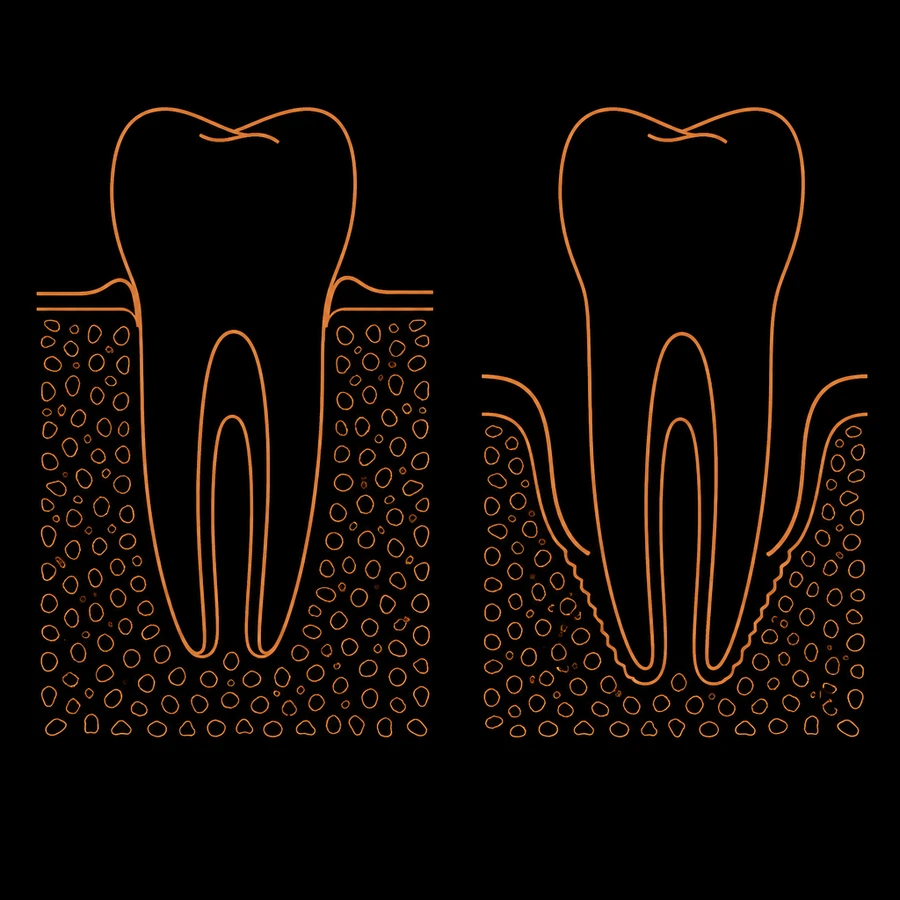
Healthy gums fit snugly around the tooth. Only a shallow groove remains between them. If the tissue remains inflamed, it separates from the tooth—the groove becomes a pocket. Bacteria collect in this pocket beyond the reach of a toothbrush and dental floss.
The critical step comes next: in response to the inflammation, the body resorbs the bone that supports the tooth. This bone does not grow back on its own. Periodontitis is therefore not a cosmetic issue but the most common cause of tooth loss in adults.
The insidious part is the lack of pain. Tooth decay makes itself felt; periodontitis usually does not. Many people notice it only when teeth become loose or change position—by then, bone has already been lost.
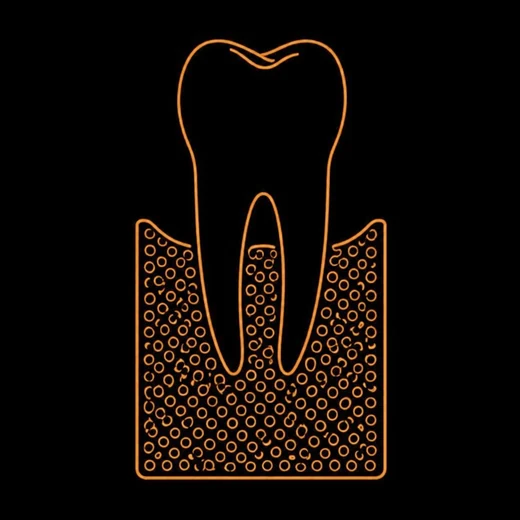
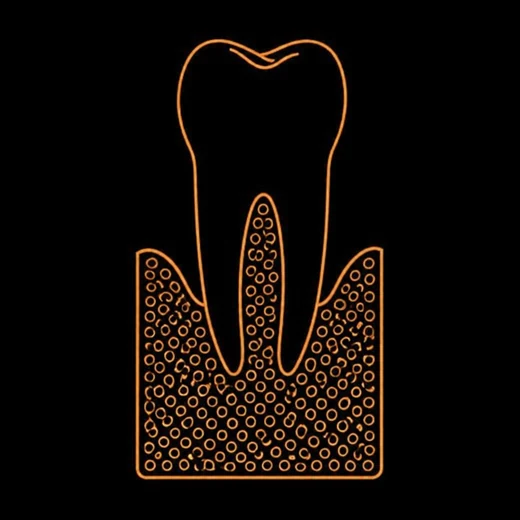
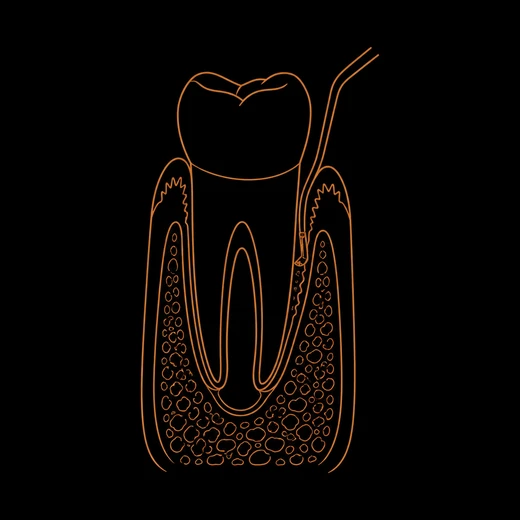
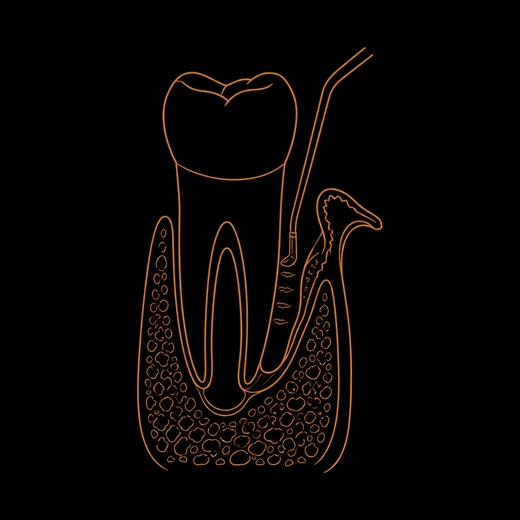
On the left, the gum fits snugly around the tooth and the bone reaches almost to the crown. On the right, the gum has detached and the bone has receded—the tooth has less foundation.
This difference remains invisible from the outside for a long time. It can be measured with a periodontal probe and seen on an X-ray, which is exactly why every treatment begins there.
Pocket depth
During the examination, we measure at several sites around every tooth how far the probe slides between the tooth and gum and whether bleeding occurs. Together with the X-rays, these readings show how far the disease has progressed and what treatment it requires.
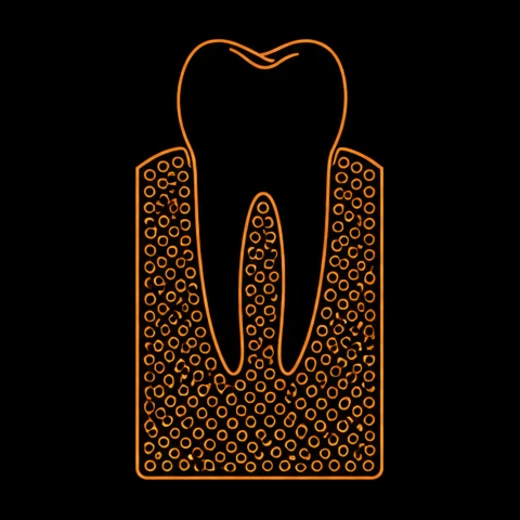
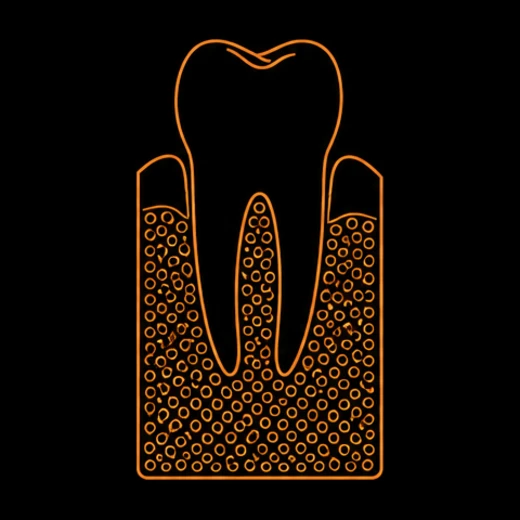
This classification is for guidance. Your actual findings come from measurements around your teeth—not from self-assessment.
Signs
Periodontitis rarely causes pain, but it almost always has other signs. Tick those you recognize—the result indicates how urgently you should be examined.
From a distance, there is nothing to suggest acute periodontitis. However, that does not rule it out: the disease can progress for years without symptoms and only becomes visible through probing measurements and X-rays. Regular check-ups remain the most reliable approach.
What you selected may be harmless—or an early warning sign. Gums that bleed when you brush are not normal; they are inflamed. At an early stage, simple measures are often enough, so it is worth raising this specifically at your next check-up.
This combination should be examined. The earlier pocket depths are measured, the more bone can be preserved—lost bone does not return on its own. An appointment for an examination including periodontal charting will clarify your situation without taking long.
Several of these points together—especially loose or shifting teeth—suggest that the tissues supporting the teeth may already be affected. Waiting worsens the starting position. Please arrange an examination even if nothing hurts.
This selection is not a test, diagnosis or substitute for an examination. It only indicates how urgently you should make an appointment. Whether periodontitis is present and how far it has progressed can only be shown by probing measurements and X-rays.
Process
Since July 2021, a directive issued by Germany's Federal Joint Committee (Gemeinsamer Bundesausschuss) has governed how periodontitis is treated for people with statutory health insurance. This is good news for you: the process is the same throughout Germany, each step builds on the last, and supportive periodontal care is an integral part—not an optional extra.
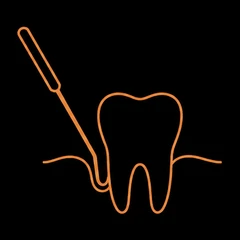
Pocket depths at all teeth, bleeding sites and X-rays are recorded. Together, they form the periodontal chart—the map of your disease.

We review the findings with you, discuss risk factors and which of them can be modified. The treatment plan is then submitted to your statutory health insurance fund for approval.
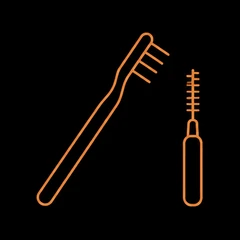
Before treatment begins below the gumline, cleaning above it needs to be effective. You learn which aids suit your interdental spaces and how to use them.
The root surfaces are cleaned through the periodontal pocket using hand instruments and ultrasonic scalers, under local anesthesia and without incisions. Usually in one or two appointments.
After several months, the measurements are repeated. Only this reassessment shows which pockets have closed and where deep sites remain. This is when we decide whether a surgical step is needed.
Only at sites that remain deep. The gum is gently lifted, the root is cleaned under direct vision, and the site is then sutured.
Regular appointments for repeat measurements and cleaning. Frequency depends on how the disease progresses. This phase is part of treatment—and determines whether the result is maintained.
Methods
This is where many descriptions are misleading: surgical and non-surgical treatment are not two options you choose between, and surgery is not simply the more thorough option for those who want more.
They are two consecutive stages. Non-surgical treatment always comes first because it requires no incision and is sufficient in many cases. Only the reassessment afterwards shows whether surgery is still needed anywhere—and if it is, only at those sites.
If you are offered surgical treatment before non-surgical treatment and reassessment, ask why.
Whether laser treatment, local antibiotics or tests for specific bacteria are useful additional measures depends on the individual case. None is considered a substitute for thorough mechanical cleaning of the root surfaces.
Costs
Unlike many dental services, periodontitis treatment is largely covered by German statutory health insurance—provided the findings meet the directive's criteria. This includes two years of supportive periodontal care, which previously had to be paid for privately.
For patients with private insurance and supplementary policies, fees are calculated under the German Dental Fee Schedule (Gebührenordnung für Zahnärzte, GOZ); coverage depends on your policy. You receive the treatment plan before treatment begins so you can submit it to your insurer.
Your part
With most dental treatments, the work is done when you leave the chair. Not here. Periodontitis is a chronic disease: it can be brought under control, but the conditions in which it developed remain. What happens next is determined largely at home.
That may sound like a lot. In practice, it means a few minutes a day and a few appointments a year—given what is at stake, the least burdensome part of the entire treatment.
Evidence
In a meta-analysis, the mean reduction in pocket depth after non-surgical treatment was 1.4 millimeters. Around 74 percent of treated pockets were considered closed after six to eight months.
Systematic review and meta-analysis of subgingival instrumentation, Journal of Clinical Periodontology 2020 – PMID 31889320 (analysis of nine studies; 95% confidence interval 1.0–1.7 mm and 64–85 percent, respectively). These are averages from studies, not a statement about your clinical findings: how an individual pocket responds depends on its initial depth, tooth shape, smoking behaviour and oral hygiene.
Bring the inflammation under control, make pockets shallower, arrest further bone loss and thereby help preserve teeth that might otherwise be lost.
Restore lost bone—regeneration is possible only for certain types of defects. Nor can treatment prevent the disease from returning without supportive periodontal care.
Questions
Cleaning below the gumline is carried out under local anesthesia. For a few days afterwards, the gums may be sensitive and the teeth may react to cold because exposed root surfaces are no longer covered by deposits. If you are very anxious, please talk to us—nitrous oxide or sedation are also options.
This cannot be determined in advance, and no one should promise it can. The decision is made at the reassessment several months after non-surgical treatment: pockets that have closed need no further treatment. Surgery may be considered only where deep pockets remain.
As the inflammation subsides, the tissue becomes firmer and settles back against the tooth, making the pockets shallower. Receded gums do not grow back to their previous level, however. Teeth may therefore look longer after successful treatment.
That depends on how advanced the bone loss is. With systematic treatment and consistent supportive periodontal care, many teeth considered hopeless can be retained for years. This is not a guarantee: where bone loss is very advanced, retaining an individual tooth may be the less appropriate option.
Typically, several months pass between the examination and the reassessment after non-surgical treatment because the tissues need time to heal. Supportive periodontal care then continues for two years. This is a long-term treatment, not a matter of two appointments.
There are well-studied associations, most clearly with diabetes: the two diseases influence each other. Associations have also been reported with cardiovascular disease and pregnancy complications. However, an association is not the same as causation—what can responsibly be said is that treated inflammation places less strain on the body than untreated inflammation.
No. Professional dental cleaning works above and just below the gumline. In periodontitis, bacteria are located deep in the pocket on the root surface—only systematic periodontal treatment can reach them there. Professional cleaning is important preparation but not a substitute.
Yes. Periodontitis is chronic: treatment brings it under control but does not remove the underlying susceptibility. That is precisely the purpose of supportive periodontal care—it identifies renewed deterioration while it is still limited.
Usually, yes. Before treatment below the gumline, everything above it should be clean; otherwise, bacteria can immediately recolonize the cleaned pocket. This preparatory treatment is usually not covered by statutory health insurance; we tell you in advance what applies in your case.
A periodontal assessment shows whether and how far the tissues supporting your teeth are affected. Arrange an appointment at Friedrichstraße 80—even if nothing hurts.
Or call: 030 436665501