
Pediatric dentistry · Berlin-Mitte

Pediatric and adolescent dentistry on Friedrichstraße in Berlin-Mitte

From the first baby tooth to a complete set of permanent teeth: preventive care in small steps and at your child's pace. The first visit can be just about getting to know us—with no treatment at all.

A small children's toothbrush leaning against a large toothbrush, both on a dark background
Dental care grows with your child: what begins with the first baby tooth later supports the permanent teeth.
Practice
Friedrichstraße 80
10117 Berlin-Mitte
Open
7 days a week
Mon–Fri until 8 p.m.
First visit
From the first
baby tooth
Preventive care
Largely covered by
statutory health insurance

Starting point

No child has to be brave here

Some children climb curiously into the chair and want to touch every instrument. Others need three tries before they open their mouth. Both are normal, and both have a place here. We do not treat a child against their will: no holding down, no springing surprises, no tricks. Whatever we do, we announce beforehand—in words a child understands.

The same goes for parents: there are no lectures here. Whether it is the bottle, sweets or a long-postponed appointment—the conversation is not about how things got to this point, but about what helps your child now. You stay with your child for as long as they need you, and you can ask any question that matters to you.

Guidance

Which first step suits your child?

Whether the next step is an introductory visit, a preventive appointment or a prompt examination depends on age, on the reason for coming and on your child. These three questions give an initial direction.

Question 1 of 3
  1. How old is your child?

  2. What brings you in?

  3. How does your child approach new things?

An introductory appointment is the right first step

The first visit makes sense from the first baby tooth onward and can be unspectacular: looking, counting teeth, answering parents' questions. The earlier the first appointment, the sooner your child gets to know the practice without anything needing to be done. That is exactly what shapes how they feel about dental appointments later on.

Feel free to bring the yellow children's health record booklet—the dental early-detection appointments are noted there as well.

A regular preventive care schedule is the right fit

Alongside the check-up comes age-appropriate preventive care: brushing instruction, fluoride application and—while the teeth are changing—the question of whether the new molars should be sealed. For children and adolescents, statutory health insurance largely covers preventive care.

How often an appointment makes sense depends on age and on the risk of tooth decay—we decide that together.

Please have this looked at soon

White or brown spots, a cavity, pain or bleeding gums should be examined. Tooth decay can reach deep into a baby tooth faster than into a permanent tooth because the enamel is thinner and the nerve lies closer to the surface.

Waiting rarely makes treatment smaller. For acute pain or after a fall, call us directly.

In small steps, at your child's pace

After a bad experience, trust comes before speed: getting to know each other first, nothing against the child's will, every step announced in advance. A child who only watches today has not wasted the appointment.

If treatment is needed, we plan short appointments with a clear pause signal—and discuss whether nitrous oxide or sedation may be appropriate after a medical assessment.

These questions do not replace an examination or a consultation. They only give an initial sense of what the first step for your child might look like. What is actually needed becomes clear at the appointment.

Ages and stages

Three sets of teeth in eighteen years

Between the first baby tooth and the complete set of permanent teeth, the mouth rebuilds itself twice. Each phase has its own weak points—and its own preventive care.

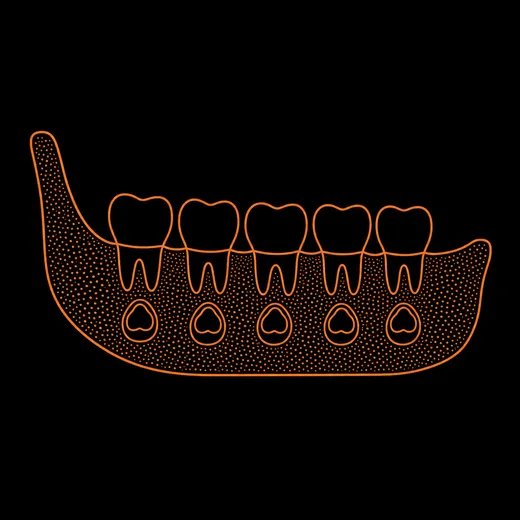
  1. Diagram: a child's lower jaw seen from the side – five milk teeth with the buds of the permanent teeth beneath them

    Baby teeth—from birth to around six

    What happens
    twenty baby teeth come through, usually starting around the sixth month of life; by about age three, the set of baby teeth is complete
    What to watch for
    brushing is the parents' job; a bottle with sweet or acidic drinks is the most common avoidable cause of tooth decay
    Preventive care
    early-detection check-ups from the first tooth, advice on brushing and fluoride, fluoride varnish to protect the enamel
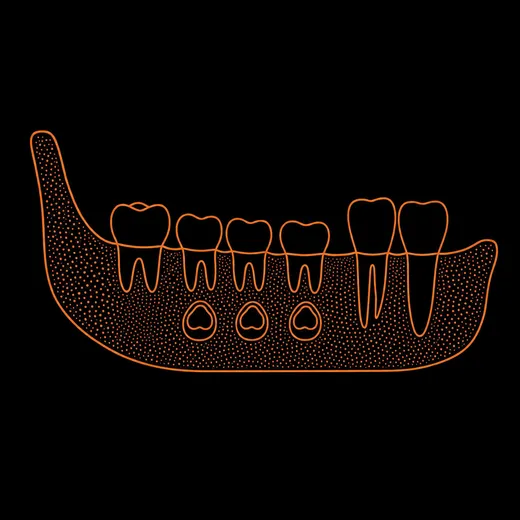
  2. Diagram: mixed dentition seen from the side – a new large molar at the back, permanent front teeth, and milk teeth in between with tooth buds in the bone

    Changing teeth—around six to twelve

    What happens
    the baby teeth fall out one by one; the first large permanent molar comes in at the very back without a baby tooth falling out to make room—which is why it is often overlooked
    What to watch for
    newly erupted teeth are not yet fully mineralized and are therefore more vulnerable; it still makes sense for parents to brush again afterwards until the child can write fluently
    Preventive care
    individual preventive care with brushing instruction and fluoride application; the chewing surfaces of the new molars can be sealed
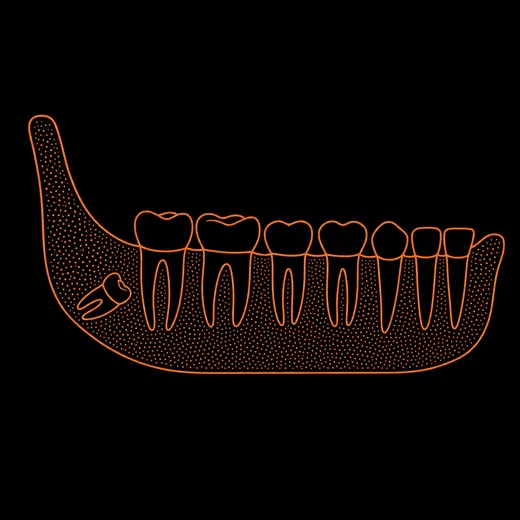
  3. Diagram: a teenager's permanent dentition seen from the side, with the germ of a wisdom tooth in the bone at the back

    Teenagers—around twelve to eighteen

    What happens
    the permanent teeth are complete; only the wisdom teeth are still to come
    What to watch for
    sugary drinks and constant snacking; the spaces between the teeth now need care of their own, and fixed braces need their own brushing routine
    Preventive care
    individual preventive care up to the eighteenth birthday, monitoring of the wisdom teeth, and a referral to orthodontics if needed

The ages given are rough guides. Every set of teeth has its own pace—teeth changing early or late is usually no cause for concern in itself.

Baby teeth

Baby teeth are not practice teeth

“They'll fall out anyway” is the most expensive sentence in pediatric dentistry. Baby teeth hold the space for the permanent teeth and guide them as they come through. They are needed for chewing and for sounds like S and Z. If a baby tooth is lost too early, the neighboring teeth can tip into the gap—and the permanent tooth can no longer find its place on its own.

Untreated tooth decay does not disappear with the baby tooth either. The bacteria stay in the mouth and meet the newly erupted permanent teeth there—at precisely their most vulnerable time. A diseased set of baby teeth is therefore a poor start for the permanent one.

Why a cavity in a baby tooth deepens faster

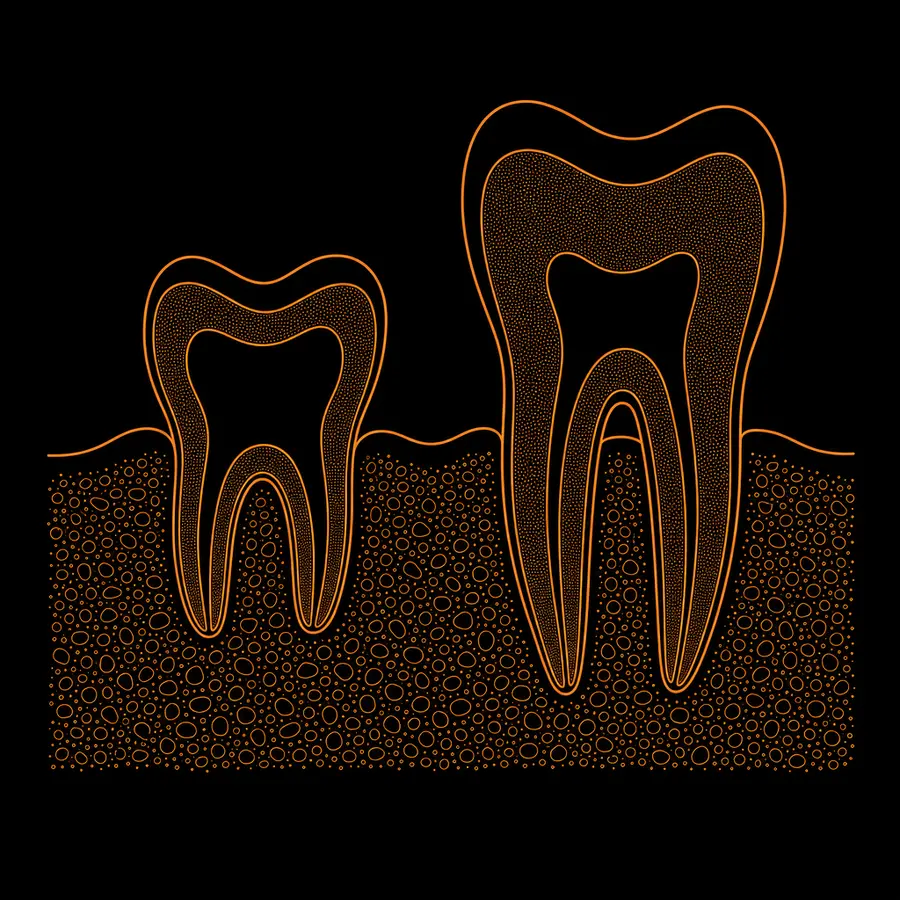
The enamel of a baby tooth is considerably thinner than that of a permanent tooth, and the nerve fills a larger share of the tooth's interior. Decay therefore has less distance to cover before reaching the nerve. What takes years to develop in an adult can be through a baby tooth in months.

So the rule is: take small spots seriously instead of treating large cavities. The earlier something is noticed, the smaller the procedure usually stays.

Diagram: baby tooth and permanent tooth in cross-section—the baby tooth has a thinner enamel layer and a larger nerve chamber
On the left, the baby tooth: thinner enamel, a larger nerve chamber. The same decay goes deep faster here.

The earliest avoidable cause is the baby bottle: when a child sucks on it constantly, juice, diluted juice and sweetened tea wash over the upper front teeth for hours. The only drink suitable for constant sucking is water.

First appointment

The first visit is deliberately unspectacular

The best time for the first dental visit is before anything hurts: from the first baby tooth, and no later than around the first birthday. That way your child gets to know the practice, the chair and the routines at a moment when nothing is asked of them.

  1. Arriving and looking around

    Your child explores the room and sits on your lap or alone in the chair—whichever they prefer. Nothing happens unannounced.

  2. Counting instead of drilling

    We count the teeth with a mirror and light and explain every move beforehand in words a child understands: explain first, then show, then do.

    Every instrument is shown first, then used.
  3. Practicing brushing, answering questions

    Brushing technique to match the age, the right amount of toothpaste, bottle, pacifier, fluoride: you get concrete answers instead of general admonishments.

  4. A plan for the next appointments

    We set the schedule for preventive care. If treatment should be necessary, it gets an appointment of its own—with time and without surprises.

    We do not mix getting to know us with treatment.

A tip for preparing: mention the appointment casually and avoid sentences like “It definitely won't hurt”—they awaken exactly the worry they are meant to take away. If you treat the visit as part of normal everyday life, you give your child the best model to follow.

Treatment

If treatment is needed after all

Treatment, too, follows fixed rules: explain first, then show on a model or on a finger, then do. Your child gets a stop signal—raising a hand means pause, immediately and without discussion. This agreement genuinely holds; it decides whether a child keeps their trust.

A signal that always applies

For children, control is the difference between “enduring” and “taking part”. The agreed hand signal stops the treatment immediately. Then we talk, and we continue only with renewed consent—even if that makes the appointment longer.

For very anxious children, we prefer to plan two short appointments rather than one long one. After a medical assessment, nitrous oxide or sedation can also be discussed; more on this on our page for anxious patients.

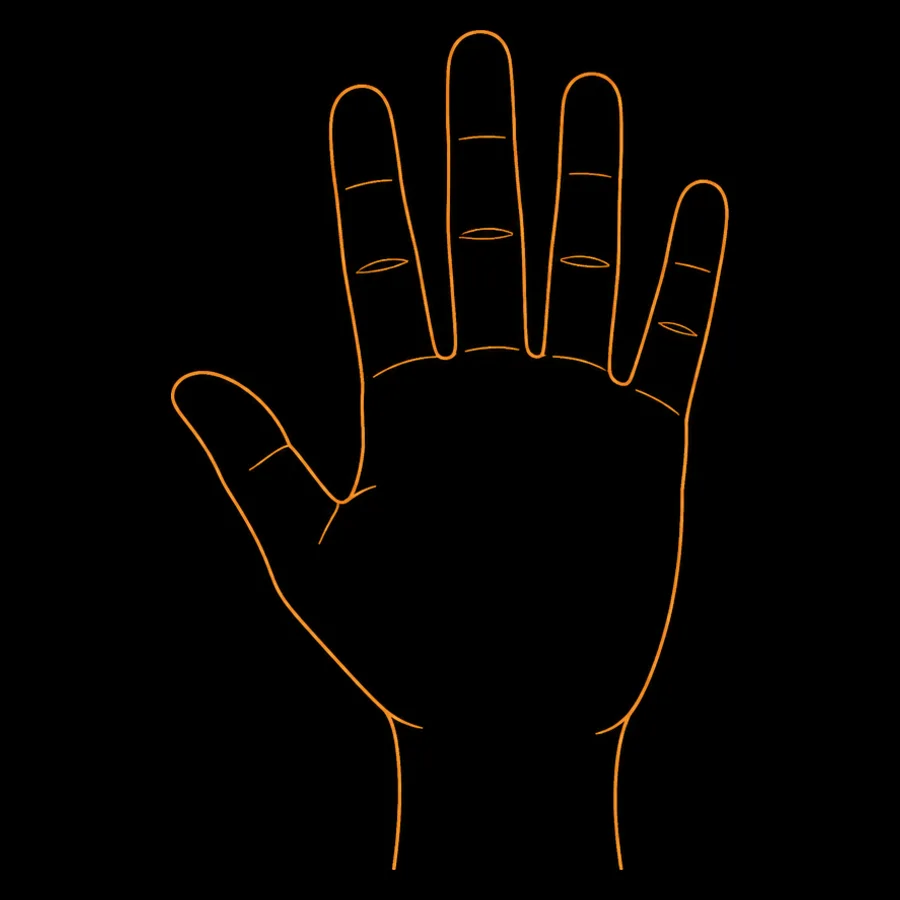
Diagram: a raised hand as the agreed stop signal during dental treatment
Raising a hand means pause. We continue only once the child agrees again.

Treating small defects early

A small cavity in a baby tooth can often be treated in one short session—with a tooth-colored filling and local anesthesia that we prepare in a child-friendly way. The earlier the finding, the smaller the step usually stays.

If more is needed

Severely damaged baby teeth can be preserved with a pediatric crown. If a tooth cannot be saved, it is removed; a space maintainer then keeps the place open for the permanent tooth. We discuss calmly in advance what makes sense.

If a tooth breaks or gets knocked out

After a fall onto a tooth, the order of steps matters: stay calm, stop any bleeding with a clean compress, then call. Touch a knocked-out permanent tooth only by the crown, do not clean it, and keep it moist—ideally in a tooth rescue box from the pharmacy, or otherwise in cold UHT milk. A baby tooth is not put back in, but the fall should still be examined. The detailed instructions are on our dental injury page.

Costs

What statutory health insurance covers for children

For children and adolescents, preventive dental care is largely covered by German statutory health insurance. It only needs to be used—every child is entitled to these appointments.

Your child is entitled to these services

Early detection for the youngest
From the first baby tooth to the sixth birthday: several early-detection check-ups, advice for parents on brushing, the bottle and fluoride, and fluoride varnish to protect the baby teeth.
Individual preventive care from age six
From the sixth to the eighteenth birthday: regular check-ups, an oral hygiene assessment, brushing instruction and fluoride application.
Fissure sealing
The chewing surfaces of the large permanent molars can be sealed so that their deep grooves give tooth decay less to attack.
Treatment
Fillings and other necessary treatments are part of standard statutory dental care. Where optional private services come into play, we say so beforehand—not on the invoice.
What remains private-pay
Professional dental cleaning beyond the individual preventive care program and special material requests are, as a rule, not covered by statutory health insurance. You will hear about this before the appointment, too.

A Cochrane review of twenty-two trials found, with fluoride varnish, on average 37 percent fewer new decayed tooth surfaces in baby teeth and 43 percent fewer in permanent teeth—each compared with placebo or no treatment.

Marinho et al., Cochrane Database of Systematic Reviews 2013 – PMID 23846772 (95-%-Konfidenzintervall 24–51 Prozent beziehungsweise 30–57 Prozent). Die Autoren stufen die Qualität der Belege wegen Verzerrungsrisiken und großer Unterschiede zwischen den Studien nur als moderat ein. Ein Studienmittelwert ist keine Zusage für Ihr Kind – Putzen, Ernährung und regelmäßige Termine bleiben entscheidend.

What preventive care can do

Detect risks early, strengthen the enamel, correct brushing mistakes before they become cavities—and keep treatments small if something does come up.

What it does not replace

Daily brushing at home and the choice of drinks between appointments. No preventive appointment can do the brushing for you—the most important dental care happens at the sink.

Questions

Frequently asked questions about pediatric and adolescent dentistry

From what age should my child see the dentist?

From the first baby tooth, and no later than around the first birthday. The yellow children's health record booklet sets out dedicated dental early-detection appointments for this. Starting early has two advantages: your child gets to know the practice without a specific reason, and questions about brushing, the bottle and fluoride are settled before mistakes turn into findings.

How do I prepare my child for the appointment?

Casually and positively. Announce the visit as a normal appointment, perhaps with a picture book on the subject. Avoid phrases like “It won't hurt” or “You don't need to be scared”—they plant exactly what they are meant to prevent. And talk about your own dental appointments only if you have good things to report.

Does a cavity in a baby tooth really need to be treated?

Yes. Decay in a baby tooth can reach deep faster than in a permanent tooth, can cause pain and inflammation, and in the worst case endangers the developing tooth bud underneath. A cavity found early can usually be treated with a small filling—one found late needs considerably more.

What happens if my child will not cooperate?

Then we do not treat against your child's will. We stop before trust is lost and try again in smaller steps or at a new appointment. For urgent or extensive treatment there are options such as nitrous oxide or sedation after a medical assessment—holding a child down is not one of them.

Is fluoride safe for children?

In the recommended, age-appropriate amount, fluoride is considered well studied and effective against tooth decay; the dental and pediatric professional societies recommend it jointly. Dosage is what matters: a rice-grain-sized amount of children's toothpaste from the first tooth, and a pea-sized amount from about age two. Which toothpaste and which amount suit your child is something we discuss in concrete terms at the appointment.

Pacifier or thumb—which is better for the teeth?

With prolonged use, both shape the jaw and the bite—the thumb usually more strongly, and it cannot be taken away. A pacifier is therefore easier to limit and to wean off, ideally by around the third birthday. At that point, an open bite can often still correct itself.

What helps with teething?

Chilled but not frozen teething rings, a cold washcloth, or a gentle massage with a clean finger. We advise against teething gels containing sugar or alcohol and against amber necklaces—cords around a small child's neck or wrist are a real accident hazard.

What should we do if a tooth has been knocked out?

Touch a permanent tooth only by the crown, do not clean it, keep it moist—in a tooth rescue box or, failing that, in cold UHT milk—and call us immediately. A baby tooth is not put back in, but the accident should still be examined promptly. Step-by-step guidance is on our dental injury page.

My teenager refuses to brush. Now what?

Power struggles here are usually lost by both sides. What can help: an appointment where we talk with your teenager rather than about them—about plaque, bleeding gums and what matters to them personally, from appearance to bad breath. Some arguments work better when they come from someone else.

The best first appointment is one with no specific reason

Get to know us before anything hurts. We take time for your child and announce every step in advance—and if the first visit consists only of watching, that is completely fine.

Or call: 030 436665501