Cold sores · Berlin-Mitte
Treat it while it is still only tingling
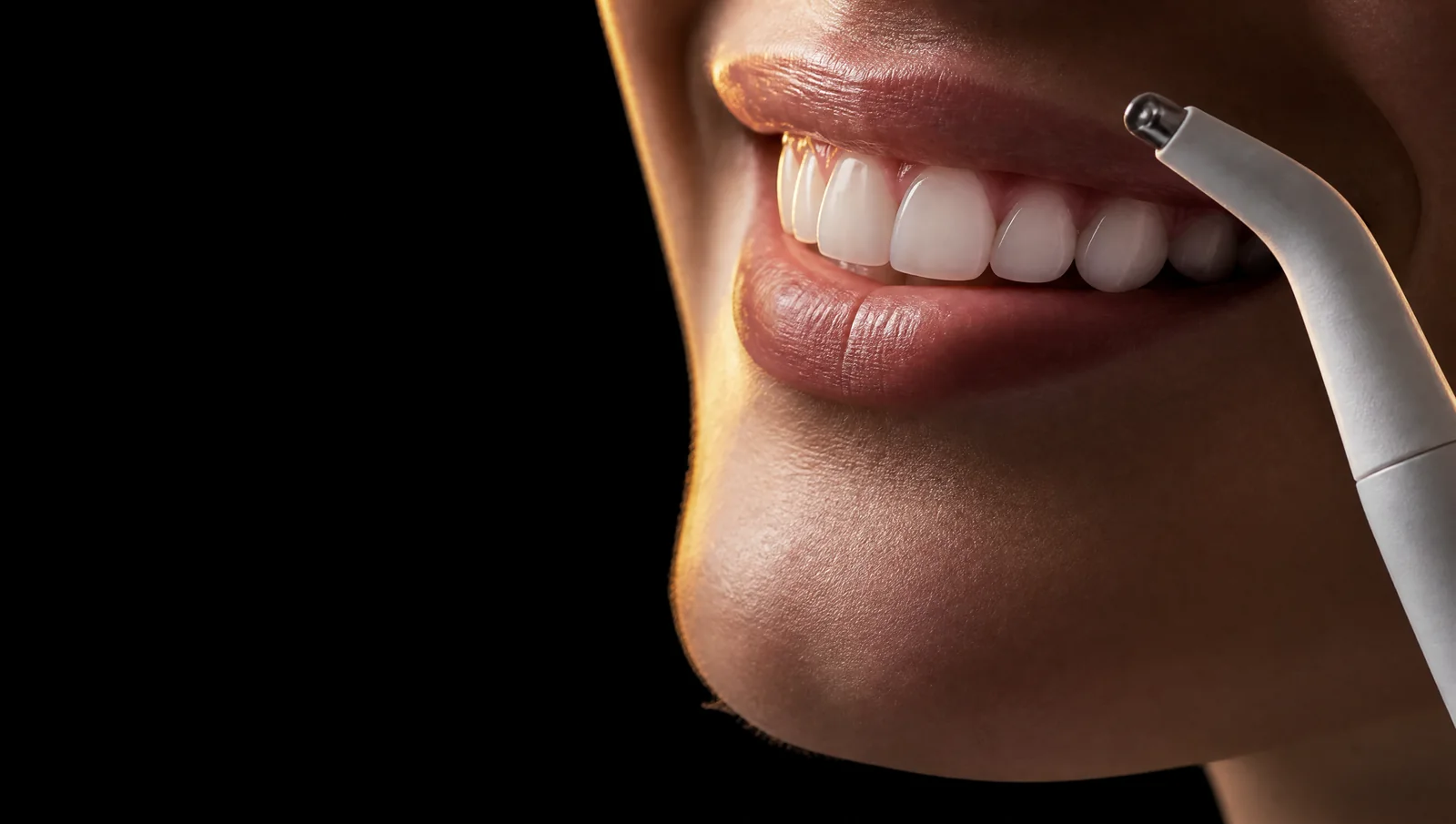
The hours between the first tightness and the first blister decide how the outbreak will run. In that window we can work with the soft laser, without you waiting for an appointment next week.
- Practice
- Friedrichstraße 80
10117 Berlin-Mitte - Open
- 7 days a week
Mon–Fri until 8 p.m. - Treatment
- a few minutes,
no anaesthetic - Appointment
- 030 436665501
Triggers
Why it so often happens after a dental appointment
Some people know the pattern exactly: two days after a treatment the lip feels tight, and the next morning the blister is there. That is not chance and not imagination.
An American study of patients who carry the herpes virus counted this after dental procedures. In the comparison group without medication, 20.6 percent developed a visible lesion within a week of the appointment. So about one in five.
The reason is easy to explain. The mouth stays open for a long time, the lip is stretched and mechanically irritated. With an anaesthetic, work is done close to the nerve pathways where the virus rests between outbreaks. On top of that, for many people a dental appointment means tension, and stress is one of the classic triggers.
What follows from that is practical: if you know that this regularly happens to you after treatment, tell us before the appointment. Then it can be planned for, instead of reacting afterwards.
Time window
Three stages, and only the first is truly open
An outbreak runs in a fixed sequence. What still makes sense depends on where you are right now.
-
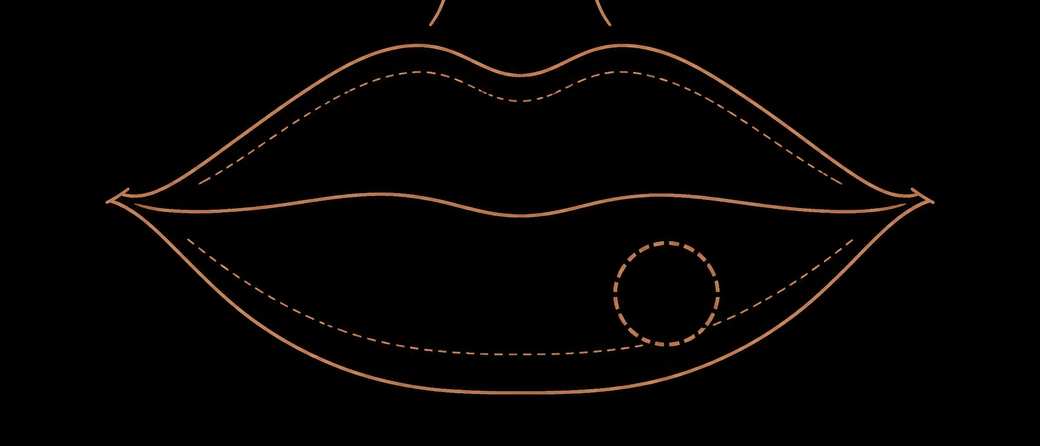
Prodromal stage
- How you notice it
- Tingling, tightness, itching or a feeling of pressure at one spot on the lip. Nothing is visible yet
- How long
- Hours to about one day
- What is possible
- Everything. This is the moment when every treatment has its best effect, the antiviral cream as well as the laser
-
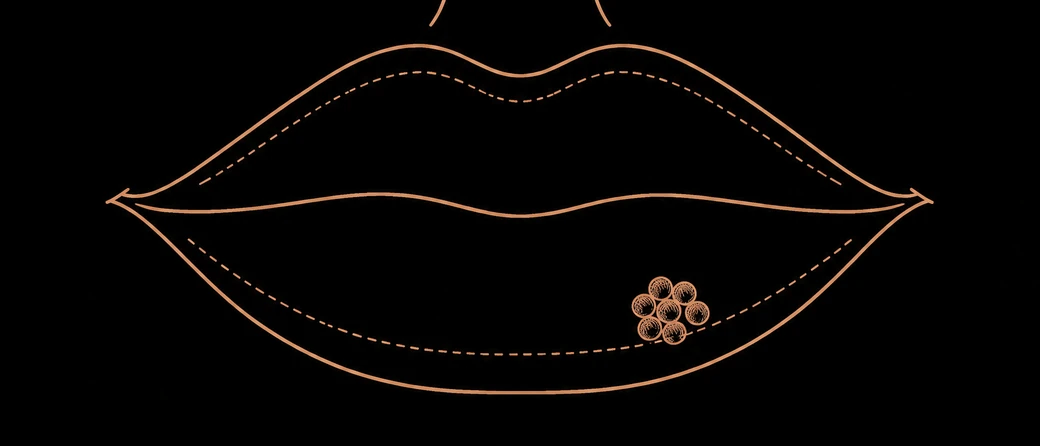
Blister stage
- How you notice it
- Clustered, fluid-filled blisters, usually at the edge of the lip. Clearly painful, and now also contagious
- How long
- several days
- What is possible
- Treatment is still worthwhile, especially for pain. The course can be softened, but no longer shortened as in the prodrome
-
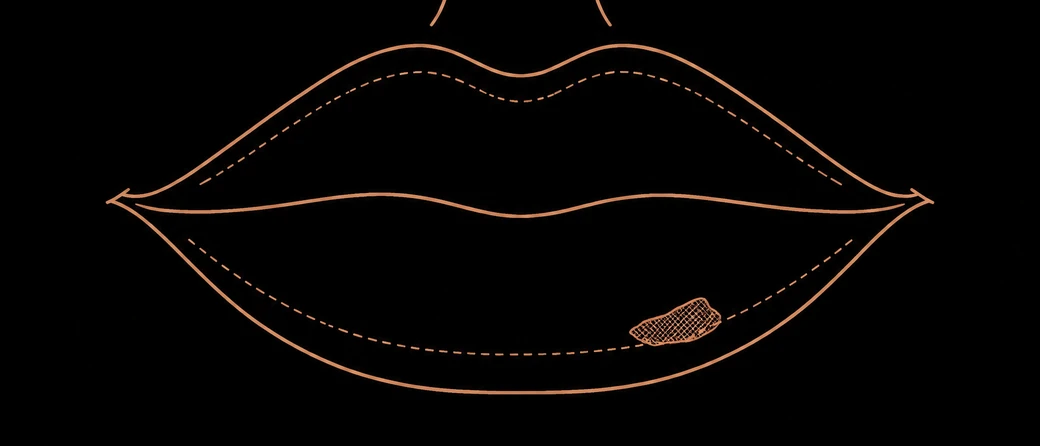
Crust stage
- How you notice it
- The blisters have opened; a scab forms
- How long
- until healing, one to two weeks in total from the start
- What is possible
- Little that is pharmacological. Now it is about care and leaving the crust alone
That is why tingling is in the heading of this page. Anyone who waits until something is visible has usually already missed the most effective window.
An untreated outbreak lasts one to two weeks and as a rule heals without scarring. That is the good news and at the same time the yardstick against which every treatment must be measured. It is not about averting a dangerous disease, but about making a bothersome episode shorter and more bearable.
Soft laser
What the laser does, and what it does not do
Soft laser is a misleading name, because the procedure has little to do with the laser used in oral surgery. The technical term is photobiomodulation. The light carries so little energy that it removes nothing and barely heats the tissue. It does not act mechanically, but through the cells' response to it: blood flow changes, inflammatory processes are dampened, wound healing runs faster.
What does not happen is just as much part of the picture. The laser does not kill viruses. After the primary infection the herpes virus retreats into the nerve ganglia and stays there for life. No laser, no cream and no tablet changes that.
What the laser can achieve is treatment of what actually bothers you: the pain, the inflammation, the time until healing. The figures are further below.
What the treatment looks like
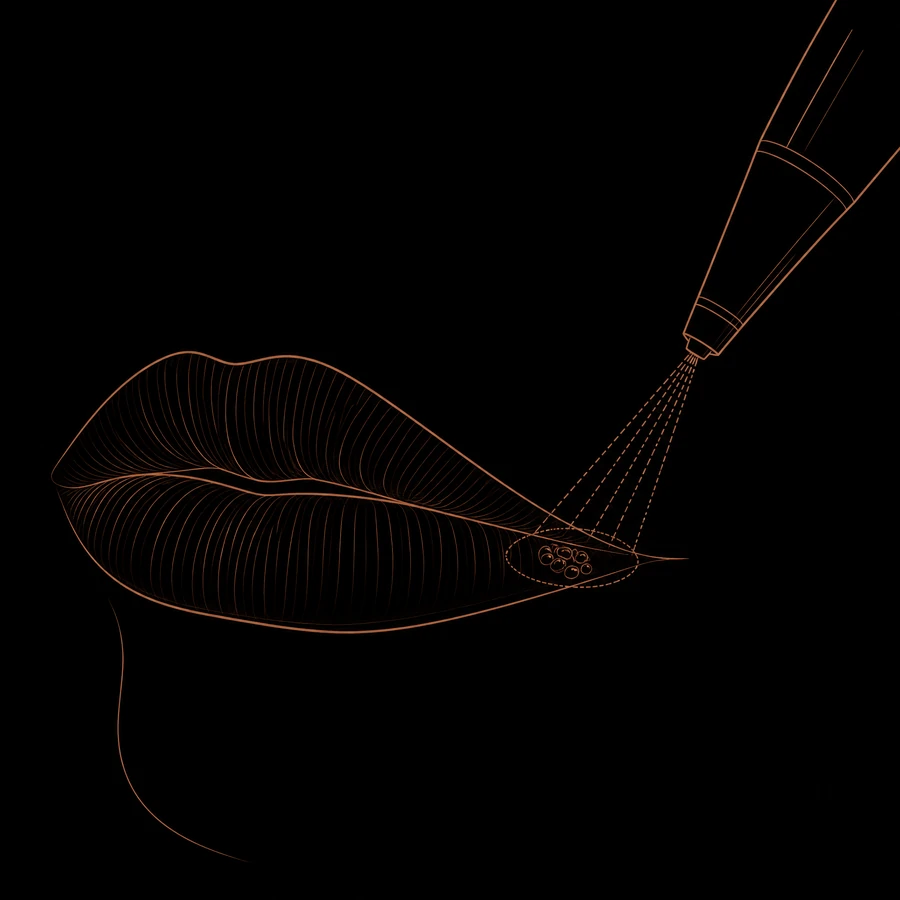
The affected site is treated directly; for a lip lesion, therefore from the outside. The handpiece is aimed at the site for a few minutes, without touching the lesion and without anaesthetic.
Lesions inside the mouth can be treated in the same way, as can aphthous ulcers, which have a different cause but respond to the treatment in a similar way.
Active substance
The active substance most people already know
Aciclovir has been the standard medicine against herpes viruses for decades. It is a building block that closely resembles a real building block of viral DNA. The virus incorporates it and then cannot continue the chain. Replication stops.
The active substance is activated only where viruses are actually present, because it needs an enzyme of the virus itself for that. That explains why it is comparatively well tolerated.
Cream or tablet
The cream from the pharmacy is available without prescription and is the usual remedy for an ordinary outbreak in otherwise healthy adults. Tablets require a prescription and come into consideration for frequent or severe outbreaks, and likewise with a weakened immune system. That is a medical decision which, if needed, we coordinate with you and your GP.
What can realistically be expected: according to the assessment of the German Institute for Quality and Efficiency in Health Care (Institut für Qualität und Wirtschaftlichkeit im Gesundheitswesen), creams and tablets shorten an outbreak by roughly one day, and the symptoms are somewhat milder. Timing is decisive: treatment should start within 24 hours of the first signs. Anyone who only starts when the blisters are already there should not expect much more from a cream.
Comparison
Both routes buy roughly one day
That is the honest answer, and it surprises most people. The antiviral cream shortens an outbreak by about one day. For the soft laser, two summary analyses show a shortening of a good day. The order of magnitude is the same. That does not yield a ranking, but a choice according to the situation.
In favour of the soft laser
- You can have it immediately in the prodromal stage, without a trip to the pharmacy and without a prescription
- It also acts against the pain, not only against viral replication
- With very frequent outbreaks there are indications of longer symptom-free intervals
- It can be combined with the cream; the two routes do not rule each other out
In favour of the cream
- available without prescription, inexpensive, always in your pocket
- works at eleven in the evening and on holiday too
- well studied, in use for decades
What applies to both
- The earlier treatment is started, the more the course can be softened
- Neither route eliminates the virus, and neither reliably prevents future outbreaks
- The difference is measured in days, not weeks
Evidence
What the studies on the laser actually show
A summary of eight studies with a total of 928 people treated found a healing time 1.37 days shorter for laser treatment. A more recent analysis of six randomised trials with 260 people treated found 1.22 days and additionally less pain on the second and third day.
Meta-analyses in Lasers in Medical Science, 2022 – PubMed 36214942 – and 2025 – PubMed 40993440. Both groups of authors state the same limitation clearly: the underlying studies are small, and their quality is predominantly weak. In the 2022 analysis only one of eight studies met the strict requirements for a low risk of bias; in the 2025 analysis five of six studies did not. No reliable effect on the time to crust formation could be shown.
A second observation concerns not the individual outbreak, but the interval between outbreaks. In a randomised double-blind study from 1999, 50 people who had an outbreak at least once a month were treated. After ten irradiations over two weeks, those treated typically remained 37.5 weeks without a new outbreak; in the comparison group, 3 weeks.
That is a remarkable difference, and still three limitations belong beside it. The study is more than 25 years old. It covered 50 people, which is few. And it expressly studied people with very frequent outbreaks; for anyone who only has an occasional episode, it says nothing.
What we take from that: we regard the soft laser as a sensible option, especially with frequent outbreaks and in the prodromal stage. We do not regard it as a cure and do not place it above the established active substances. There is no German guideline on this procedure, and we do not pretend that there is one.
Process
How an appointment with us works
-
Call as soon as it tingles
Do not wait to see whether this time it might come to nothing. We are open seven days a week, on weekdays until 8 p.m.
-
Brief examination
We look at the site and establish whether it is indeed a cold sore. Aphthous ulcers and other changes of the oral mucosa look similar and are classified differently.
-
The irradiation
The handpiece is aimed at the affected site for a few minutes. You do not need an anaesthetic. Most people feel at most a slight warmth.
-
Afterward
There is no downtime. Eating, drinking and everything else is possible again immediately.
-
What you can do in addition
Do not touch or pick at the site, wash your hands after contact, use your own towel. As long as blisters and fluid are present, cold sores are contagious, and transmission into your own eye is the complication you really want to avoid.
Important
No planned dental treatment with an active blister
This page is about treating the cold sore itself. For everything else the opposite applies, and that needs to be said clearly: if a blister is present, we postpone planned dental treatment until the site has crusted or healed. That is also the recommendation of the American Academy of Oral Medicine.
There are three reasons for that. The fluid in the blisters is contagious, for the team and for other patients. During treatment the lip is stretched, which worsens the lesion and delays healing. And the risk of carrying the virus by hand into your own eye rises with every manipulation of the face.
Pain and emergencies are excepted. If it hurts, we treat, then with appropriate precautions. Everything that can wait, waits.
For acute problems outside surgery hours you will find help via the emergency dental service in Berlin.
Differentiation
Three things that are often confused
Not everything that hurts in or around the mouth is a cold sore. The distinction is not pedantry, because it decides whether something is contagious and how it is treated.
| Point | Cold sores | Aphthous ulcer | Herpetic gingivostomatitis |
|---|---|---|---|
| Where | at the edge of the lip, outside | on the mucosa inside the mouth | gums and oral mucosa, over a large area |
| How it looks | cluster of small blisters, then a scab | single oval ulcer, yellowish-white with a red border | many painful sites at once, gums heavily inflamed |
| Contagious | yes | no | yes, strongly |
| Also | tingling beforehand, often returns | often returns, cause usually unclear | usually primary infection, often children, with fever and swollen lymph nodes |
We also treat aphthous ulcers with the soft laser, with the same aim: to ease pain and support healing. In herpetic gingivostomatitis, which mainly affects young children and comes with fever, treatment belongs in paediatric hands; we help with everything that concerns the mouth.
If you are unsure what you have, we will take a look. It is usually clear within a few minutes.
Costs
What the treatment costs
Laser treatment of cold sores is a self-pay service. Statutory health insurance does not cover it, because it is not part of the benefits catalogue.
How it is billed
- Billing
- The scale of fees for dentists has no dedicated item for this procedure. It is therefore billed by analogy under § 6 Abs. 1 GOZ, that is via an equivalent service.
- Beforehand, not afterwards
- What that means for you we will tell you before treatment.
- Privately insured
- You submit the invoice as usual. Whether it is reimbursed depends on the tariff; with services billed by analogy, queries do occur. We issue the invoice so that the reasoning is comprehensible.
- The cream
- Buy it at the pharmacy. For that you need neither a prescription nor an appointment with us.
Questions
Frequently asked questions about cold sores
Does the laser still help once the blister is already there?
Yes, but less than in the tingling stage. It still acts against the pain. If you have the choice, come earlier.
Does the treatment hurt?
No. Nothing is cut and nothing is numbed. Most people feel at most a slight warmth.
How long does the appointment take?
The actual irradiation takes a few minutes. Expect a short appointment, not a morning of treatment.
Will this get rid of the cold sores for good?
No. After the first infection the virus remains permanently in the nerve ganglia, regardless of how it is treated. What can be influenced are the duration and symptoms of an outbreak, and with frequent outbreaks possibly the interval between them.
Can I still use the cream?
Yes. The two routes do not rule each other out, and the combination has been studied in trials.
I get one after almost every treatment. Can it be prevented?
Tell us before your next appointment. Then we will discuss what makes sense in your case. With very frequent outbreaks, medicinal prevention may also come into consideration, though it must be prescribed by a doctor.
Is a cold sore a reason to cancel an appointment?
A planned one, yes, as long as the site is weeping or blisters are visible. For pain and in emergencies we of course still treat. When in doubt, call rather than simply not coming.
Does health insurance cover the costs?
Statutory insurance does not. With private insurance it depends on the tariff.
Call at the first tingling
Open seven days a week, on weekdays until 8 p.m. For this treatment we need only a few minutes; a short-notice appointment can almost always be arranged.
Or call: 030 436665501