What worsens the prognosis
Smoking is the best-documented risk factor for early implant loss. Other factors include untreated periodontitis, poorly controlled diabetes, severe teeth grinding and irregular follow-up care.
Implantology · Berlin-Mitte
A dental implant replaces the tooth root. Whether it is the right solution for your gap is determined by the clinical findings – not by a desire for the latest option.
Decision
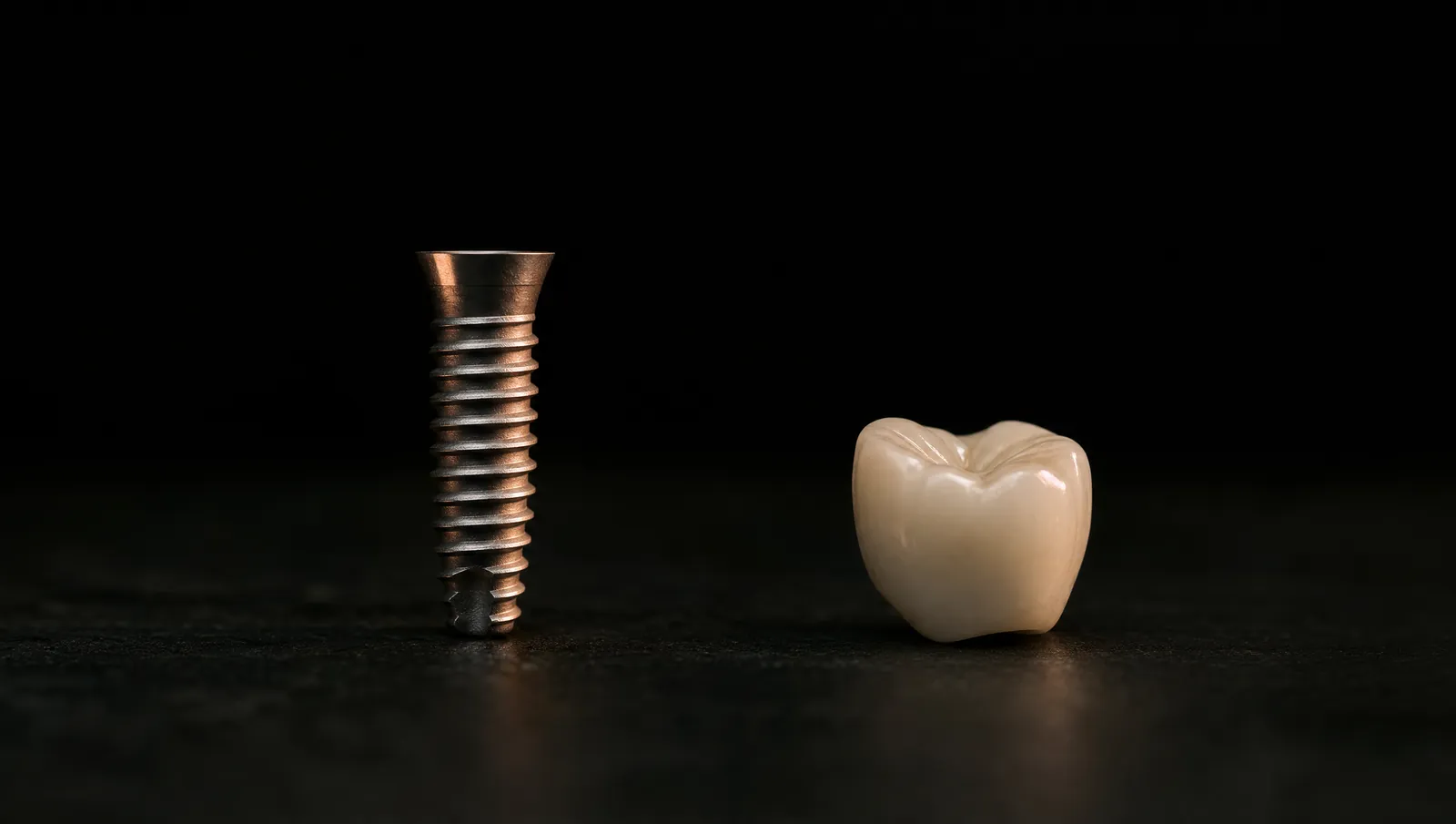
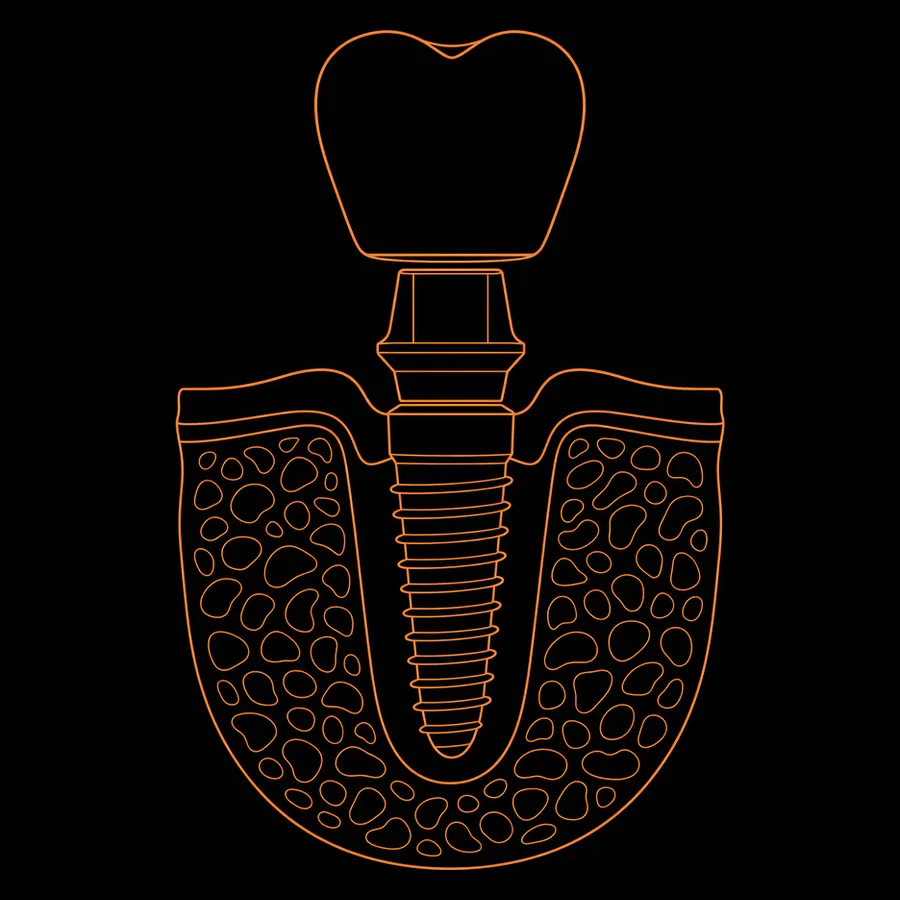
A dental implant is a screw made of titanium or ceramic that is inserted into the jawbone, where it replaces the root of the missing tooth. An abutment and crown are placed on it later. The main advantage: the neighboring teeth remain untouched.
Nevertheless, an implant is not automatically the better choice. If the neighboring teeth already have crowns or large fillings, a bridge may be the more appropriate solution. Smoking, untreated periodontitis or poorly controlled diabetes also affect the decision. We will explain in advance what supports and what argues against the surgical option.
After placement, bone tissue grows directly onto the implant surface. This bond – osseointegration – takes time and must remain undisturbed. This is why there are usually several months between surgery and the final crown, and why an implant cannot be loaded immediately in every situation.
Guidance
Whether an implant is right for you is determined by the clinical findings – not by a questionnaire. These three questions can, however, indicate the likely direction of the discussion and what we will examine first.
What does the gap look like?
What is the condition of your gums and bone?
What matters more to you?
Your answers indicate a situation in which an implant can offer its main advantage: The neighboring teeth do not need to be treated. Only an examination with an X-ray can show whether the bone at this site can support it – that is the actual deciding factor, not the shape of the gap.
Bring any existing X-rays, including older ones. They can sometimes avoid the need for a new image.
If the neighboring teeth already have crowns or you would like to avoid surgery, a bridge is not an inferior solution but a different one – with fewer appointments and no healing period. It does, however, require the neighboring teeth to be prepared and capable of supporting it.
We will calculate both options for you before you decide.
In your case, another question comes before the choice of restoration: whether a tooth can still be preserved, a gum condition that should be treated first, or simply insufficient information. Untreated periodontitis is the most common reason an implant develops problems later – so it is addressed first.
The first appointment is therefore for clinical assessment, not planning. This is not lost time but the prerequisite for planning that remains sound later.
These questions do not replace an examination, diagnosis or consultation. They provide only a broad indication of what we will discuss. What is possible and appropriate in your case depends on the clinical findings, X-ray and your medical history.
Qualifications
Many searches include this term – but no such title exists in Germany. “Fachzahnarzt” (a protected German specialist dentist designation) requires several years of postgraduate training and recognition by the Landeszahnärztekammer (state dental association). Under Berlin’s Weiterbildungsordnung (specialist training regulations), there are exactly three such fields: orthodontics, oral surgery and public health. Implantology is part of oral surgery but is not a separate specialty.
What exists instead are verifiable additional qualifications: the professionally regulated Tätigkeitsschwerpunkt (declared focus of professional practice), certifications from the DGI and DGOI professional societies, or a master’s degree. Anyone choosing a practice for implant placement should ask about these – and receive a specific answer referring to an individual rather than a marketing term.
At our practice, surgery is performed not by “the practice” but by a specific person. We discuss who will treat you and that person’s training during the consultation – and you can find this information on our Team page.
We perform surgical procedures in the mouth in our oral surgery department.
Process
The conventional route is the best documented. Immediate restoration is faster but subject to strict requirements. Only the examination can show which route is possible.
Medical history, examination, X-ray. We determine whether your own tooth can still be preserved – preserving a tooth takes priority over replacing it – and record risk factors such as smoking, diabetes or periodontitis.
Planning works backwards: first we determine where the future crown should be positioned; this determines the implant position. In complex cases, this includes a three-dimensional X-ray (DVT) – whether it is needed is determined by the clinical findings, not by routine.
Inflammation is treated first. If necessary, the tooth is removed or bone is grafted – both require their own healing time.
The procedure is performed under local anesthesia. Upon request and after medical assessment, nitrous oxide, sedation or general anesthesia are also possible.
Usually several months, and longer if bone grafting is required. During this time, you wear a temporary restoration depending on the situation.
Once healing has been confirmed, scanning, the abutment and final crown follow, after which the bite is checked.
Implants require lifelong care and monitoring. The recall schedule depends on your personal risk.
With immediate implant placement, the implant is inserted into the same tooth socket directly after the tooth is extracted. The term immediate restoration is used when a fixed temporary restoration is also fitted within a few days.
This is possible only under clear conditions: the bone wall around the tooth socket must be intact, the implant must be stable from the outset, there must be no acute inflammation at the site, and the soft tissue must be sufficiently robust. If any one of these conditions is not met, the conventional route is not the inferior choice but the correct one.
A temporary restoration, not the final crown, is made on the day of the procedure. The definitive restoration follows after healing. For a full jaw, we describe this route in detail on the Fixed teeth in one day page.
Bone
After a tooth is lost, the jawbone recedes at that site. The longer the gap has been present, the more often grafting is required. However, “no bone” rarely means “no implant.”
| Procedure | Purpose | Scope |
|---|---|---|
| Ridge preservation | preserve as much bone as possible immediately after extraction | limited; often avoids later grafting |
| Local bone graft | add missing width or height at a single site | additional healing time |
| Internal sinus lift | limited grafting in the posterior upper jaw | often possible at the same time as implant placement |
| External sinus lift | larger graft beneath the maxillary sinus | separate procedure, longer process |
| Angled implants | use existing bone by positioning the implants at an angle | can avoid grafting, but not always |
Costs
An implant is not a product with a list price. The Gebührenordnung für Zahnärzte (German fee schedule for dentists) requires fees to be assessed according to the effort and difficulty of each individual case; blanket fixed prices are problematic under professional law. Your written Heil- und Kostenplan (the treatment and cost plan required before treatment) is therefore the first binding estimate.
Germany’s gesetzliche Krankenversicherung (statutory health insurance system) pays a diagnosis-based Festzuschuss (fixed subsidy) toward dental prostheses – not the implant placement itself. The subsidy is based on the Regelversorgung (standard treatment defined by the German system) for your clinical findings and remains available if you choose an implant. Without a Bonusheft (German record booklet documenting regular preventive check-ups), it amounts to 60 percent of the Regelversorgung, rising to 70 percent after five uninterrupted documented years and 75 percent after ten years.
Private supplementary insurance pays according to the policy. Submit the Heil- und Kostenplan (the treatment and cost plan required before treatment) for written review before treatment begins – this is no longer possible once treatment has started.
Prognosis
A systematic review found a ten-year survival rate of 96.4 percent at implant level; the more cautious calculation in the same review found 93.2 percent.
Dreyer et al., 2019 – PubMed 30904559. Study values describe groups, not individual cases: smoking, periodontitis, diabetes, bone availability and home care substantially affect your individual prognosis.
Smoking is the best-documented risk factor for early implant loss. Other factors include untreated periodontitis, poorly controlled diabetes, severe teeth grinding and irregular follow-up care.
Tissue around an implant can also become inflamed and bone can be lost. No material prevents this. When detected early, it can be treated effectively – this is the actual reason for regular monitoring.
Questions
The procedure is performed under local anesthesia; you will feel pressure and movement, but no pain. Afterwards, swelling and wound pain for a few days are normal – their severity varies from person to person. We discuss in advance which pain medication is suitable for you.
The surgery is a single appointment. It usually takes several months until the final crown because the implant must heal into the bone. If bone grafting is also required, the period is extended accordingly.
Sometimes. This requires an intact bone wall, sufficient implant stability from the outset, and no acute inflammation at the site. Only an examination can show whether this applies to you – it cannot be promised with certainty before extraction.
Not in every case. An implant preserves the neighboring teeth but requires a surgical procedure and healthy bone. A bridge is completed sooner and can be appropriate if the neighboring teeth already need crowns.
Generally, yes, but with clear information: smoking demonstrably increases the risk of early implant loss, particularly in the upper jaw. A pause before and after the procedure measurably improves the initial conditions.
There is no upper limit – bone and general health, not year of birth, are decisive. There is a lower limit: in young people, jaw growth should be complete; otherwise, the implant position may later prove unsuitable.
Not for local anesthesia – on the contrary, eat normally beforehand. Fasting is required only for sedation or general anesthesia; you will receive the exact instructions in writing beforehand.
This is rare but possible. The implant is then removed, the site is allowed to heal and, in many cases, a second attempt is possible. We discuss how we would proceed in this situation before treatment – not only if it occurs.
Like a natural tooth, but more consistently: thorough cleaning at the transitions, interdental care and regular professional cleaning. The most common cause of late implant problems is not the material but biofilm.
During the consultation, we examine the situation, discuss the implant and alternatives, and you receive a written plan to take home – before you decide.
Or call: 030 436665501