After teeth straightening · Berlin-Mitte

Retainers on Friedrichstraße, Berlin-Mitte

Once the teeth are where they are meant to be, the part begins that decides whether they stay that way. We secure every result in two ways: with a bonded wire and with a removable set of trays.

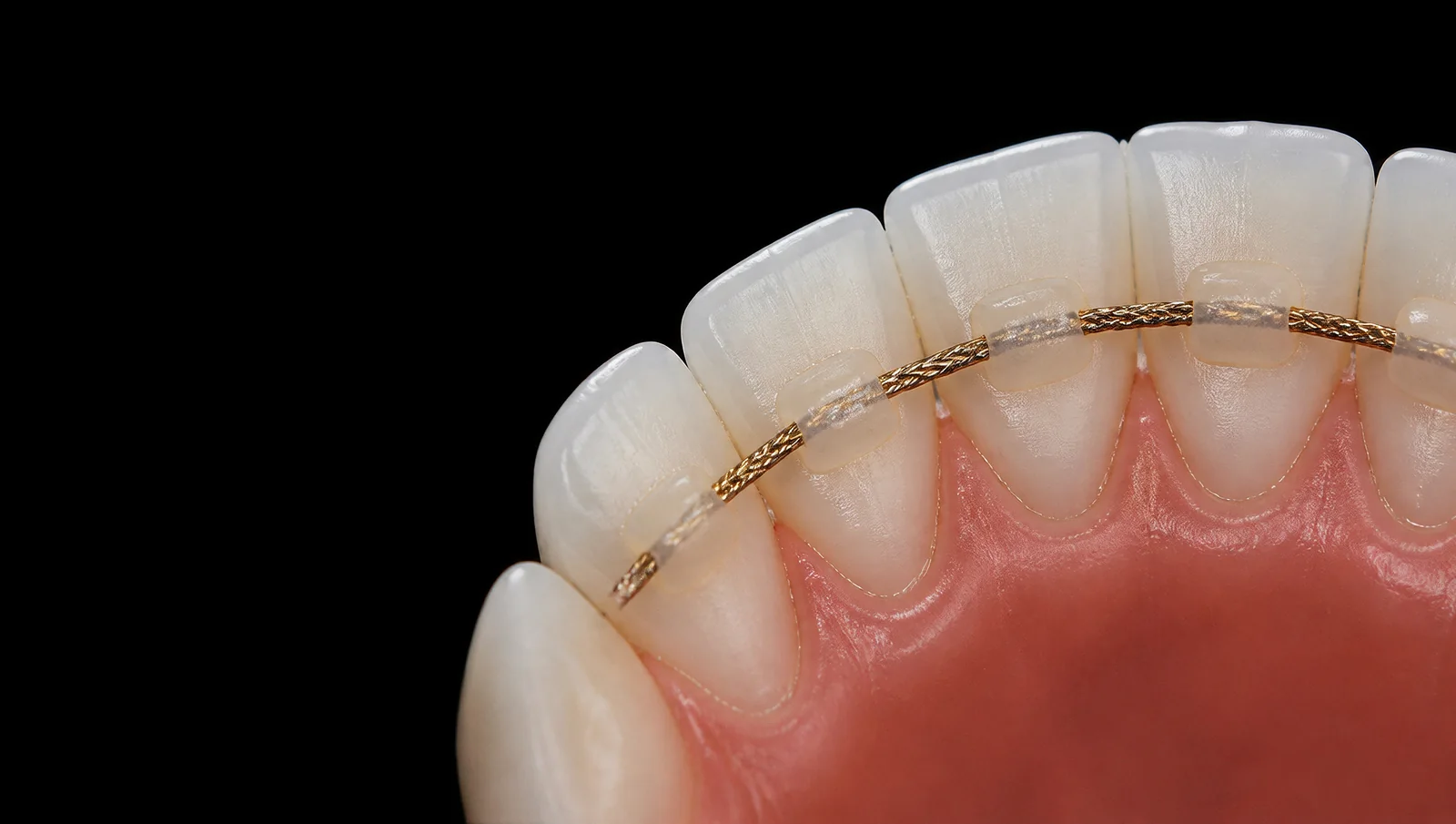
Bonded retainer: a fine braided gold wire on the inner surface of the front teeth, fixed to each tooth with a small dot of composite, on a black background
The bonded wire sits on the inner surface and cannot be seen from the front. It connects the front teeth to one another without moving them.
Practice
Friedrichstraße 80
10117 Berlin-Mitte
Open
7 days a week
Mon–Fri until 8 p.m.
Even without prior treatment with us
detached retainers, replacements, check-ups
Appointment
030 436665501

Why

The tooth is in the right place, but not yet firmly held

On the last day of treatment everything looks finished. The teeth are in the planned position, the result is there. What you cannot see: the bone that carries these teeth is still in the middle of its work.

A tooth does not sit rigidly in the jaw. Between root and bone lies a narrow gap of taut fibers, the supporting structures of the tooth. When a tooth is moved, the body breaks bone down on one side so that the bone can give way, and builds new bone up on the other side so that the tooth finds support there. Breaking down is quick. Building up takes longer.

That gap is exactly where the tooth stands at the end of treatment: in the right place, but in a socket that is not yet finished. Added to this are the fibers of these supporting structures. They were stretched and are contracting again, like a rubber band that is released. Together the two pull the tooth back toward its old position, reliably, and without your having done anything wrong.

That is why securing the result is not an accessory and not an add-on sale. It is the part of the treatment that decides whether the preceding months hold.

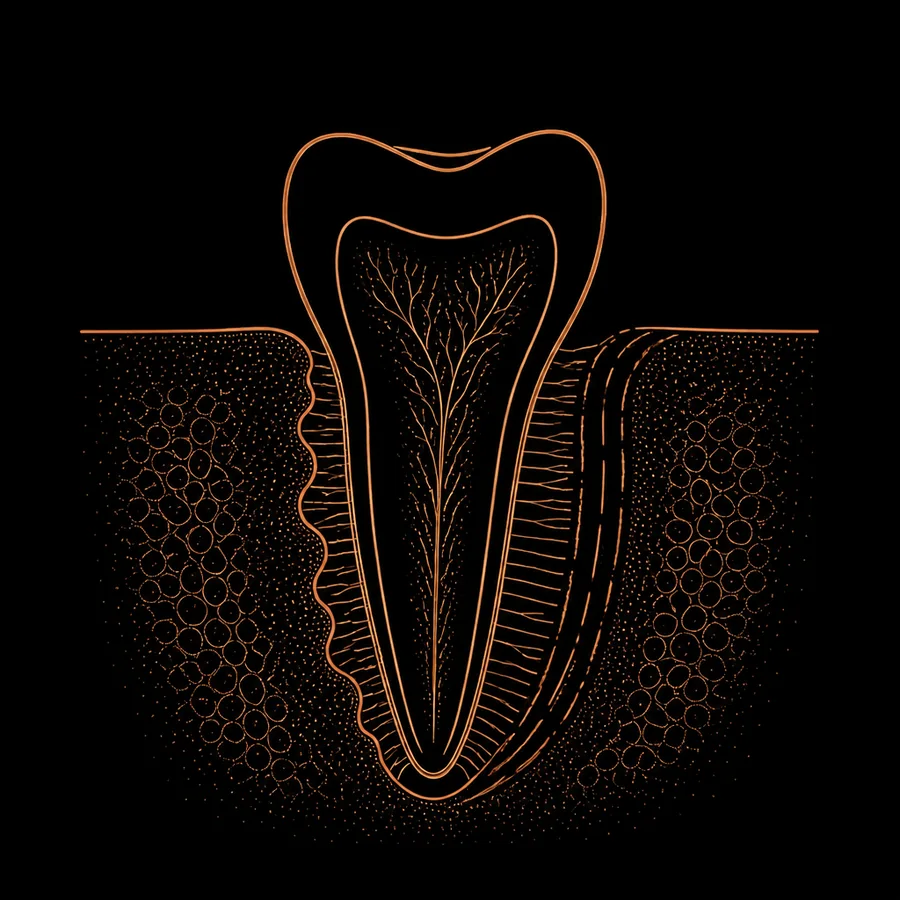
Diagram: longitudinal section of a tooth in the jawbone, on the left an irregular resorption edge, on the right broken layered lines of newly formed bone, between them the stretched fibers of the supporting structures of the tooth
On the left, bone has given way; on the right, new bone is forming, but it cannot bear load yet. In this phase nothing holds the tooth except the retention.

Phases

The active phase ends, the treatment does not

With our patients we speak of two stages, because that sets the expectation right from the start.

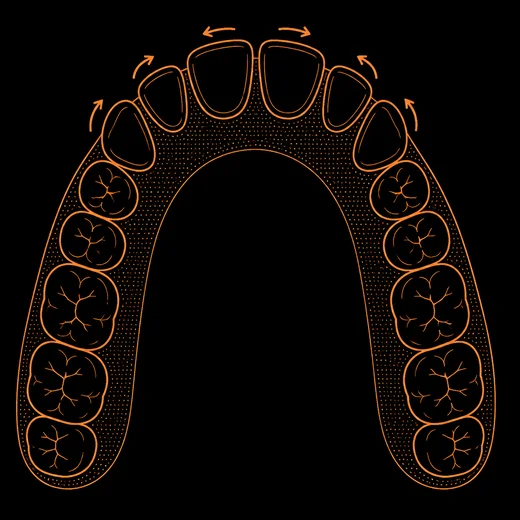
  1. Diagram: dental arch from above, small arrows on the front teeth indicating the movement under way

    Active phase

    What happens
    Teeth are moved, aligner by aligner or with a fixed appliance
    What you notice
    Pressure after each change, visible change
    What ends it
    The planned position has been reached
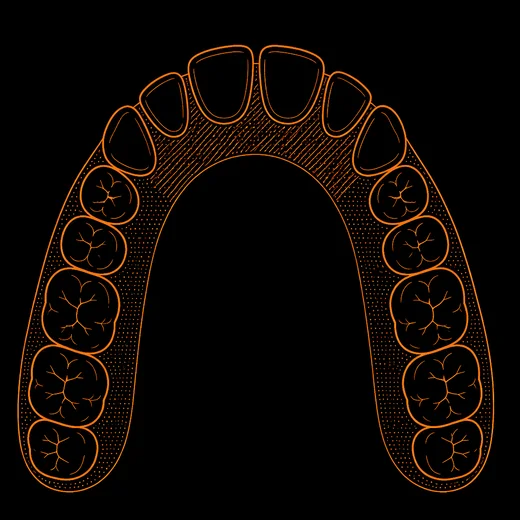
  2. Diagram: the same dental arch without arrows, the bone around the front teeth hatched and consolidating

    Passive phase

    What happens
    Nothing is moved any more. The bone consolidates around the new position
    What you notice
    Little to nothing, and that is precisely the difficulty
    What ends it
    Nothing. A residual risk remains, and so the retention remains too

The passive phase is the less conspicuous of the two. It asks for nothing but consistency, and that is exactly where it most often fails.

We explain this distinction before the first aligner, not after the last. If you know that the treatment has two stages, you do not experience the second as an unannounced extra demand. And that is why retention is in the cost estimate with us from the start, and not on an invoice at the end.

Procedure

Bonded wire and removable set

The fixed retainer

A thin wire is attached to the inner surface of the front teeth, in the upper and in the lower jaw from canine to canine, in dental jargon three to three. It cannot be seen from outside and you cannot forget it, because it is always there. That is its strength.

We work with wire made of stainless steel or of gold, or white gold. The choice depends on tolerance and on the situation. Gold alloys are an option when a nickel sensitivity is known or suspected.
The removable set

Added to this is a set of transparent trays that you insert and take out yourself. We use Vivera retainers, a set of three trays for the upper jaw and three for the lower. They encompass the whole jaw, not only the front, and so they also hold the back teeth where they belong.

Because the set contains several identical trays, there is a replacement if one is lost or damaged. That is more practical than it sounds: a single lost tray is the most common reason why people break off retention.

Principle

Why we do both and not one or the other

Each of the two procedures has a weakness, and in each case it is the one the other does not have.

The bonded wire works around the clock, but only where it is bonded: on the front teeth. It does not hold the back teeth. A bond point can also come loose without your noticing, and then it no longer holds what it is meant to hold. It is even possible for a partly detached or deformed wire to move teeth itself, slowly and unnoticed. That is precisely why it needs to be checked and not forgotten.

The removable set encompasses the whole jaw and so secures the back as well. In return, it only works while you wear it, and experience is unambiguous: wear discipline slackens over the years, in almost everyone.

Together the two cover what the other leaves open. The wire bridges the nights on which the tray stays in its box. The tray secures the areas the wire does not reach, and catches it when a bond point comes loose.

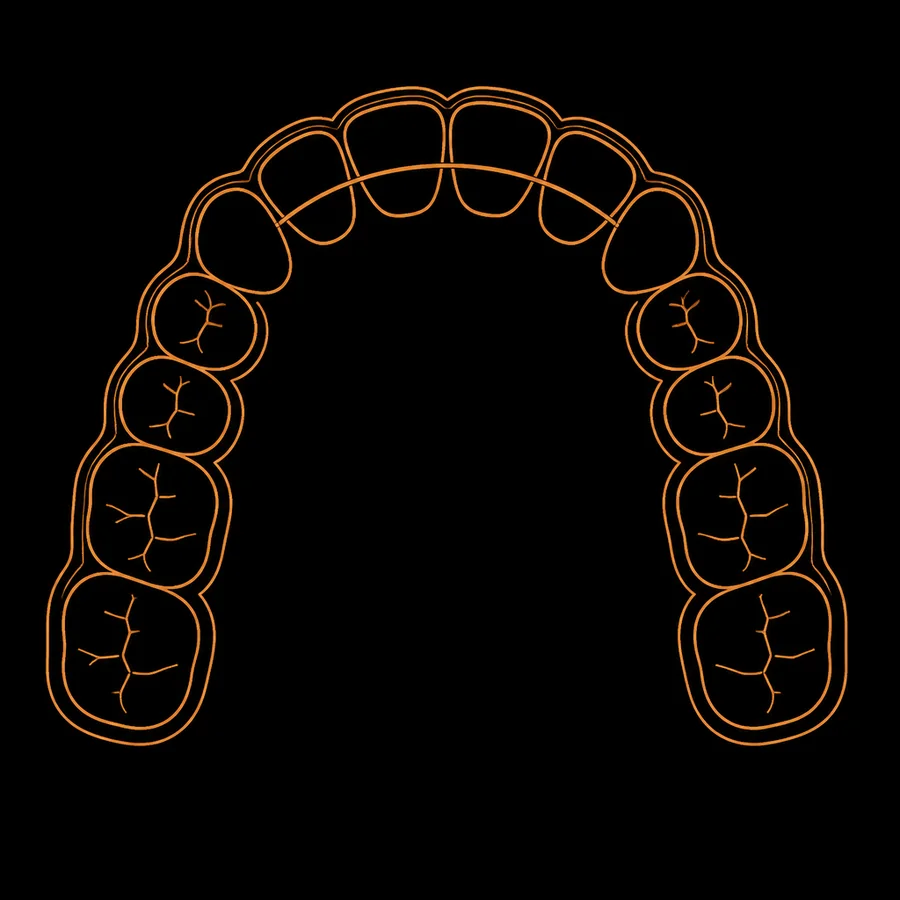
Diagram of a dental arch from above: a single wire line runs along the inside of the six front teeth, a double contour line encloses the entire arch including the molars
One jaw, both procedures: the wire runs along the inside from canine to canine, while the tray encloses every tooth as a double contour, back to the last molar.

This is a judgment call, not a truth established by studies. Why we make it this way nonetheless is set out further below in the section on the evidence.

Process

What happens at the final appointment

  1. Removing the attachments

    The bonded bumps that served as points of purchase during the aligner treatment come off. The tooth surface is smoothed and polished until nothing can be felt any more.

  2. Checking the result

    We look at the position in the bite, not only from the front. If anything needs reworking, now is the moment and not after the bonding.

  3. Fitting and bonding the wire

    The wire is shaped to the inner surface of the teeth and fixed there point by point, upper and lower, from canine to canine. The area has to be dry while this is done, otherwise the bond does not hold.

    Keeping the area dry determines how long the bond points last.
  4. Scan for the set of trays

    A second scan records the new situation, this time with the bonded wire in place. Only then do the trays really fit later on.

  5. Having the set made

    The set is manufactured and delivered. You collect it or we send it to you, and we insert it together once and check the fit.

    Until the set arrives, an interim solution applies, which we discuss with you.
  6. Control

    We look at the bond points, the gums and the fit at intervals. The wire is not something you place once and then forget.

Everyday life

What a retainer asks of you

Little, but that little over years.

  • Clean under the wire, not only in front of it. The wire lies exactly where tartar particularly likes to form. Dental floss with a threader or an interdental brush gets underneath it. Without this care the gums become inflamed on the inner surface, and that is noticed late.
  • Have it checked regularly. You cannot see a loose bond point yourself. At the professional teeth cleaning the wire is looked at as well.
  • Wear the trays, even when nothing is happening. That nothing changes is the proof that it is working, not the proof that it is superfluous.
  • Clean the trays cold. A soft brush, cold or lukewarm water, no abrasive toothpaste. Hot water warps the material irreversibly.
  • Not into the napkin. The most common way removable trays get lost leads through restaurant waste. There is a box, and that is what it is for.
  • Get in touch if there is pressure or a sharp edge. A wire that suddenly presses or that noticeably sticks out to the tongue is a case for a prompt appointment, not for the next routine one.

Replacement

Your retainer has come off and the treatment was elsewhere

This is one of the most common situations and one of the few cases in which people walk into a dental practice with a very specific request: the wire has come loose at one point, or it has come off completely, and the former practice is in another city or no longer exists.

You do not need any prior history with us for this. We look at what is still there, whether the teeth have already moved, and whether the existing wire can be bonded again or has to be replaced.

One thing matters above all: be quick. As long as the teeth are still in place, bonding it again is a manageable matter. Once they have moved, the old wire no longer fits, and then the more unpleasant question arises of whether a correction is needed again before the result can be secured.

The same applies to removable trays that no longer fit or have been lost. Here too a new scan is the first step.

If your retainer came off today, call us instead of putting it on the list for next month. The difference between the two can be a new course of treatment.

Evidence

What the research shows and what it does not

A systematic review by the Cochrane Collaboration evaluated 47 controlled trials with 4,377 participants on retention procedures. The result: “The evidence is low to very low certainty, so we cannot draw firm conclusions about any one approach to retention over another.”

Cochrane Database of Systematic Reviews, May 2023, Martin and colleagues – PubMed 37219527. The review compares different retention procedures with one another. It does not question that retention is necessary; it concludes that the existing studies are too weak to identify one procedure as superior. What does not follow from this: that the choice is arbitrary.

We write this down because it is the honest answer to a question we are often asked: which is better, fixed or removable? The reliable answer is that there is no reliable answer to it.

What follows from it is our decision and not a study result: if the data do not identify either procedure as the better one, but both have known weak points, then we combine them instead of relying on one. That takes somewhat more effort and closes both gaps.

And one more thing follows from it: if someone sells you a retention method as scientifically proven to be superior, it is worth asking questions.

Costs

What determines the cost

Retention is a dental service in its own right and is assessed according to the effort involved under the German scale of fees for dentists (Gebührenordnung für Zahnärzte). If the retention is part of a treatment with us, it is in the cost estimate from the start and not an additional claim at the end.

Factors that affect the cost

Scope
One jaw or both. As a rule we secure the upper and the lower jaw.
Material of the wire
Stainless steel or a gold alloy. The choice depends on tolerance and on the situation, not on habit.
Effort involved in the bonding
Shaping, keeping the area dry and fixing the wire point by point are the actual work. How long the bond lasts depends on that.
Removable set
Scan, manufacture and fitting of the set of trays.
Preparatory work
If teeth have already moved, a correction comes before the result can be secured. That is then a treatment of its own.
Check-ups
Regular follow-up, usually within the appointments that are due anyway.

In adults, orthodontic services, and with them retention, are as a rule not a benefit of statutory health insurance. In adolescents whose treatment ran through the statutory health insurance fund, retention is part of the treatment plan. Private policies cover different things. What applies in your case we clarify beforehand and not afterward.

Questions

Frequently asked questions about retainers

How long do I have to wear a retainer?

As things stand today, for an unlimited period, if the result is to hold. That is not a sales statement but the consequence of the fact that teeth keep moving throughout life, even without earlier treatment. How much retention is still needed after many years is something we discuss as we go.

Can the bonded wire be seen?

Not from outside. It sits on the inner surface of the teeth. With your tongue you will clearly feel it in the first few days; after that most people no longer notice it.

Does the wire get in the way when speaking or eating?

Not after a short period of getting used to it. What is noticeable is the tooth care: dental floss can no longer simply be inserted from above, and for that there are floss threaders and interdental brushes.

Can the wire cause damage?

If it is left unchecked, yes. A loose bond point can lead to individual teeth shifting unnoticed, and tartar forms on a wire that is not cleaned underneath. Both are a reason for regular check-ups, not a reason against the wire.

Why are the trays alone not enough?

Because they only work while you wear them. Reckoned over years, every forgotten night becomes a gap in the retention. The bonded wire keeps working on those nights.

Why is the wire alone not enough?

Because it only connects the front teeth. It does not hold the back teeth, and if a bond point comes loose you may not notice it for months.

My teeth have shifted again. Is it too late?

No, but it changes the task. The question is then whether a correction comes first, before the result can be secured. How much effort that involves depends on how far the teeth have moved, and that can only be said from the clinical findings.

I had my braces at another practice. Can I come to you?

Yes. For a loose or lost retainer you do not need any prior history with us. Come soon, while the teeth are still in place.

Do I get a replacement if I lose a tray?

The set contains several identical trays, so a loss is not immediately a problem. If they are all used up or nothing fits any more, a new scan is the first step.

Is a Vivera retainer better than a simple clear tray?

It is made from a different plastic and is supplied as a set. Whether the material lasts longer in everyday use is something the manufacturers advertise; independent comparisons between retention procedures are, as described above, limited in what they can show. We use the set above all because replacement trays are included.

Hold the result, do not hope for it

Whether your teeth were straightened with us or elsewhere: arrange an appointment at Friedrichstraße 80. We look at what is there and tell you how the situation can be secured.

Or call: 030 436665501