Four implants
Can make targeted use of available bone and support a fixed full arch. The concept requires particularly careful distribution and a viable plan in case one position fails.
Full-arch restoration · Berlin-Mitte
“Fixed teeth in one day” means a fixed provisional restoration on the day of surgery or within one week. The final bridge follows after healing; anyone promising otherwise is promising too much.
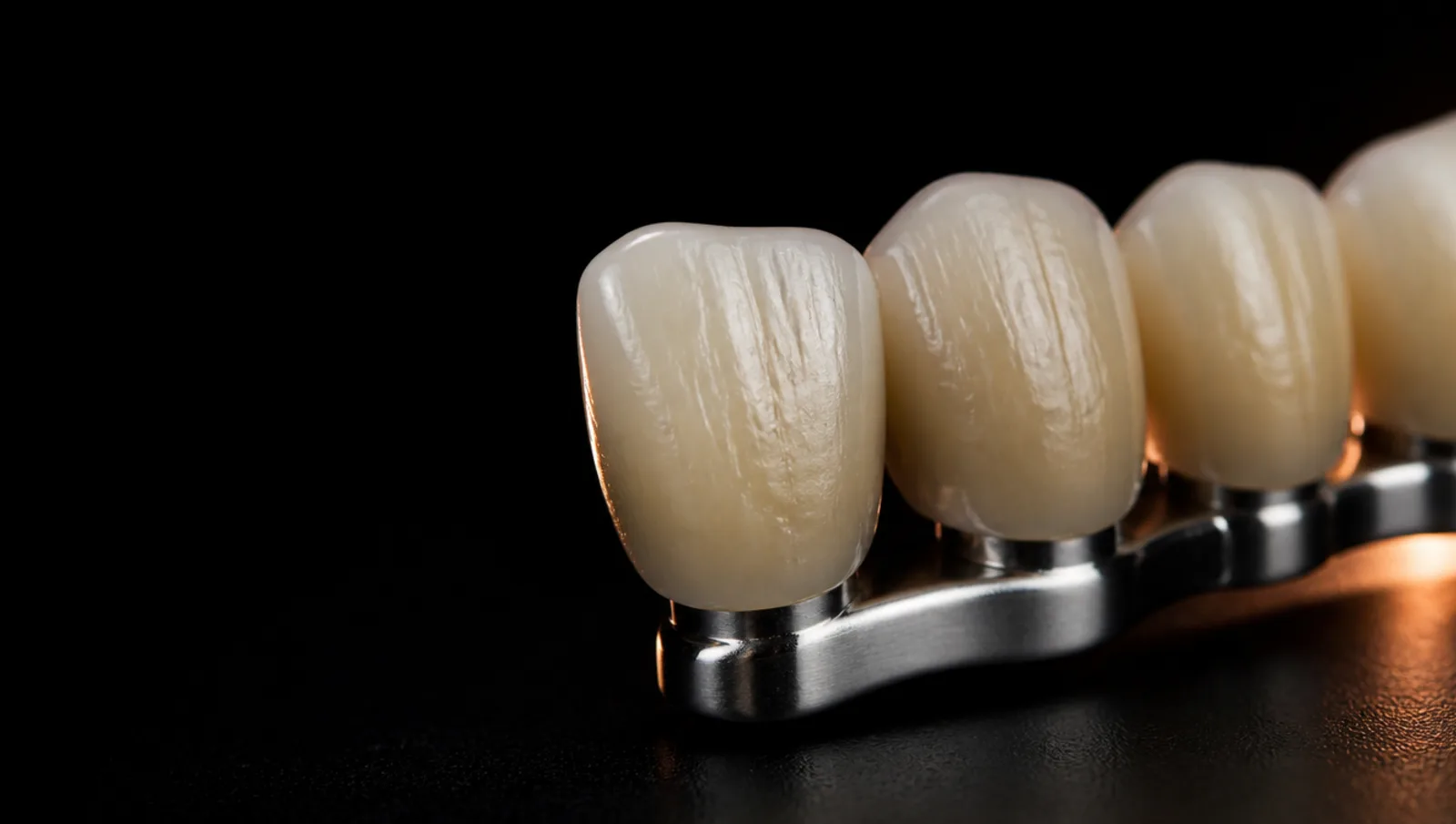
Starting point
A loose denture, sore spots, or remaining teeth that can no longer be preserved can make eating and speaking difficult. Some people withdraw as a result. The consultation is not about how things reached this point, but about which restoration now suits your jaw and your daily life.
Fixed implant-supported restorations may be an option for a toothless or severely damaged jaw. They are not a standard package. Oral health, bone, bite, general health, and your expectations must first be considered together.
Guidance
A fixed restoration on the day of surgery requires suitable initial conditions and a prepared Plan B. These three questions indicate whether the discussion is more likely to concern immediate restoration, a staged approach, or the clinical findings first.
Which best describes your situation?
How do you feel about healing time and Plan B?
What matters most to you in the planning?
With suitable clinical findings in the jaw, a fixed provisional restoration can be planned for the day of surgery or shortly afterward. The final decision is made only once the primary stability achieved is known. The provisional restoration is not the final bridge and must be protected during healing.
Before the procedure, we determine which temporary restoration will be used if the necessary stability is not achieved.
If the implants should initially heal without strain, the restoration is planned over several stages. Healing takes priority over early loading. During this phase, a removable or otherwise relieved temporary restoration may be necessary.
After controlled healing, the further steps leading to the final bridge follow.
Remaining teeth worth preserving, inflammation, bone, bite, and general health can change the direction. A joint assessment comes before any immediate-restoration concept. Adjustments, another implant-supported restoration, or preserving teeth may also be part of the approach.
Only an examination and imaging make it possible to develop a plan for the provisional restoration, healing, and final restoration.
These questions do not replace an examination, diagnosis, or consultation. They only provide an initial direction for the discussion. Whether immediate restoration is possible in your case depends on the clinical findings and planning.
Terms
“Immediate” can refer to the time of implant placement, prosthetic restoration, or loading. To make an informed decision, the plan must state which step actually takes place immediately.
| Term | Meaning | Important |
|---|---|---|
| Immediate implant placement | An implant is placed immediately after a tooth is removed. | This does not indicate when a dental restoration will be attached to it. |
| Immediate restoration | A provisional dental restoration is fitted on the day of surgery or within a few days. | On this page, the term refers to a fixed provisional restoration. |
| Immediate loading | The implants bear a defined functional load at an early stage. | This is only appropriate with sufficient initial stability and favorable distribution. |
| Final restoration | The final bridge is made after controlled healing. | It is not the provisional restoration fitted on the day of surgery. |
We explain the general process of diagnostics, implant placement, and healing on the companion page Dental implants in Berlin-Mitte.
Planning
With All-on-4, a full-arch bridge is supported by four strategically distributed implants. With All-on-6, there are six. More implants are not automatically better, and four are not automatically sufficient. The number is determined by the available bone, bite, opposing jaw, possible teeth grinding, and the prosthetic design.
Together, the implants must form stable support. Posterior implants can be planned at an angle to use the available bone. Whether this concept is appropriate for your jaw can only be determined by three-dimensional diagnostics and planning the later bridge.
The illustration shows one possible four-implant arrangement in the lower jaw. It is not a blueprint for every jaw.
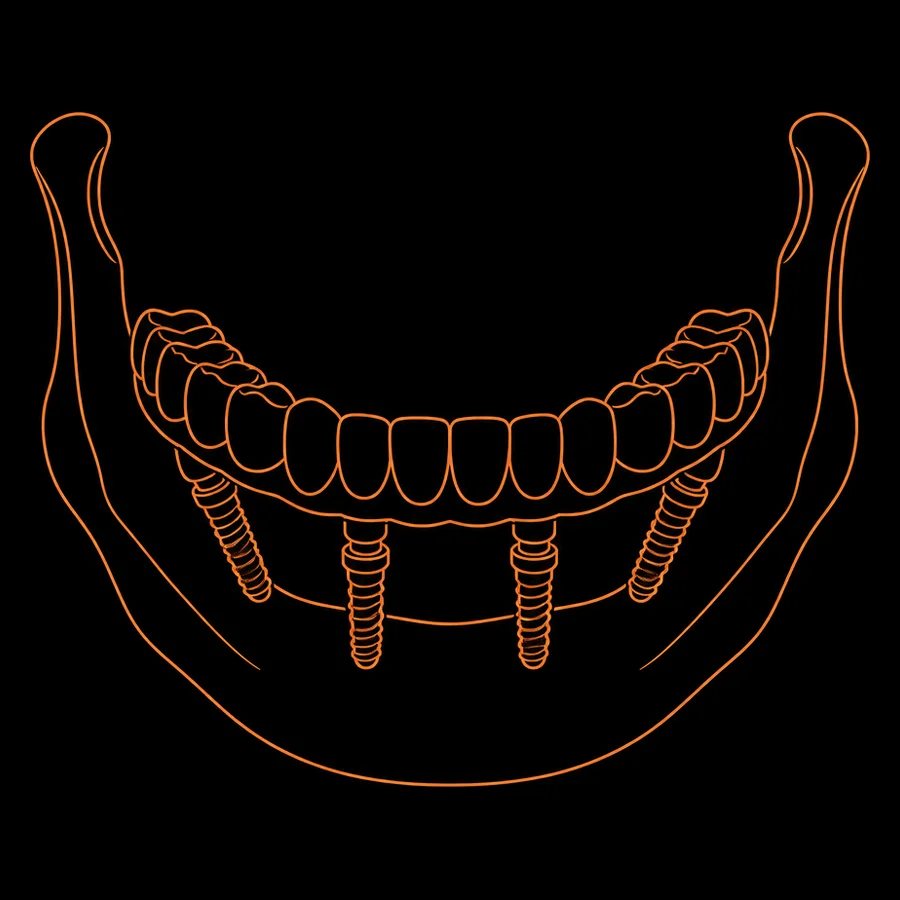
Can make targeted use of available bone and support a fixed full arch. The concept requires particularly careful distribution and a viable plan in case one position fails.
Can provide additional support depending on anatomy, the opposing jaw, and loading. They are only appropriate if the bone allows suitable positions and the prosthetic plan benefits from them.
Requirements
Whether the provisional restoration can be fitted as a fixed restoration at an early stage is finally determined during surgery. Planning must therefore also cover the possibility that the necessary stability is not achieved.
The bone in the upper jaw is often softer than in the lower jaw. The German S3 guideline therefore requires strict selection criteria for immediate loading of a toothless upper jaw. Sufficient primary stability, biomechanically favorable distribution, and secure connection of the implants must all be present. If one requirement is not met, a removable temporary restoration or healing without loading is the responsible approach.
The procedure can be performed under local anesthesia. If there is marked anxiety or the treatment is extensive, sedation or general anesthesia can be discussed after a medical assessment. They do not change the biological requirements for healing. Fasting, an accompanying person, pre-existing conditions, and medications are assessed separately for this purpose.
Costs
The name All-on-4 or All-on-6 does not indicate which services are included. Therefore, do not compare the heading of a quote, but each item through to the final bridge. Before treatment begins, you will receive a written Heil- und Kostenplan (the written treatment and cost plan required before treatment).
The gesetzliche Krankenversicherung (German statutory health insurance) provides a subsidy for dental restorations based on the clinical findings. Implant placement itself is generally not part of the Regelversorgung (the standard care defined by German statutory health insurance). The approved Heil- und Kostenplan is decisive. Private and supplementary insurers provide benefits according to the contract; submit the complete plan for written review before treatment begins.
Plan B
Despite careful planning, an implant can lose its stability or fail to integrate with the bone. It is then removed. Depending on the position and clinical findings, the provisional restoration may be adjusted, made temporarily removable, followed by placement of a replacement implant at a later date, or the final plan may be changed.
These possibilities must be discussed before surgery. You should know which temporary restoration would then be possible, how the healing time would change, and which services the Heil- und Kostenplan provides for this situation.
A ten-year cohort of fixed full-arch restorations on four implants reported an implant-level survival rate of 96.2 percent. At patient level, the rate was 94.1 percent; smoking had a negative effect.
Maló et al., ten-year cohort – PubMed 35407547. The study followed a selected treatment group and does not prove suitability in an individual case. An average from a study is not a promise for your restoration; jaw, loading, smoking status, care and follow-up affect the prognosis.
It protects the healing process and can be adjusted or repaired during this phase. A fixed restoration does not mean that every food and every level of loading is permitted immediately.
The bridge, screw connections, gums, and implants require checkups and professional cleaning. The practice can remove a screw-retained bridge for this purpose; at home it remains fixed.
Questions
In suitable cases, a fixed provisional restoration can be fitted on the day of surgery. Sometimes it follows within one week. The final bridge is made only after healing. Before surgery, it must also be clear what will happen if the necessary primary stability is not achieved.
No. The implants must heal despite the fixed bridge. The permitted food consistency and loading are specified individually. A fixed provisional restoration does not permit unrestricted loading.
This cannot be decided from the product name. Bone, bite, opposing jaw, teeth grinding, implant distribution, and bridge design determine the number. More is not automatically better, and fewer are not automatically less invasive.
Posterior implants planned at an angle can use available bone and, in some cases, avoid bone augmentation. This is not a promise. If the bone situation is insufficient, a different implant distribution, bone augmentation, or another restoration may be considered.
The implant is removed. Depending on the position and clinical findings, the provisional restoration may be modified, made temporarily removable, a replacement implant may be planned, or the restoration concept may be adjusted. We determine which Plan B applies to you before surgery.
Not as a general rule. Local anesthesia is possible. Sedation or general anesthesia can be discussed after a medical assessment if the extent of treatment, anxiety, and general health support their use. They do not improve implant healing.
A screw-retained bridge is fixed for you. The practice can remove it when necessary for checkups, cleaning, or repair. Before deciding, ask how the planned restoration will be maintained.
Compare the complete restoration: extractions, 3D diagnostics, anesthesia or sedation, provisional restoration, final bridge, laboratory services, follow-up care, repairs, and serviceability. If a quote ends with the provisional restoration, it is not comparable with a complete restoration.
We explain diagnostics, conventional healing, bone augmentation, and the choice between an implant and a bridge in detail on our page about dental implants in Berlin-Mitte. Here we focus on full-arch restoration.
We assess your situation without judgment and determine whether a fixed full-arch restoration is appropriate. You receive a written plan covering the provisional restoration, the final bridge, and what happens if the initial approach is not viable.
Or call: 030 436665501