Teeth whitening · Berlin-Mitte
Whitening with the aligner that already fits
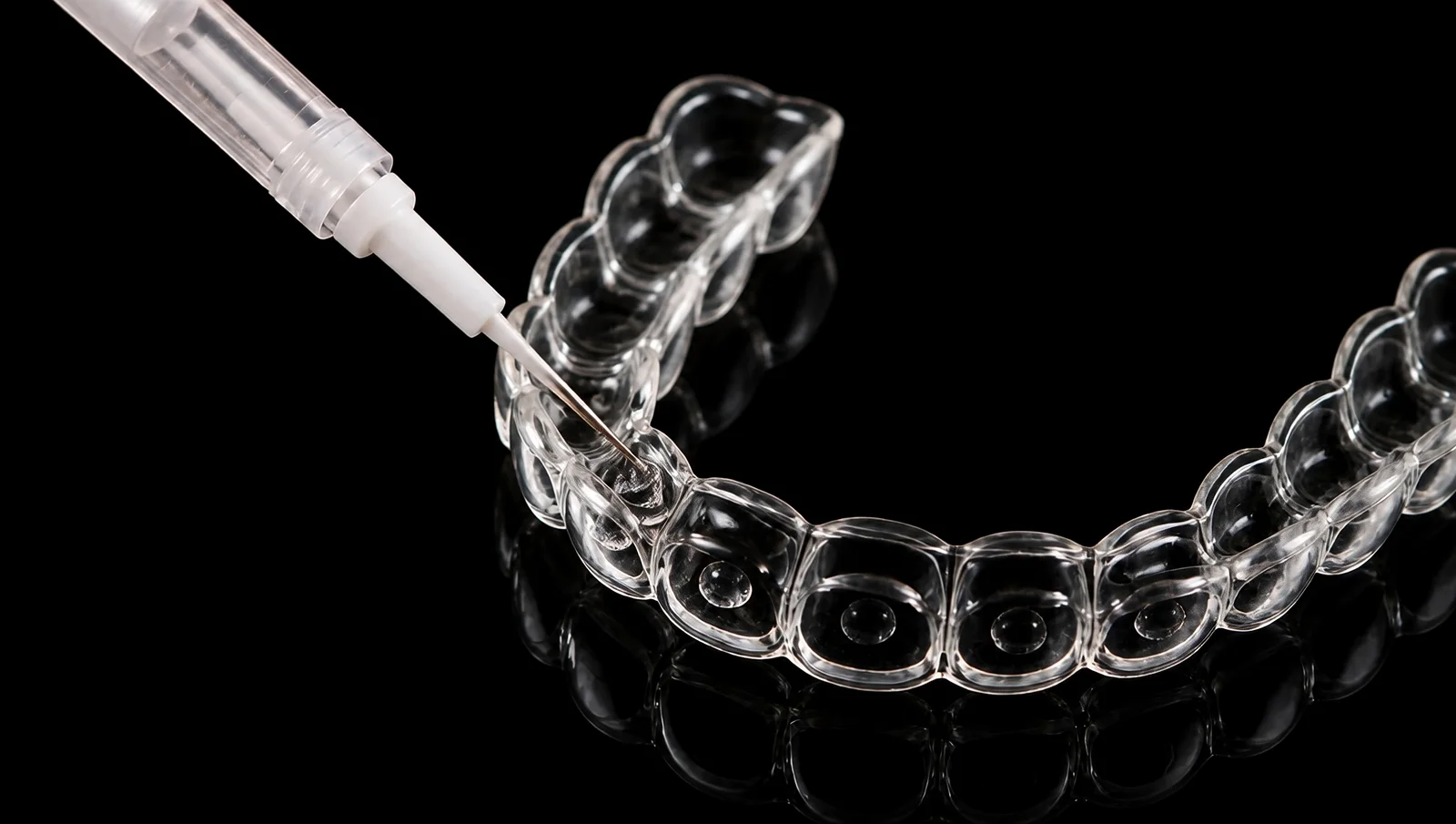
Anyone wearing aligners, or who afterward receives a set of trays to secure the result, already has in their mouth the precisely fitting form needed for teeth whitening. There is a gel developed for precisely this carrier.
- Practice
- Friedrichstraße 80
10117 Berlin-Mitte - Open
- 7 days a week
Mon–Fri until 8 p.m. - Carrier
- Your aligners or your Vivera retainer
- Appointment
- 030 436665501
Principle
The carrier decides too, not only the gel
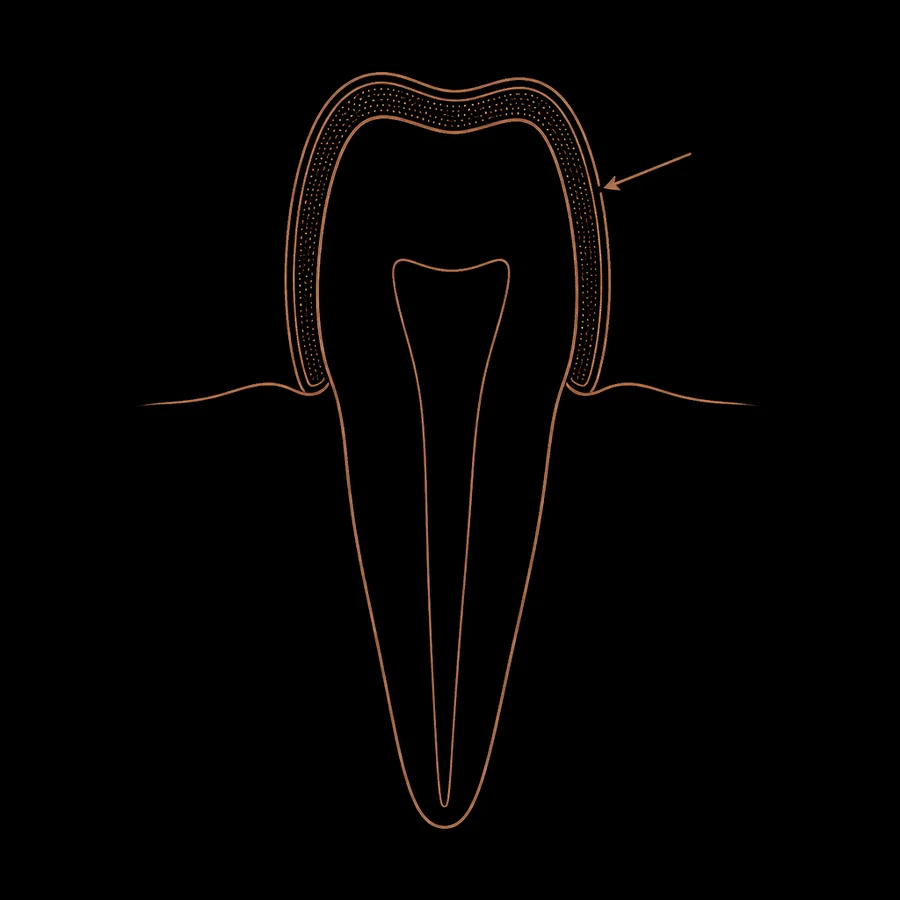
Teeth whitening works through a peroxide. It breaks down on the tooth surface and penetrates the hard tooth tissue, where it breaks up the pigment molecules that have built up over the years. The tooth is not worn away and not coated; instead, the embedded pigment is altered.
For this to work, the gel must stay where it is meant to act, evenly and long enough. That is exactly what an aligner that fits your teeth precisely does: it holds the gel against the tooth, keeps saliva and the tongue away, and confines it to the surface that matters.
Anyone undergoing aligner treatment already has this form. It was made from a scan of your own jaws and sits more closely than any prefabricated tray from a drugstore. The same applies to the set of trays that secures the result after treatment, the Vivera retainer.
Why not every gel fits every tray
A whitening gel for custom-made bleaching trays is formulated to be thick. It is meant to stay put and not run out. In an aligner, which sits more closely and is thinner, such a gel behaves differently: when the aligner is seated, it is pushed to the edges instead of spreading.
That is why Align, together with the bleaching manufacturer Ultradent, developed a gel whose viscosity is set for precisely this carrier. It spreads when the aligner is seated and stays on the surfaces instead of flowing out.
The gel
What sits in the aligner
The preparation is called Invisalign Professional Whitening System and is made by Ultradent, the manufacturer of the Opalescence range. In Germany it is available only as a home application and only through dental practices.
What is in it and what it does
- Ten percent carbamide peroxide. Carbamide peroxide breaks down slowly in the mouth and in doing so releases hydrogen peroxide, the actual active agent. Ten percent carbamide peroxide releases roughly three and a half percent hydrogen peroxide. The slow breakdown is why these preparations are worn for longer periods and are still regarded as milder than highly concentrated in-office products.
- Potassium nitrate and fluoride. Both additives are intended to dampen sensitivity during use. The evidence on this is mixed: some studies find an effect, others do not. We name the additives because they are present, not because they guarantee an effect.
- At least twenty percent water. A water-rich gel dries the tooth out less. A dehydrated tooth surface appears temporarily lighter than it is and reacts more sensitively.
Ultradent's own Opalescence gel for custom trays is a different product and is expressly not cleared by the aligner manufacturer for use in aligners and Vivera retainers. For this carrier there is exactly one preparation developed for the purpose.
Timing
Beforehand, during or afterward
Unlike a classic whitening with custom-made trays, an additional question arises here: at which point in the teeth straightening should whitening take place? All three times are possible, but they have different consequences.
-
Before the correction
- Carrier
- a custom-made tray or the first aligner
- In favor
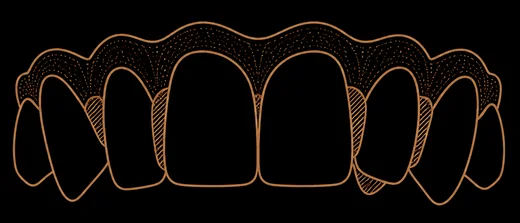
- The teeth are still where they are; overlapping surfaces remain covered
- Against
- Exactly these surfaces only become exposed during the correction and are then still darker
-
During the correction
- Carrier
- Your current aligners
- In favor
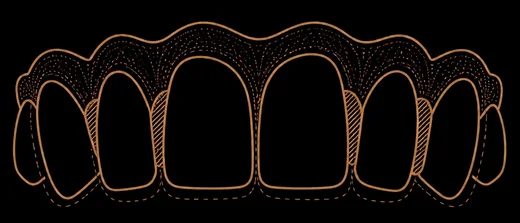
- No extra effort, no extra carrier
- Against
- Tooth position is still changing, so the result is harder to judge
-
After the correction
- Carrier
- the last aligners or the Vivera retainer
- In favor
- All surfaces are exposed, the result can be judged, retention is running anyway
- Against
- Nothing that would speak against a good finish
In most cases we recommend the last route. When crowded teeth move apart, surfaces become visible that no one has seen before, and that no whitening has reached either.
That is the real reason why whitening and teeth straightening complement each other well: after the correction every surface is exposed. What was hidden in crowding before can now be treated evenly. A result that looks good right after whitening and later shows dark strips at the newly exposed edges is produced exactly by the wrong sequence.
Attachments
The question that only comes up with aligners
During aligner treatment, small tooth-colored raised areas of composite sit on individual teeth, the attachments. They give the aligner a point of purchase for movements that would otherwise not succeed. And during whitening they raise a legitimate question: does the tooth under the attachment also become lighter?
The answer has to do with how it works. The released peroxide does not act only where it sits on the surface, but penetrates the hard tooth tissue and spreads within it. Direct contact at every single point on the surface is therefore not necessary. The manufacturer expressly clears the preparation for use with bonded attachments.
What still has to be borne in mind
The attachment itself is made of composite resin, and resin does not lighten. As long as it is bonded, it is tooth-colored matched to the state at the start of treatment. After removal it becomes clear whether the tooth underneath has followed the rest. As a rule that is the case; one should not rely on it.
Anyone who wants to rule this out whitens after the attachments have been removed. That is one of the reasons why in most cases we advise whitening at the end of treatment.

Process
How a whitening proceeds with us
-
Findings before anything else
We look at teeth and gums and establish where the discoloration comes from. Whitening presupposes healthy teeth. Cavities, leaking fillings and inflamed gums are treated first.
-
Cleaning
No gel acts on plaque and tartar. Before whitening there is therefore a professional teeth cleaning. Often the tooth color already looks different afterward than expected.
-
Recording the starting shade
We determine the shade before treatment. Without this starting point it is not possible to judge afterward what has changed. One's own memory is not enough for that.
-
First application in the practice
You receive the instruction and apply the gel for the first time with us. This is not a formality but required for this product group.
-
Application at home
You continue the application over the agreed period. How long the aligner is worn for this follows the instructions for use and how your teeth respond.
-
Check-up and completion
We look at the result, compare it with the starting value and discuss whether and when a touch-up makes sense.
Limitations
What does not lighten
This is the point where expectation and result most often diverge. It belongs before treatment, not after.
- Fillings, crowns and veneers do not become lighter. They are made of resin or ceramic, and neither reacts to peroxide. After whitening they can look darker than before, because the teeth around them have become lighter. That changes the sequence in the treatment plan: whiten first, then make replacements in the new shade.
- Attachments do not lighten. See above. During treatment they are matched to the tooth, not to the later result.
- A single dark tooth after a root canal treatment has a different cause and needs a different procedure. More on this is on the page on teeth whitening.
- Discoloration from inside the tooth caused by medication or developmental disorders responds more poorly and more unevenly than discoloration from the outside.
- White spots do not become invisible. After whitening they can temporarily stand out more clearly before the contrast equalizes again.
- There is no target shade to order. How far a tooth lightens depends on its structure and cannot be promised in advance. Anyone who wants a specific shade is talking about veneers, not about bleaching.
For persons under eighteen years this product group is not authorized. That also applies when an aligner treatment is under way, and therefore expressly also covers Invisalign Teen.
Tolerability
Sensitivity is to be expected and should be discussed
During and shortly after whitening, teeth more often react to cold, heat and sweet. That is the best-known side effect, it is as a rule temporary, and it is not a sign that something is going wrong.
What we can do if it occurs: shorten the wear time, build in breaks, change the rhythm or use a desensitizing preparation. What matters is that you get in touch rather than silently discontinuing use. An adjusted application usually still reaches the goal.
The gums can react with irritation if gel spills beyond the tooth margin. That is why we practice the dosage together the first time. Too much gel does not whiten better; it only ends up on the gums.
Framework
Why the gel is only available with us
Whitening products are classified by their hydrogen peroxide content. Preparations that release more than one tenth of a percent and at most six percent may be supplied exclusively to dental practices; the first application of each treatment cycle is carried out by a dentist or under direct dental supervision. The preparation used here, at roughly three and a half percent, falls within this range.
Over-the-counter products from drugstores or online retailers must be dosed markedly lower, which at the same time limits their possible effect. The full classification including the age limit is on the page on teeth whitening.
Evidence
Is the aligner weaker than the in-office application?
An updated review evaluated 32 studies comparing home application and in-office application, 23 of them in the meta-analysis. Result: for the risk of tooth sensitivity no meaningful difference was found; for the intensity of sensitivity the home application came out better.
Systematic review and meta-analysis, Operative Dentistry 2025 – PubMed 40485133. For color change the results diverge depending on the measurement method: in one measure the home application was ahead, in another no difference appeared. The authors expressly rate the quality of the evidence as low. A comparison across study groups also says nothing about how an individual tooth responds.
In practical terms that means: application in the aligner is not a budget option and not a second choice. It is a procedure in its own right that achieves over time what the in-office application achieves through concentration.
What does not follow from this is a ranking. If someone tells you that one procedure is scientifically superior to the other, that is more than the data support.
Costs
What determines the cost
Teeth whitening is a cosmetic service and not a benefit of statutory health insurance. It is assessed according to the German scale of fees for dentists (Gebührenordnung für Zahnärzte). What it costs in your case we tell you before treatment begins, in writing.
Factors that affect the cost
- Scope
- One jaw or both, and over what period the application runs.
- Carrier
- Whether your existing aligners or your retainer are used or a separate tray is made.
- Pre-treatment
- The cleaning before whitening is a separate service, as is any treatment that becomes necessary beforehand.
- Findings and check-up
- Shade determination, instruction, first application in the practice and the final check-up.
- Touch-up
- Reapplying later is common and is then charged again.
If you are undergoing aligner treatment anyway, the effort for a custom-made bleaching tray falls away. That is the only cost difference that can be generalized.
Questions
Frequently asked questions about bleaching with Invisalign
Can I put my own bleaching gel into the aligners?
We advise against that. Gels for custom-made trays are formulated thicker and spread differently in an aligner. The aligner manufacturer expressly does not clear them for this carrier.
Does the tooth under the attachment lighten as well?
As a rule yes, because the active agent penetrates the hard tooth tissue and does not act only on the surface. The manufacturer clears use with bonded attachments. Anyone who wants to be entirely sure whitens after removal.
How long does the result last?
That depends on your habits. Coffee, tea, red wine and smoking restain. A touch-up after some time is normal and not a sign that the treatment did not work.
Does it harm the enamel?
On current knowledge, no, when the application is supervised by a dentist and the dosage is correct. That is exactly why this product group is tied to the practice.
I only wear the retainer now. Does it work with that too?
Yes, the Vivera retainer is intended as a carrier. That is even a good time, because the teeth are then in their final position.
Why am I not allowed to simply buy the gel?
Because the concentration is above the limit for over-the-counter products. This group may only be supplied through dental practices, and the first application of each cycle takes place with us or under our supervision.
My teeth react sensitively. Is it still possible?
Usually yes, with adjusted wear time, breaks or a desensitizing preparation. Say so beforehand, then we plan it that way from the start.
I am seventeen and wear aligners. Can I take part?
No. For this product group an age limit of eighteen years applies.
Will the result be as light as in advertising images?
How far a tooth lightens depends on its own structure and cannot be promised in advance. We determine the starting shade and tell you honestly what appears realistically achievable.
First the findings, then the shade
Arrange a consultation at Friedrichstraße 80. We look at teeth and gums, establish the cause of the discoloration and tell you whether and when whitening with your aligner makes sense.
Or call: 030 436665501