What is down to the bond
The adhesive bond to porous enamel does not reach the values healthy enamel allows. Margins come loose, small chips break off, and plaque settles underneath.
Paediatric dentistry · Berlin-Mitte
The enamel is there, but soft: with chalky teeth the occlusal surface breaks down under chewing instead of being slowly hollowed out by decay. How far a tooth needs to be stabilised – and when ceramic made in the practice is the right step.
Starting point
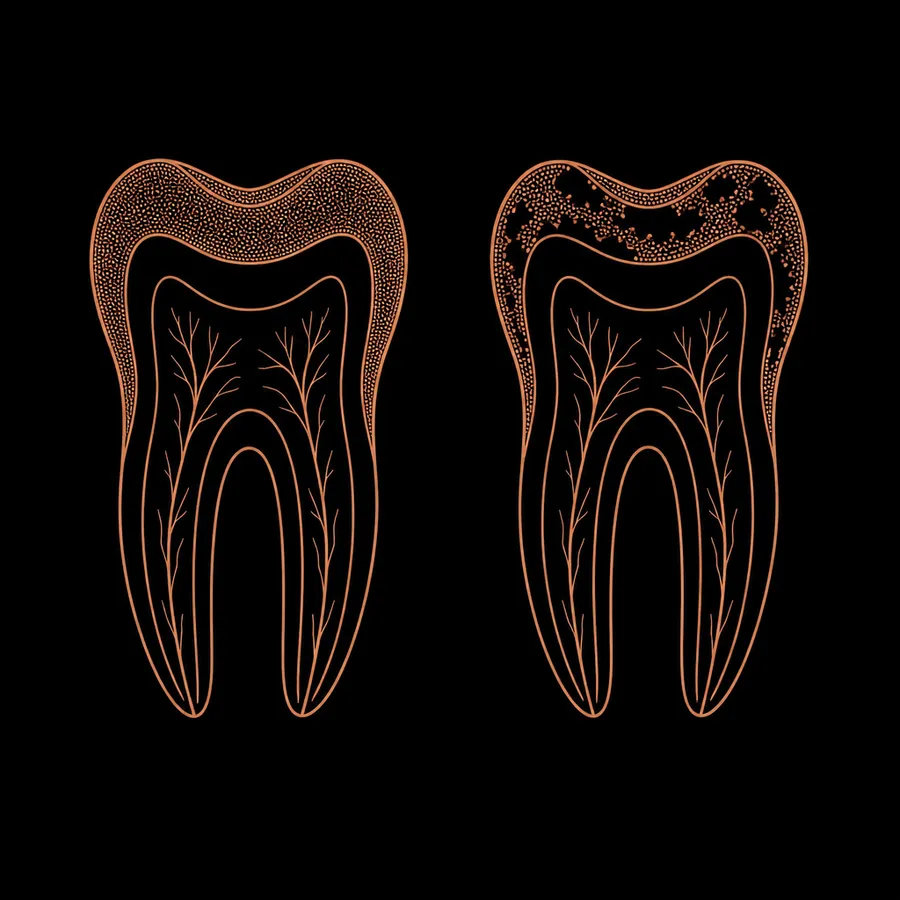
Behind the word lies molar incisor hypomineralisation, MIH for short: a disturbance of enamel formation on the first permanent molars, often together with the permanent incisors. The enamel is present in normal thickness, but low in mineral and porous. It looks like chalk, and it behaves like chalk too.
What matters most in the conversation with parents is the timing: the enamel of these teeth is formed from roughly the last trimester of pregnancy into the fourth year of life – long before the teeth appear in the mouth. What you see when they erupt was already laid down. Sugar, brushing and fluoride have nothing to do with it, and MIH is not contagious either.
What actually causes it is still unclear, despite large birth cohort studies. Respiratory illnesses in the first years of life, courses of antibiotics, vitamin D status and environmental influences are all under discussion. None of these factors has been proven to be the cause, and dentistry does not yet know an effective way to prevent it. Anyone who tells you otherwise is ahead of the research.
Healthy enamel is a dense crystalline structure – the hardest substance in the body. With MIH the same structure has gaps: less mineral, more embedded protein, many fine pores. That is where the two complaints parents describe come from.
The two reinforce each other: where brushing stings, plaque stays behind – and on that very tooth decay is then added on top of the hypomineralisation.
In the Sixth German Oral Health Study, 15.3 percent of the twelve-year-olds examined showed MIH – roughly one child in seven. On average 3.4 teeth were affected, and just under two thirds of cases were mild.
Bekes et al., Deutsche Zahnärztliche Zeitschrift 2025 – DMS 6, Institut der Deutschen Zahnärzte (922 twelve-year-olds examined). Children undergoing orthodontic treatment were excluded because their molars could not be assessed there – the actual proportion may be higher. Older surveys report considerably higher figures; whether there has been a real decline in between, or a difference in how the data were collected, is an open question. In any case, a population average says nothing about your child.
Severity
Not every chalky tooth needs the same treatment. The classification we work with asks two questions of each individual tooth: has tooth substance already been lost? And is it sensitive? The answers show how much needs to be done now.
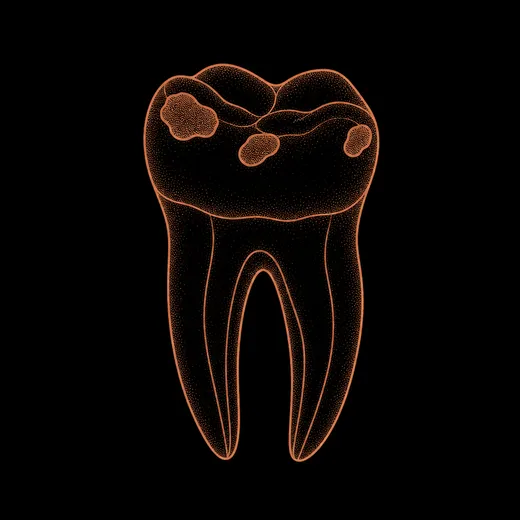
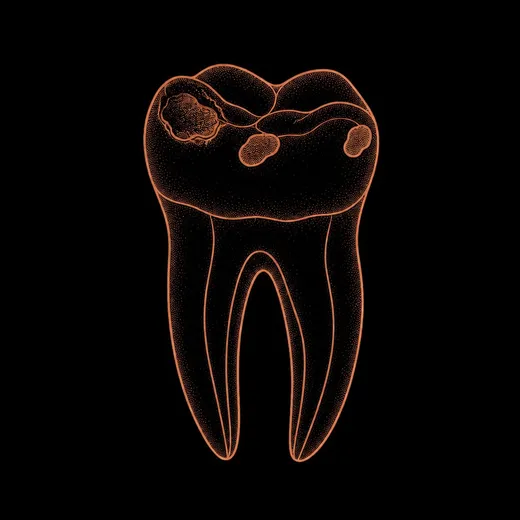
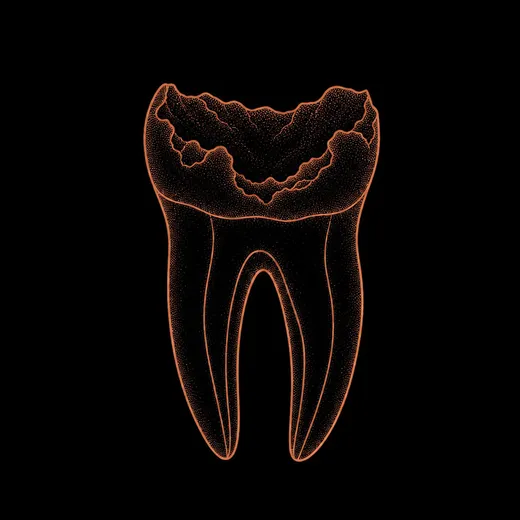
A child's four first permanent molars can differ markedly – one only discoloured, another already broken down. That is why each tooth is assessed on its own, not the dentition as a whole.
Guidance
How much needs to be done now depends on three things: how far the enamel has given way, how far the teeth have erupted, and what your child feels day to day. These three questions show what we will talk about at the first appointment.
What do you see on the back molars?
How far have the permanent molars erupted?
What bothers your child most day to day?
As long as only discolouration is visible and your child feels nothing, the aim is to make the existing enamel as resistant as possible: fluoride varnish at short intervals, fissure sealing of the occlusal surfaces, brushing technique. At this stage the tooth does not need a filling – but it does need a firm check-up appointment.
Chalky teeth change most in the first years after they erupt. That is why we see them more often than other teeth, so that a beginning breakdown is not noticed only once it hurts.
When a tooth twinges, that is not just unpleasant – it means that this exact spot stops being brushed. That is why desensitisation comes at the beginning, not at the end. There are varnishes and pastes that seal the porous enamel and are applied without drilling.
If the enamel has already chipped, we cover the defect so that it does not grow. Which material suits depends on how far the tooth has erupted.
A newly erupted tooth with a large defect is the most difficult case – and at the same time the one where there is least time. A bonded ceramic restoration needs an absolutely dry working field, and a half-erupted tooth cannot provide that. Here the preformed crown is not a stopgap, but the restoration that fits this age.
It keeps the tooth in shape and out of pain until it has erupted far enough. The definitive restoration then follows years later – as a planned step, not as a repair.
A fully erupted molar with calm gums can be kept dry – and can therefore be restored adhesively with ceramic. Teeth that have already been patched up several times benefit from this in particular, because a ceramic onlay carries the occlusal surface as a whole instead of filling hole after hole.
Whether this is possible in a single appointment also depends on how long your child can comfortably manage a session. We plan that together beforehand, not on the spur of the moment.
These questions do not replace an examination or a diagnosis. They only give a sense of what we will talk about first. What actually makes sense for your child's teeth follows from the findings on each individual tooth.
Limitations
Tooth-coloured fillings are not wedged in, they are bonded. For that to work, the enamel is briefly etched: this creates a microscopically rough surface into which the composite interlocks. Hypomineralised enamel does not etch evenly – the pattern the whole bonding technique relies on forms only incompletely.
On top of that comes a second problem that has nothing to do with the filling itself: the enamel next to the filling is just as porous as before. If it breaks down later, the defect travels right past the restoration. The filling is then flawless – the tooth is not.
Many parents know the result from their own experience: the same tooth, again and again, at ever shorter intervals. And because anaesthetic often works less well on chalky teeth than on healthy ones, these are not casual appointments. For many of these children, this is exactly where the fear of the dentist they bring with them later comes from.
The adhesive bond to porous enamel does not reach the values healthy enamel allows. Margins come loose, small chips break off, and plaque settles underneath.
Even a perfectly fitting filling does not support the enamel beside it. The tooth keeps breaking down where it is not covered – and the next appointment turns out bigger than the last.
So with a severely affected tooth the question is not “filling or ceramic?”, but: how do we get this tooth stable in as few steps as possible – and how many appointments does that save us over the next few years?
Staged plan
Several years lie between the eruption of the first permanent molars and early adolescence. The definitive restoration comes at the end of this path – not out of caution, but because a half-erupted tooth cannot be reliably kept dry, and an adhesive bond needs exactly that.
As soon as the first permanent molars come through, we look closely. Each tooth is assessed on its own: discolouration, loss of tooth substance, sensitivity.
Fluoride varnish at shorter intervals than usual, desensitising preparations and – as soon as enough of the tooth is exposed – fissure sealing of the occlusal surfaces. The first goal is that your child can brush the spot again.
If the enamel breaks down, the site is restored before it grows. In the mixed dentition often with materials that can be placed without elaborate drying and sometimes without anaesthetic.
Where a lot of tooth substance has been lost in the mixed dentition, a preformed (stainless steel) crown is the most robust interim solution. It encloses the tooth, takes it out of the painful situation and holds off further breakdown.
Once the tooth is fully erupted and the gums are calm, the definitive restoration follows: an adhesively bonded ceramic onlay that replaces only as much as necessary.
Where destruction is very far advanced, planned removal of the tooth can be the better decision – but then only after an orthodontic assessment and within a window in which the molar behind it can close the gap on its own.
In an analysis of 115 restorations on MIH molars, 94.4 percent of the preformed stainless steel crowns were intact after two years – compared with 49.2 percent of the composite fillings.
de Farias et al., International Journal of Paediatric Dentistry 2022 – PMID 34115431 (54 stainless steel crowns, 61 fillings, 24 months of follow-up). This is a retrospective analysis of treatment records, not a randomised trial: which tooth received which restoration was decided by the clinical situation at the time – the more difficult cases probably tended to receive a crown. The comparison therefore does not prove superiority under equal conditions, but it does support why the crown has its firm place in the mixed dentition.
The staged plan is not automatic. A child with four mild chalky teeth may stay at stage two for years – another may need stage four straight away on a single tooth. Both are normal.
Ceramic
Instead of filling a broken-down tooth hole by hole, a ceramic onlay covers the occlusal surface as a whole. Its margins sit where the enamel still bears load, and chewing pressure is taken off the porous areas. The tooth gets its shape back – in one piece rather than in parts.
It is made in the practice: the prepared tooth is scanned optically, the onlay is designed on screen and milled from a ceramic block. How this works in detail is described on our page about CEREC.
For children and adolescents, something counts here that is merely convenient for adults: the second appointment is not needed. No temporary restoration, which tends to come loose on poorly bonding enamel anyway. No second injection on a tooth where the anaesthetic is harder to get working in the first place. And no weeks in between during which the prepared tooth is sensitive.
The broken-down occlusal surface is smoothed until a clean, load-bearing shape is created. The ceramic onlay sits on top of it, its underside the exact counterpart of that surface.
Unlike a crown, it does not enclose the tooth all the way round. That matters with young permanent teeth: their pulp chamber is still large, and grinding all around would come dangerously close to it. So only what has been lost is replaced.
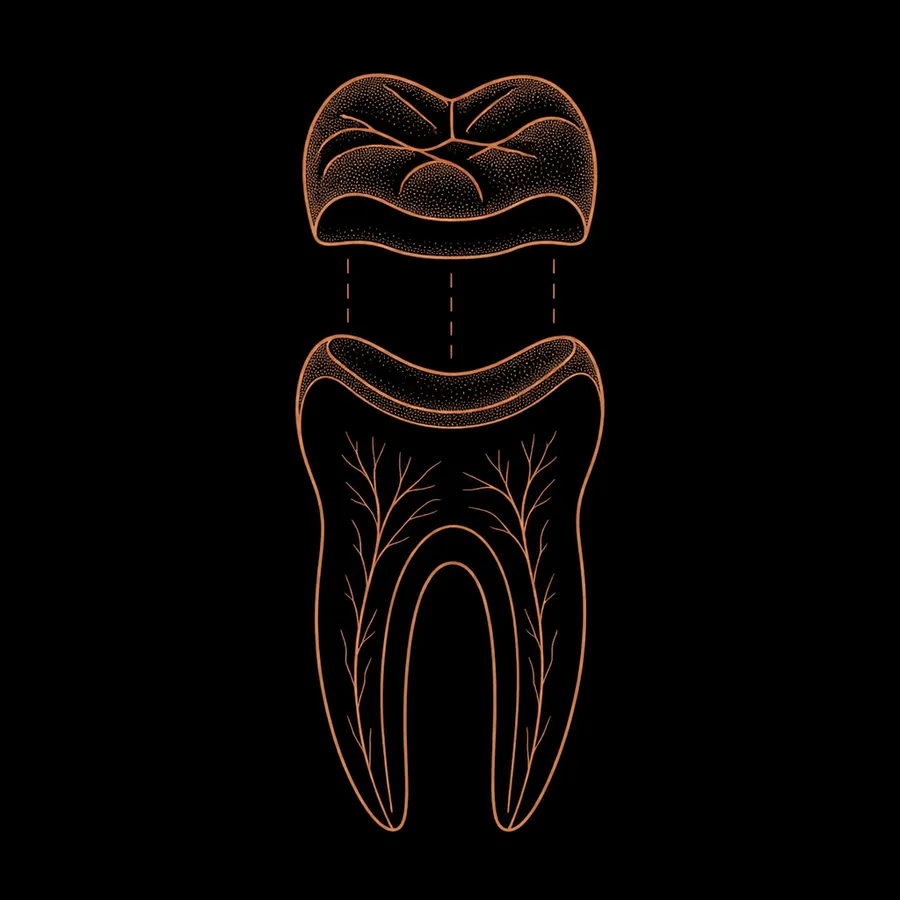
In a randomised trial on eighty first permanent molars with severe MIH, 86.7 percent of the onlays milled in the practice were intact after two years, compared with 73.4 percent of the composite fillings. For tooth shape, 90.9 percent versus 65.6 percent were rated without fault.
Zhao et al., Frontiers in Dental Medicine 2025 – doi 10.3389/fdmed.2025.1696662 (79 children, 7 to 11 years old, 24 months of follow-up). Important for putting this in context: the difference in survival rate alone was statistically not significant (p = 0.17) – only tooth shape (p = 0.02) and secondary caries (p = 0.04) differed reliably. Two years is also a short observation period, and the study used a resin-infiltrated ceramic. Long-term data specifically for ceramic restorations on MIH teeth are still lacking; here too, debonding is the most common reason for failure.
Costs
A large part of what a chalky tooth needs over the years is covered by the statutory health insurance. With the definitive restoration, it then depends on the form chosen. What applies in your case is set out in writing in the treatment and cost plan before treatment begins.
A chalky tooth is something we accompany over years, not a one-off procedure. What it costs in total therefore depends less on any single appointment than on how early it becomes stable.
Questions
No. The enamel of these teeth forms between the last trimester of pregnancy and roughly the fourth year of life – long before the teeth become visible. Sugar, oral hygiene and fluoride have no influence on this process. When we ask about illnesses or medication in the first years of life, it is to put things in context, not to assign blame.
MIH is not contagious – it is a developmental disturbance of the enamel, not an infection. Research has not been able to demonstrate simple inheritance either; genetic studies have so far not confirmed such hypotheses. Siblings being affected does happen, but it is not proof of a hereditary pattern.
As long as there is only discolouration and your child has no symptoms, we do not drill – then it is about hardening the enamel, sealing and checking. Treatment starts as soon as tooth substance is being lost or the tooth becomes sensitive. The reason is not the appearance: porous enamel keeps breaking down under chewing pressure, exposed dentine hurts, and where brushing hurts, decay develops on top.
This is a well-known phenomenon with chalky teeth: the nerve of severely affected teeth is often chronically irritated, and a local anaesthetic works less well on that. Do tell us if earlier appointments went badly for this reason. We then plan differently – with more time, with other anaesthetic techniques and, after a medical assessment, with nitrous oxide or general anesthesia.
Yes, above all the back baby molars – there it has a different technical name, but the principle is the same. More important than the name is the clue it gives: if the baby molars were affected, the risk of chalky teeth on the permanent molars is clearly higher, because the formation periods overlap. From the eruption of the permanent teeth onwards we watch these children particularly closely.
In the mixed dentition it is often the most robust solution – and it sits far back, where it is barely visible when speaking or laughing. It is also not the end of the road: once the tooth is fully erupted, a tooth-coloured restoration can follow. For children to whom the appearance matters, there are also preformed white crowns; whether they are suitable in a particular case is something we discuss based on the findings.
No. A tooth no longer grows once it has erupted – what still changes are the jaw and the line of the gums. That is precisely why we place the margins of the restoration above the gum and check them regularly. Even so, a definitive restoration is only planned once the tooth is fully erupted.
The permanent incisors can be affected too – there it is usually about the appearance, less often about loss of tooth substance. Depending on the type of discolouration, polishing, resin infiltration or a small tooth-coloured restoration may be options. Classic bleaching is out of the question for children and adolescents: EU rules effectively do not permit such products under the age of eighteen. We will look at what is possible together.
More often than the usual six-month rhythm – with chalky teeth, two to four appointments a year make sense. The reason is that these teeth change most in the first years after they erupt: a breakdown that is just beginning can be restored with a small treatment, one discovered late rarely can.
For children and adolescents, preventive care, fluoridation, fissure sealing and fillings are covered by the statutory health insurance, as is the preformed crown on a permanent tooth in the appropriate situation. For the ceramic partial crown there is a fixed allowance based on the findings; for smaller ceramic restorations it goes through an additional-cost agreement. What always applies is the treatment and cost plan, which you receive before treatment begins and can submit to your health insurer.
Bring along whatever you have noticed – a patch, a sensitive spot, a tooth that has been patched up several times. We assess each molar individually and tell you what needs doing now and what can wait.
Or call: 030 436665501