Time required
Treatment takes place in one appointment at the practice. The gel is applied, activated with a special light source, and reapplied up to two times at F80.
Teeth whitening · Berlin-Mitte
Teeth whitening lightens natural tooth structure. Fillings, crowns and veneers retain their color – so planning begins with them.
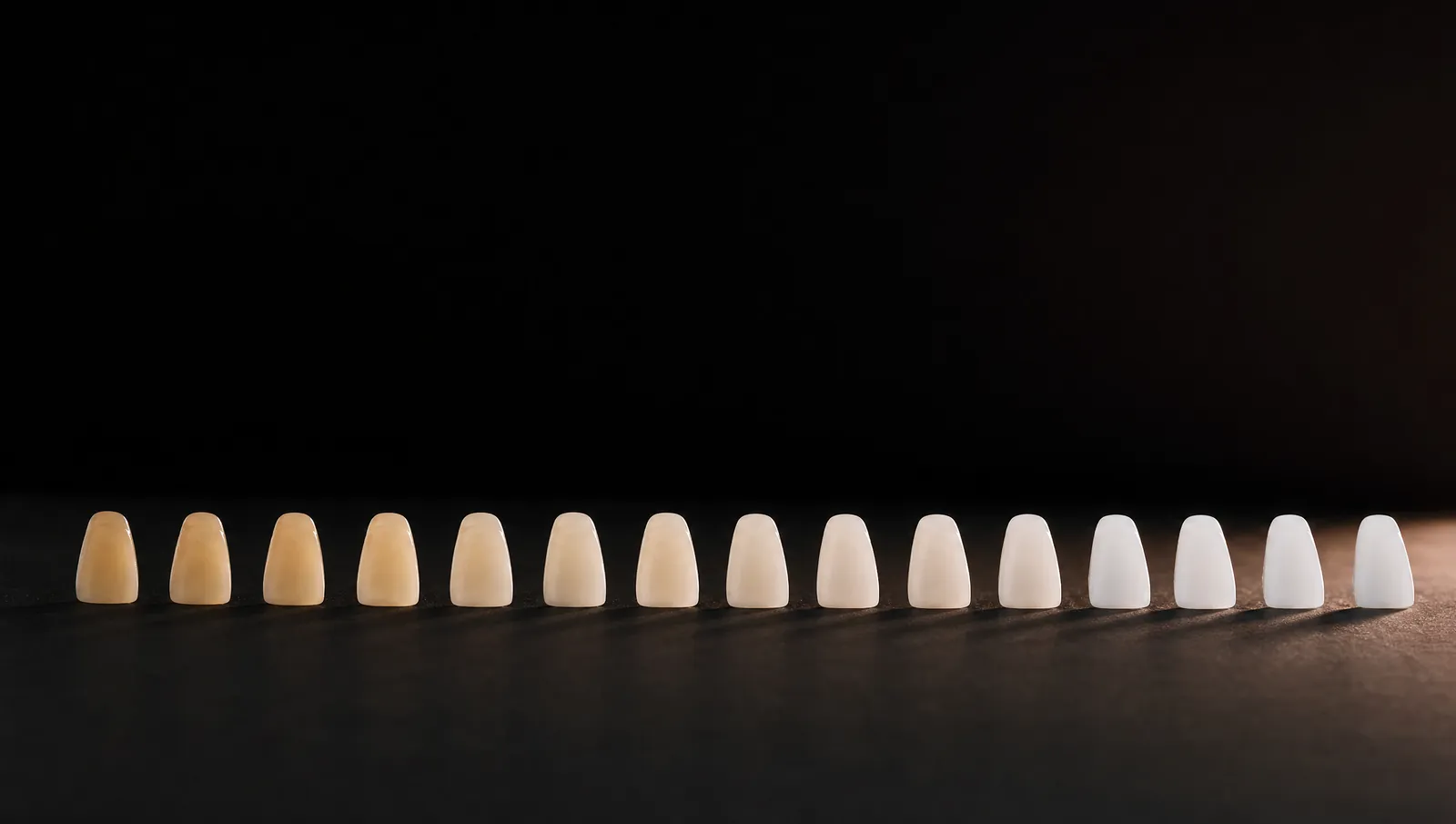
Planning
Whitening changes pigments in natural tooth structure. Composite fillings, crowns, bridges and veneers do not respond to it. A restoration that matches the tooth color today may stand out visibly after whitening. This is one of the most common reasons why the result may look inconsistent despite lighter teeth.
For this reason, examination and cleaning come first, followed by whitening; only afterward is the color of a planned filling, crown or ceramic restoration selected. Existing restorations are not replaced automatically. We discuss in advance what color differences can be expected and whether any further treatment will be needed.
Hydrogen peroxide or carbamide peroxide triggers oxidation – a chemical reaction that changes embedded color molecules. The enamel is not ground away in the process. How strongly a tooth responds depends on the cause, depth and initial color of the discoloration.
External deposits from coffee, tea, red wine or tobacco should first be addressed with a professional teeth cleaning. A single gray, root canal-treated tooth, however, requires a separate diagnosis.

Guidance
The cause and distribution of the discoloration are considered before a procedure is selected. These three questions indicate whether the discussion is more likely to focus on in-office treatment, custom trays or first on the clinical findings.
How does the discoloration appear?
How would you like to organize the treatment?
What matters to you during treatment?
If you prefer a compact treatment performed entirely under dental supervision, we will discuss in-office whitening. Gum protection, the gel and the exposure time are managed directly at the practice. Beforehand, the teeth, gums and existing restorations are examined.
It is not possible to predict with certainty how the teeth will respond or whether sensitivity will occur.
If you would like to whiten your teeth gradually at home, we will discuss 3D at-home whitening. The trays are made for your teeth after a scan. You will also receive gel, instructions and follow-up appointments.
Wear time and frequency can be adjusted after consultation if the teeth become sensitive.
One dark tooth, unexplained spots, or visible fillings and crowns require separate assessment. The procedure is selected only after the clinical findings are known. External deposits may require cleaning, while a root canal-treated tooth may need a different approach.
We also determine which existing restorations will retain their color and may stand out after whitening.
These questions do not replace an examination, diagnosis or consultation. They provide only an initial direction for the discussion. The clinical findings determine which whitening procedure is appropriate in your case.
Preparation
Deposits and external discoloration lie on the tooth surface. Professional teeth cleaning removes them before bleaching gel is used. Sometimes the natural tooth shade revealed by cleaning is already the change being sought.
Cleaning also creates an even surface for the gel. Without this step, deposits could cause uneven exposure. Bleaching is intended to change the color within the tooth, not cover layers on the tooth.
We examine the teeth, gums, cavities, cracks, leaking fillings and crowns, exposed tooth necks, and existing dental restorations. Unexplained discoloration is assessed before any gel is used.
Deposits and external discoloration are removed. Inflamed gums or teeth requiring treatment are treated first. You can find more information about cleaning under F80 Signature Prophylaxe.
We document the current shade, discuss your goal, and show which fillings, crowns, or veneers will retain their color. We then decide together between in-office bleaching, home bleaching, or a combination.
At the practice, the gums are protected and the gel is applied in defined cycles. For home bleaching, you receive custom trays, gel, and detailed instructions. Any sensitivity is taken into account during continued use.
Procedure
F80 offers power bleaching at the practice, 3D home bleaching with custom trays, and a combination of both approaches. The deciding factors are the time required, the desired level of supervision, and your response to the gel—not the assumption that the more involved method must be more effective.
Treatment takes place in one appointment at the practice. The gel is applied, activated with a special light source, and reapplied up to two times at F80.
Gum protection, dosage, exposure time, and the response of the teeth are monitored directly at the practice.
The concentrated application can cause temporary twinges or an increased response to cold, heat, and touch.
At F80, the gel remains in the trays for 60 minutes in the evening. Treatment typically extends over two to three weeks.
After a 3D scan, F80 makes custom, thin trays. You receive a lower-concentration gel and detailed dental instructions.
The intensity of sensitivity was lower in the available meta-analysis. Wear time or schedule can be adjusted after consultation.
With combination bleaching, whitening begins at the practice and continues at home with custom trays. F80 offers this approach when the supervised treatment at the practice and the gradual treatment at home both fit the treatment plan.
The combination is not automatically more effective or better tolerated. We determine whether the additional step is appropriate based on the tooth shade, the available time, and possible sensitivity.
If you are wearing aligners anyway. Anyone undergoing teeth straightening with transparent aligners, or who afterward wears a removable set of retainer trays, already has in their mouth the fitting form for whitening. There is a gel developed specifically for this carrier that spreads inside the aligner instead of flowing out. The rhythm differs from our home bleaching with custom trays; the dental rules remain the same. How it proceeds, when in the course of treatment it makes sense and what happens with the attachments is on its own page: Bleaching with Invisalign.
A meta-analysis found no clear difference between home and in-office bleaching in effectiveness or risk of sensitivity. The intensity of sensitivity was lower with home bleaching.
Systematic review and meta-analysis, 2025 – PubMed 40485133. The quality of the evidence was rated as low. A result across study groups is not a promise for an individual tooth.
Single tooth
If a single tooth darkens after root canal treatment, the discoloration is often inside the tooth crown. External bleaching would then also treat the neighboring teeth without specifically reaching the cause in the dark tooth.
For internal bleaching, the access opening in the tooth is opened, a bleaching agent is placed in the tooth crown, and the tooth is temporarily sealed. It must first be checked that the root canal treatment is intact and securely sealed toward the root canal.
Only an examination can distinguish internal discoloration from a cavity, a crack, or a problem with the existing root filling.
The agent remains in the tooth. It is checked after a few days; depending on the response, several cycles may be necessary.
After internal bleaching, the access opening is permanently restored. This is not the same method used for vital teeth.
Tolerability
The most common side effect is temporary tooth sensitivity. Cold, heat, touch, or air can cause twinges during and after treatment. The intensity varies from person to person and cannot be predicted reliably.
If needed, F80 uses desensitizing gel or fluoride. With home bleaching, wear time and frequency can be adjusted after consultation with a dentist. If severe pain occurs, treatment is stopped and the cause is investigated.
During pregnancy and breastfeeding, the Bundeszahnärztekammer (German Federal Chamber of Dentists) generally advises against bleaching because of insufficient data. Cosmetic tooth-whitening products containing more than 0.1 percent hydrogen peroxide must not be used on anyone under 18.
Untreated conditions or unexplained discoloration must also be diagnosed and treated if necessary before bleaching.
Law
The EU Cosmetics Regulation 1223/2009, Annex III, entry 12 sets limits for hydrogen peroxide contained in or released from tooth-whitening products.
Cosmetic oral-care products in this range may be sold over the counter. The low concentration limit also restricts the potential whitening effect.
These products may only be supplied to dentists. The first use in each treatment cycle is performed by a dentist or under direct dental supervision.
Products above this limit may not be marketed as cosmetic tooth-whitening products under these rules.
For people under 18, dental use of products containing more than 0.1 up to 6 percent is not permitted. The legal framework explains factually why products from drugstores or beauty salons must have a lower concentration. It is not a judgment about the quality of providers, but a limit on product supply and use.
The dental part begins before the gel: identifying the cause of the discoloration, ruling out cavities and leaking restorations, protecting the gums, and responding to symptoms.
Service
Bleaching is generally a privately paid service. The gesetzliche Krankenkasse (German statutory health insurance fund) does not usually cover cosmetically motivated tooth whitening; with private insurance, possible reimbursement depends on the policy and the individual case. F80 provides a transparent written overview before treatment begins.
Questions
No. Bleaching affects natural tooth structure, not composite or ceramic. We therefore discuss in advance whether existing restorations could stand out in color after whitening. The shades of new fillings or crowns are selected only after bleaching.
Cleaning removes deposits and external discoloration that would otherwise cause the gel to act unevenly. It also reveals the natural initial shade. Sometimes cleaning alone is sufficient, so bleaching is not necessary.
Scientific evidence does not show a clear winner in effectiveness. In-office treatment is more compact and is supervised entirely at the practice. Home bleaching spreads treatment over several weeks; in the cited meta-analysis, the intensity of sensitivity was lower. Your clinical findings are decisive.
After examination and cleaning, the gums are protected. At the practice, we apply bleaching gel and activate it with a special light source. Depending on the course of treatment, this application step is repeated up to two times at F80.
After a 3D scan, F80 makes custom, thin trays. You apply the lower-concentration gel in the evening and leave it on for 60 minutes as instructed. Treatment typically takes two to three weeks. After a dental check, your trays can be reused later for a touch-up.
Temporary sensitivity is the most common side effect. Cold, heat, air, or touch can cause twinges. If needed, we use desensitizing gel or fluoride and adjust the schedule for home bleaching. Severe pain must be investigated.
Internal bleaching may be considered for a root canal-treated tooth. The bleaching agent is placed in the tooth crown and the tooth is temporarily sealed. An intact root canal treatment and a secure seal toward the root canal are required.
The Bundeszahnärztekammer (German Federal Chamber of Dentists) generally advises against bleaching during pregnancy and breastfeeding because of insufficient data. Tooth-whitening products containing more than 0.1 percent hydrogen peroxide must not be used on anyone under 18.
Over-the-counter products must contain or release no more than 0.1 percent hydrogen peroxide. Higher-concentration cosmetic products up to 6 percent are subject to the Zahnarztvorbehalt (restriction to use by or under the direct supervision of a dentist). The limit is based on EU law, not on a blanket assessment of individual products.
Cosmetically motivated tooth whitening is generally a privately paid service and is not usually covered by the gesetzliche Krankenkasse (German statutory health insurance fund). Whether private insurance provides coverage in an individual case depends on the policy. You receive a written overview before treatment begins.
We assess the cause of your tooth shade, existing restorations, and possible sensitivity. You will then know which method is suitable for your clinical findings—or why another step should come first.
Or call: 030 436665501