Children's prophylaxis · Berlin-Mitte

Children's prophylaxis with Guided Biofilm Therapy in Berlin-Mitte

First the plaque is disclosed with a dye and looked at together in the mirror, then a fine jet of warm water and powder does the cleaning – no rotating brush, no scraping. A dental cleaning children take part in rather than endure.

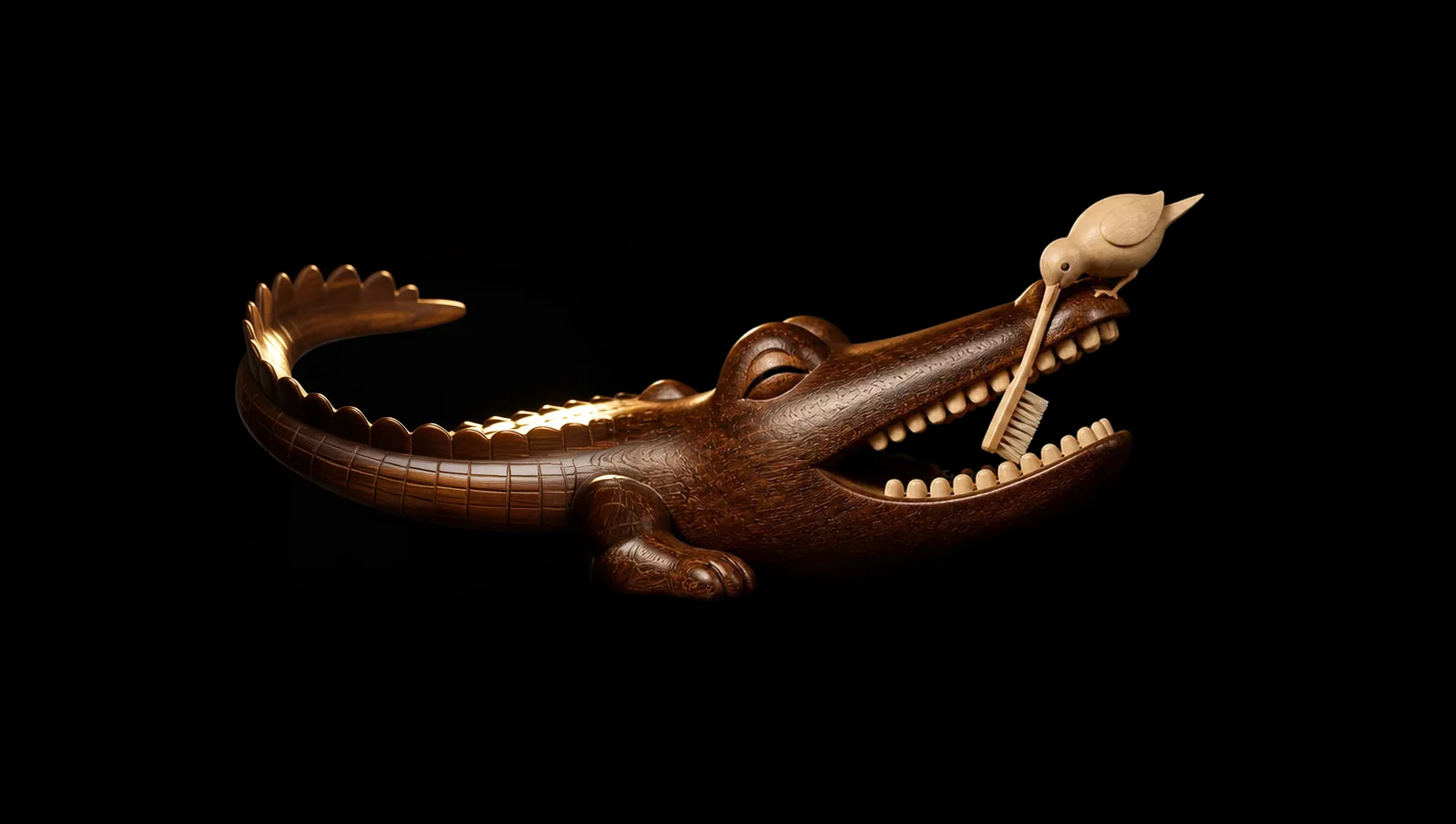
Wooden figurine of a friendly crocodile with its mouth open; a small wooden bird stands on its snout brushing the teeth with a tiny toothbrush
Like the crocodile bird of legend: one holds still, the other does the cleaning – it has worked that way for thousands of years.
Practice
Friedrichstraße 80
10117 Berlin-Mitte
Open
7 days a week
Mon–Fri until 8 p.m.
How often
Every 3 to 6 months,
depending on caries risk
Method
Powder jet (GBT) instead of
brush and paste

Starting point

With children, well-brushed is a snapshot

Children brush every day – and something still gets left behind. That is not a question of good will: fine motor skills are still developing, new molars sit half-hidden for months as they erupt, and freshly erupted teeth are not yet fully mineralised – at their most vulnerable stage they are the hardest to brush. That is exactly where it is decided whether plaque turns into caries.

The children's prophylaxis appointment is where both things happen: the teeth get properly clean everywhere for once, including where the brush at home never reaches. And your child sees for themselves where their brushing can improve. There are no reproaches – neither for children nor for parents. It is never about who is at fault, only about what helps now.

This page describes the prophylaxis appointment itself. How the very first visit works, what is due at which age and what statutory insurance covers is summarised on our page on pediatric dentistry.

Guided Biofilm Therapy

Make it visible first, then remove it

A thin bacterial film grows on every tooth – the biofilm. It is almost invisible, feels furry and is the beginning of almost everything that harms teeth: caries, gum inflammation, bad breath. As long as it is soft, it can be removed completely. You just need to know where it sits.

Guided Biofilm Therapy (GBT) is a fixed treatment protocol by the Swiss manufacturer EMS – the same one we use for adults. The core idea: the biofilm is first made visible with a harmless disclosing dye and then removed precisely – with a fine jet of warmed water, air and an erythritol-based powder. "Guided" means: the colour guides the cleaning. What is stained gets treated – not simply everything.

Why this suits children

Disclosing is not a test but an aha moment in front of the mirror. The powder jet works without a rotating brush and without pressure on the tooth. And the powder is a sugar substitute of the kind found in sugar-free chewing gum – it tastes slightly sweet and is harmless if a little is swallowed during spraying.

The full GBT protocol has eight steps – up to cleaning deep gum pockets and implant surfaces, issues that healthy children's teeth simply do not have. At a children's appointment the process therefore focuses on what matters: disclose, understand, clean, protect.

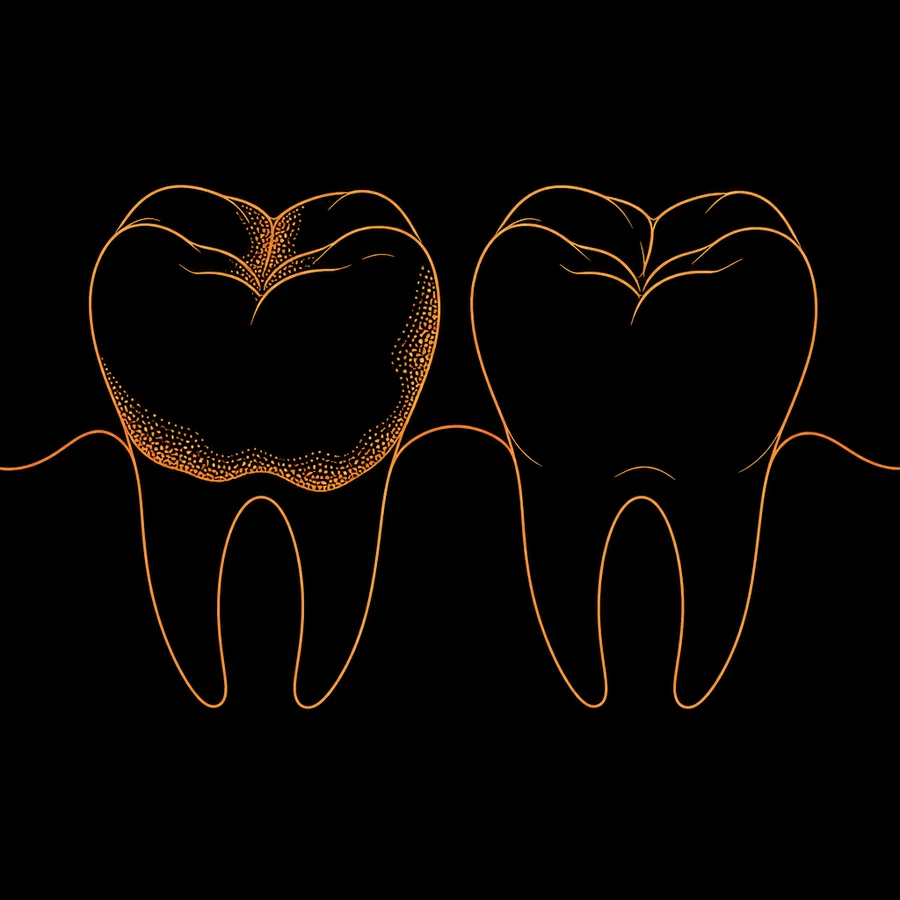
Schematic drawing: two molars – on the left with disclosed plaque along the gumline and in the fissure, on the right completely clean
On the left, plaque made visible: along the gumline and in the grooves, exactly where the brush leaves it. On the right, the same tooth after cleaning.

The appointment

The prophylaxis appointment, step by step

Depending on age and attention span, the appointment takes about 30 to 45 minutes. As always with us: every step is announced beforehand and explained in words a child understands.

  1. A look and a few questions

    How is brushing going at home, what works, what doesn't, is anything sensitive? We start with a conversation and a look at teeth and gums. With teenagers, braces are part of the check too.

  2. Disclosing

    A disclosing dye makes the biofilm visible, in different colours depending on the age of the plaque. It looks spectacular and is completely harmless – the colour comes off fully with the cleaning.

    Not a test. More like a magic trick that shows where the brush hasn't been.
  3. Look in the mirror, brush better

    Together in front of the mirror: where does colour remain? That is exactly where we practise, with the technique and the brush that fit your child's age. It is the most important step of the appointment because it keeps working at home. Parents get concrete spots instead of general appeals.

  4. The cleaning with the powder jet

    A fine jet of warmed water, air and erythritol powder lifts the stained plaque off all surfaces – including pits and interdental spaces – without touching the tooth. No rotating, no scraping, no pressure. What most children notice above all: it tickles.

    The powder tastes slightly sweet.
  5. Tartar – only if there actually is any

    Calcified plaque is much rarer in children than in adults. If we do find some, usually behind the lower front teeth, we remove it precisely with a fine ultrasonic tip. There is no need to scrape across all teeth by default.

  6. Check, fluoride and a plan

    At the end we double-check every surface and apply fluoride varnish to protect the enamel. Then we agree together when the next appointment makes sense – every three to six months, depending on caries risk.

The difference

What does not happen here: brushes, paste, scraping

A classic dental cleaning polishes every single tooth with a rotating rubber cup or brush and polishing paste. It works – but it hums, it vibrates, it tastes like a dental practice. For many children that feeling is precisely why they dislike dental cleanings.

Spraying instead of scrubbing

The powder jet works without contact: it sprays the plaque away instead of scrubbing it off. The water is warmed, and the erythritol powder, at a grain size of around 14 microns, is fine enough to be gentle on enamel – including the softer enamel of milk teeth. And because everything was disclosed beforehand, both sides can see at the end that it is really all gone: your child in the mirror, we at the tooth.

It does not always work entirely without classic instruments – tartar needs ultrasound. But the standard case for a healthy child's dentition is: disclose, practise, spray, done.

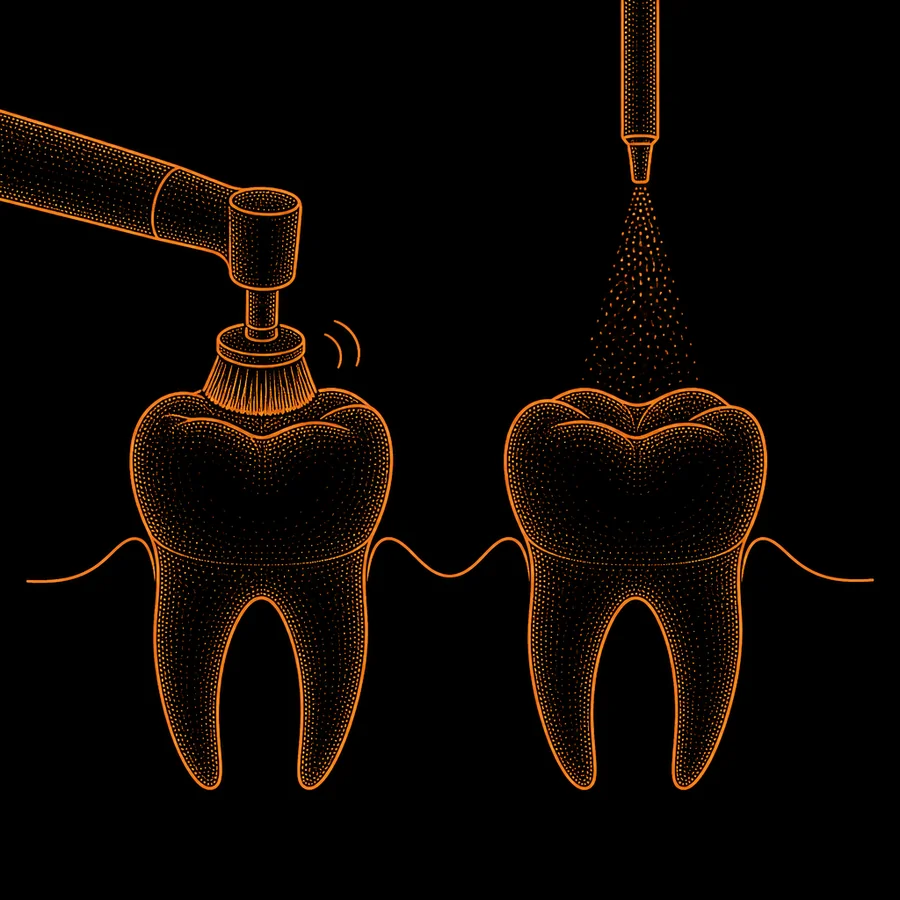
Schematic drawing: on the left a rotating brush polishes a molar directly on its surface, on the right a fine powder jet cleans the tooth without contact
On the left the classic polish, on the right the powder jet: cleaning without contact with the tooth.

In adults, air polishing is well studied: it removes plaque at least as thoroughly as polishing with a rubber cup and paste, is faster, and is gentler on enamel, gums and fixed braces. For children the evidence is younger: the first randomised trial comparing GBT head-to-head with classic cleaning in six-to-twelve-year-olds was completed in 2024 with 120 children – the results have not yet been published.

Overview in adults: PMID 33491396 · Paediatric trial: ClinicalTrials.gov NCT06765343. Studies in adults are no guarantee for every child – brushing, diet and regular appointments remain decisive.

Two special cases

Two moments when the powder jet matters most

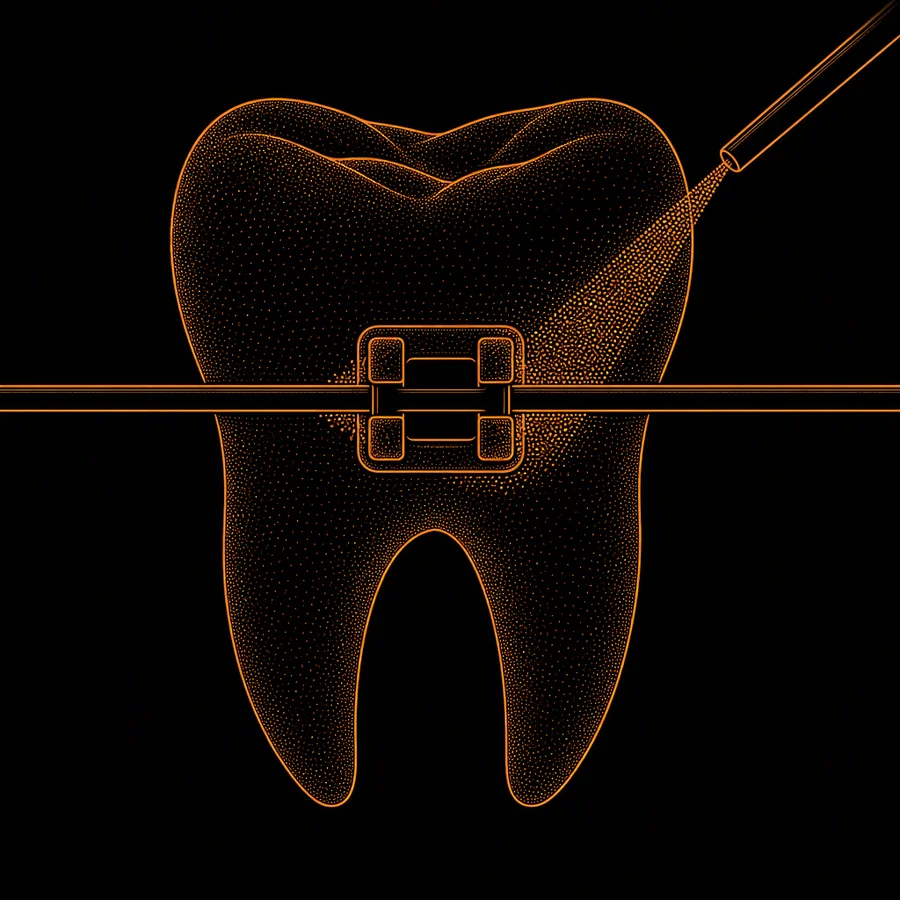
Schematic drawing: molar with bracket and archwire, a fine powder jet cleans around the bracket and under the wire
No brush reaches under the archwire – the powder jet does.

With fixed braces

Brackets and archwire are plaque magnets – and no brush reaches right under the wire. The powder jet cleans around brackets, under archwires and along bands without anything being removed and without damaging the appliance. With fixed braces, shorter intervals between cleanings pay off. Removable aligners are easier to keep clean – more on our page on Invisalign for teenagers.

Before fissure sealing

The deep grooves of new permanent molars can be sealed so caries finds no hold there – a statutory insurance benefit for the large molars. For the sealant to bond, the fissure must be absolutely clean. The powder jet cleans the grooves more thoroughly than any brush – the best preparation for a sealant that lasts.

Honestly speaking

Who the powder jet is not (yet) for

For children, GBT is an especially pleasant form of dental cleaning – but not a dogma. There are situations in which we take a different approach. We discuss them beforehand, not halfway through.

Asthma and airway conditions

The powder jet produces a fine spray mist. With asthma or other airway conditions we weigh up together before the appointment whether the powder jet is suitable or whether a classic cleaning is the better choice. Please let us know in advance.

Chalky teeth (MIH)

Hypomineralised teeth can be highly sensitive to temperature and touch. In that case we adjust water temperature, distance and duration, skip sensitive teeth – or switch methods. More on our page on MIH and chalky teeth.

The youngest

For nursery-age children the full procedure is often simply too long. Then the appointment consists of disclosing, brushing practice and fluoride varnish – the powder jet joins in once your child is ready. An appointment spent only practising is not wasted.

If a child doesn't want to

The same rule applies to dental cleaning as to every treatment here: nothing against the child's will. A raised hand means pause – even when it just tickles.

Costs

What statutory insurance covers – and what remains private

Statutory prevention for children is good, and your child is entitled to it. The GBT cleaning builds on it – it does not replace the insurance benefits, it complements them.

How insurance and GBT interlock

Up to six years
Dental early-detection check-ups, advice for parents and fluoride varnish are covered by statutory insurance, from the first milk tooth.
Six to eighteen
The statutory individual prophylaxis includes the oral hygiene status with disclosing, brushing training and fluoridation – once or twice a year – plus sealing of the large permanent molars.
The GBT cleaning
The complete dental cleaning with the powder jet goes beyond the insurance scope and is a private additional service. What it costs depends on the effort involved – you will know before the appointment, not on the invoice.
Supplementary dental insurance
Many supplementary dental insurance plans for children reimburse professional cleanings in full or in part, and some statutory insurers subsidise them through bonus schemes. You will receive an itemised invoice from us to submit.

Questions

Frequently asked questions about children's prophylaxis with GBT

From what age does the GBT cleaning make sense?

There is no rigid limit. In our experience school-age children do very well – they last the whole appointment and are proud of the result. With younger children we use the building blocks that already fit: disclosing, brushing practice, fluoride varnish. The powder jet joins in once your child is ready.

Does the powder-jet cleaning hurt?

No. Nothing is drilled, nothing is scraped, nothing rotates on the tooth. The jet of warmed water and fine powder feels unusual – most children describe it as tingly or ticklish. And the pause sign applies: raise a hand and we stop immediately.

What is in the powder – and what if my child swallows it?

We use a powder based on erythritol, a sugar substitute also found in sugar-free chewing gum and sweets. It is very fine, tastes slightly sweet and is harmless if a little is swallowed during spraying.

My child has asthma. Is the treatment still possible?

Please tell us before the appointment. The powder jet produces a spray mist that can irritate sensitive airways. Depending on course and medication the treatment is often perfectly possible – or we clean the classic way. We decide that together in conversation, not in the treatment chair.

How often should my child come for prophylaxis?

As a rule of thumb every three to six months – depending on caries risk, brushing situation and braces. The insurance check-ups form the backbone; whether and how often a GBT cleaning is added is decided by findings, not by a fixed scheme.

Does health insurance cover the costs?

The statutory individual prophylaxis – disclosing, brushing training, fluoridation, sealing of the permanent molars – yes. The complete GBT cleaning is a private additional service; many supplementary dental plans reimburse it. We tell you the costs before the appointment.

Does it work with fixed braces?

Especially then. Around brackets and under the archwire every brush fails – the powder jet gets there without the wire being removed and without attacking the appliance. With fixed braces, shorter intervals between cleanings are advisable.

My child has chalky teeth (MIH). Is the powder jet a good idea?

Cautiously yes – with adjustments. Hypomineralised teeth are often sensitive; we adjust temperature, distance and duration and skip sensitive teeth. What else matters with chalky teeth is on our MIH page.

Does the professional cleaning replace brushing?

No – it makes brushing better. The cleaning catches up on what was left behind, and the disclosing shows where. The real work still happens every day at the bathroom sink. No appointment in the world brushes that for you.

The best time is before there is anything to see

Book a prophylaxis appointment for your child – as a statutory check-up or as a GBT cleaning. Every step is explained beforehand. So are the costs.

Or call: 030 436665501