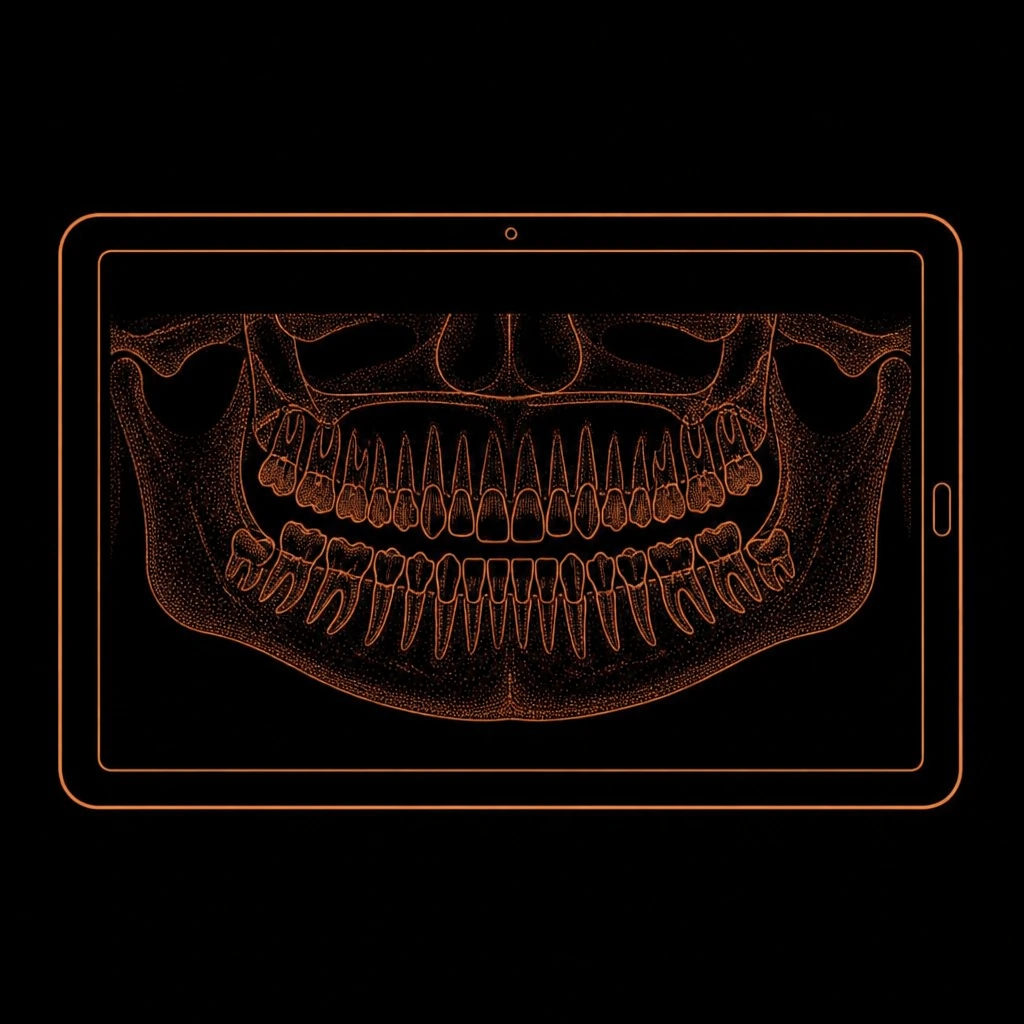
1. Consultation
Your situation, your expectations, time frame and budget; plus 3D diagnostics as the basis of all planning.
The Tooth and Face Specialists

Implant dentistry · Full-arch restoration · Berlin-Mitte
On four implants that support an entire jaw, a single day of surgery, and the care that comes before it.
Book a consultationMany years of implant experience · 4.9 out of 5 on Google (over 330 reviews) · 5.0 on Jameda
What is All-on-4?
At the center of this treatment is a single day. It begins in the morning with a jaw that no longer offers support: with a denture that causes pressure, or with teeth that can no longer be saved. In suitable cases, it ends in the evening with a fixed row of teeth on four implants, without palatal coverage and able to bear load.
The concept behind it is called All-on-4, literally: everything on four. It was developed in the 1990s by the Portuguese implant dentist Paulo Maló together with the manufacturer Nobel Biocare and has been used internationally ever since; at F80, we implement it with the Pro-Arch system from the Swiss manufacturer Straumann. For many people, the fact that fixed teeth are possible after just one day of surgery is the reason to look into the concept. That is precisely why this day follows clear rules, and the care taken before the procedure determines whether it is enough.
The principle
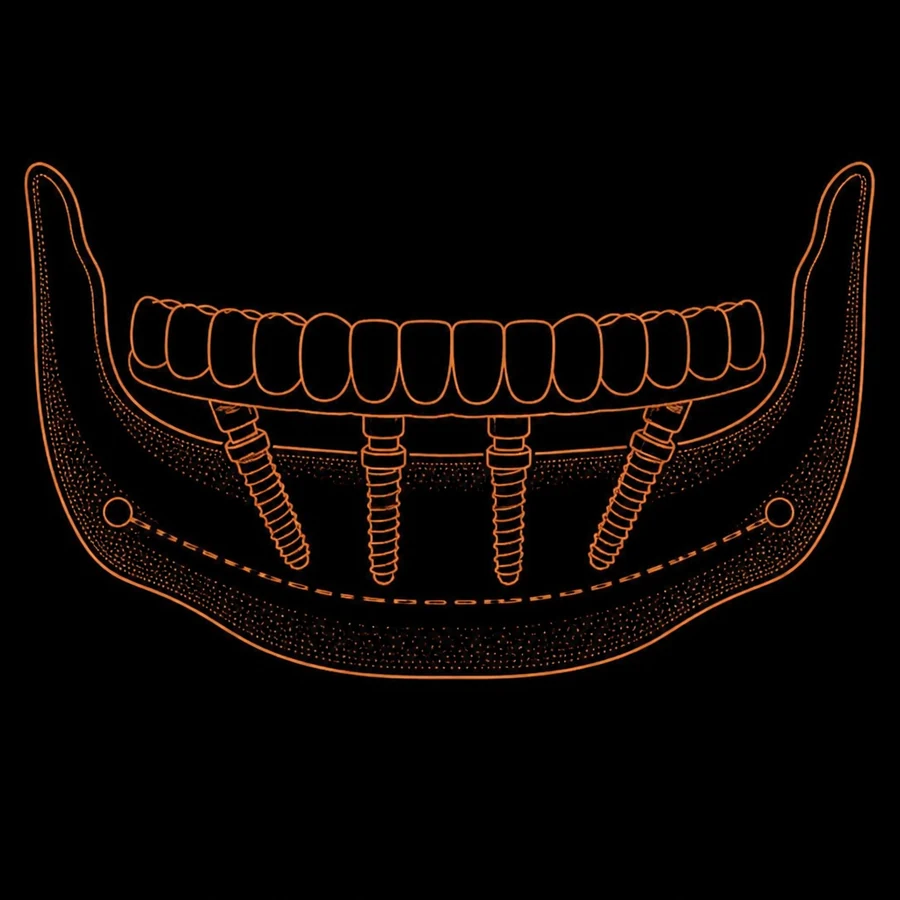
Conventional implants need a healing period of several months; during this phase you live with a loose provisional restoration that can only bear limited load, and a further procedure is needed to fit the fixed dental restoration. The All-on-4 concept removes both: on the very day of surgery, a stable, fixed provisional restoration without palatal coverage is screwed onto the implants.
The geometry makes this possible. The two posterior implants are placed at an angle of 30 to 45 degrees: this way they avoid the critical zones where the inferior alveolar nerve runs in the lower jaw and where the maxillary sinuses lie in the upper jaw, use the anterior bone instead, which is usually considerably more stable, and at the same time shorten the lever arm acting on the bridge. All four implants are rigidly connected by the fixed arch and support one another.
After a long period without teeth, or as a result of inflammation, the jawbone recedes. Conventional implants often no longer find secure anchorage in it and first require time-consuming bone augmentation, for example a sinus lift. The angled special implants of the All-on-4 concept find sufficient anchorage even in thinner jawbone that has already receded, and in many cases avoid the need for extensive augmentation. 3D diagnostics show whether this also applies to your jaw.
Suitability
The concept is intended for people whose upper or lower jaw is completely or almost completely toothless. If a few teeth remain that are loose, badly decayed and can no longer be preserved, they can be removed on the day of surgery. Typical starting situations:
For anxious patients, the short, combined treatment can be a relief: on request, the procedure takes place under twilight sleep or general anesthesia, and our team is trained in caring for anxious patients. Find out more on our page for anxious patients.
The limits are just as clear. Untreated periodontitis is treated first, and uncontrolled diabetes is brought under control first. Heavy smoking measurably worsens healing and the long-term prognosis; we address this openly. If you clench or grind heavily at night, you need a plan for it, from the choice of material to a protective night guard. And in rare cases the bone is not sufficient even for angled implants; then we plan a different approach. In the end, whether All-on-4 is right for you is not a question of what you would like, but of the clinical findings, and that is exactly what diagnostics are for.
The comparison
The two timelines show, as an example, how the path to fixed teeth differs: with conventional implant dentistry and with All-on-4. Depending on your dental situation, general health and medication, the individual steps and healing phases can vary; however, the difference in time remains considerable. With All-on-4, in suitable cases you wear a fixed provisional restoration on the evening of the day of surgery; on the conventional path, several months pass before the fixed restoration, and considerably more than a year with bone augmentation.
Teeth that cannot be preserved are extracted; the wounds have to heal.
If bone is missing, it is built up, for example with a sinus lift, and has to heal.
The implants are placed and heal protected under the gums.
A second procedure exposes the implants; the gums take shape.
Impression, fabrication and fitting of the final restoration.
3D scan, digital surgical planning, informed consent discussion and a written cost plan.
Removing remaining teeth, placing four implants, screwing the fixed provisional restoration in place.
The implants fuse with the bone; the provisional restoration stays in the mouth and is adjusted.
The final restoration replaces the provisional one, in ceramic if you wish.
Guidance
Not sure whether implants are an option for you, and which ones? These three questions give an initial direction before we take a thorough look at your situation in the consultation.
How many teeth are missing or can no longer be saved?
What is your current restoration?
What matters most to you on the way there?
Your answers match the profile of a full-arch restoration on four implants: a largely toothless jaw, the wish for fixed teeth and for a combined treatment process. 3D diagnostics determine whether the concept will work in your jaw.
In the consultation, we look at the available bone, your bite and your general health, and plan what happens on the day of surgery and what comes afterward.
If many of your own teeth can be preserved, a full-arch restoration is rarely the first step. Single implants, bridges or preserving teeth can be the less invasive answer.
Our page on dental implants explains the basics; in the consultation, we compare the options for your situation.
Inflammation, uncertain tooth prognoses or ongoing treatment need to be clarified before a type of restoration is chosen. A joint assessment comes before the concept.
An examination and imaging produce a plan that suits your jaw, whether with four implants or otherwise.
These questions do not replace an examination, diagnosis or consultation. They only provide an initial direction for the discussion with our dental team.
The process
The entire process of All-on-4 treatment, from the first consultation to long-term care:
Your situation, your expectations, time frame and budget; plus 3D diagnostics as the basis of all planning.

The procedure, choice of anesthesia, pre-existing conditions and medications; depending on your health, with a blood count and ECG.
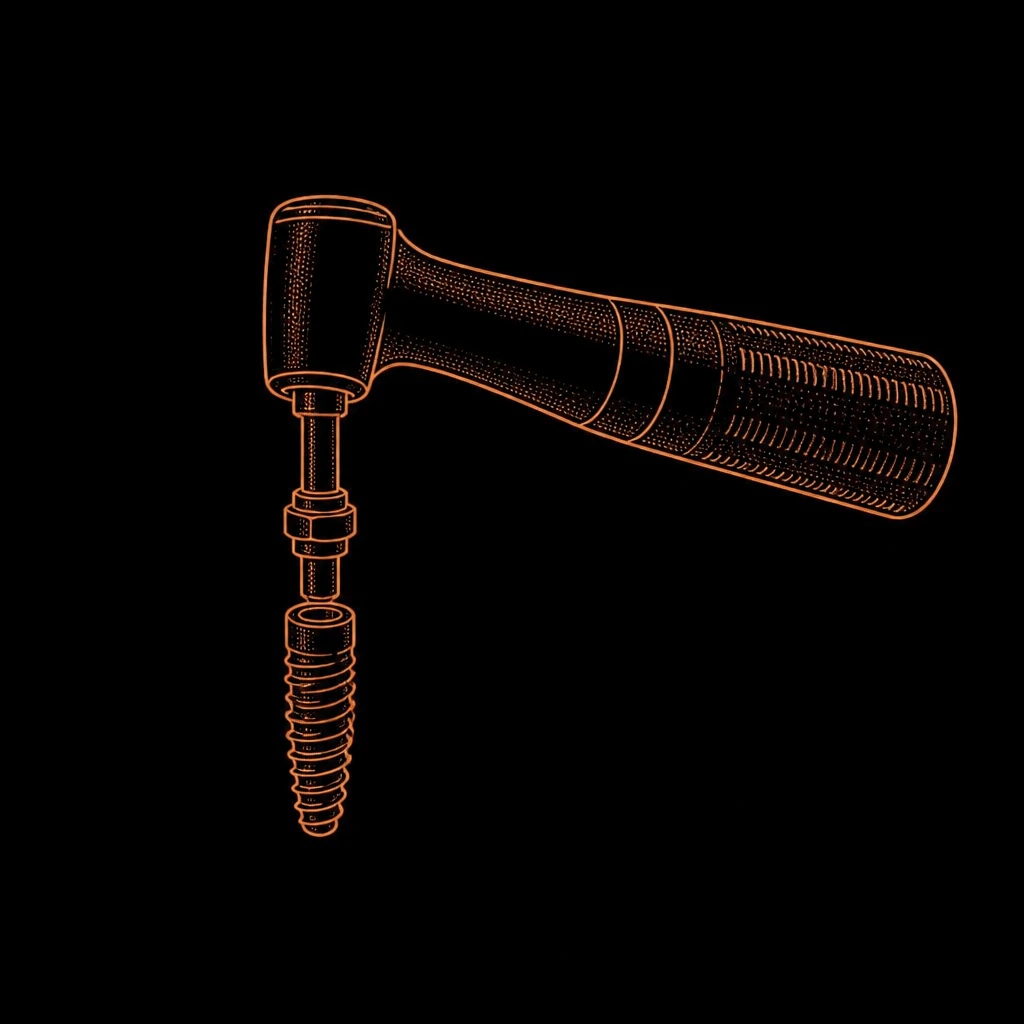
Placing the implants, adjusting the provisional restoration and screwing it in place; in suitable cases you leave the practice in the evening with fixed teeth.
Monitoring healing, readjusting the provisional restoration, answering questions; meanwhile the implants fuse with the bone.
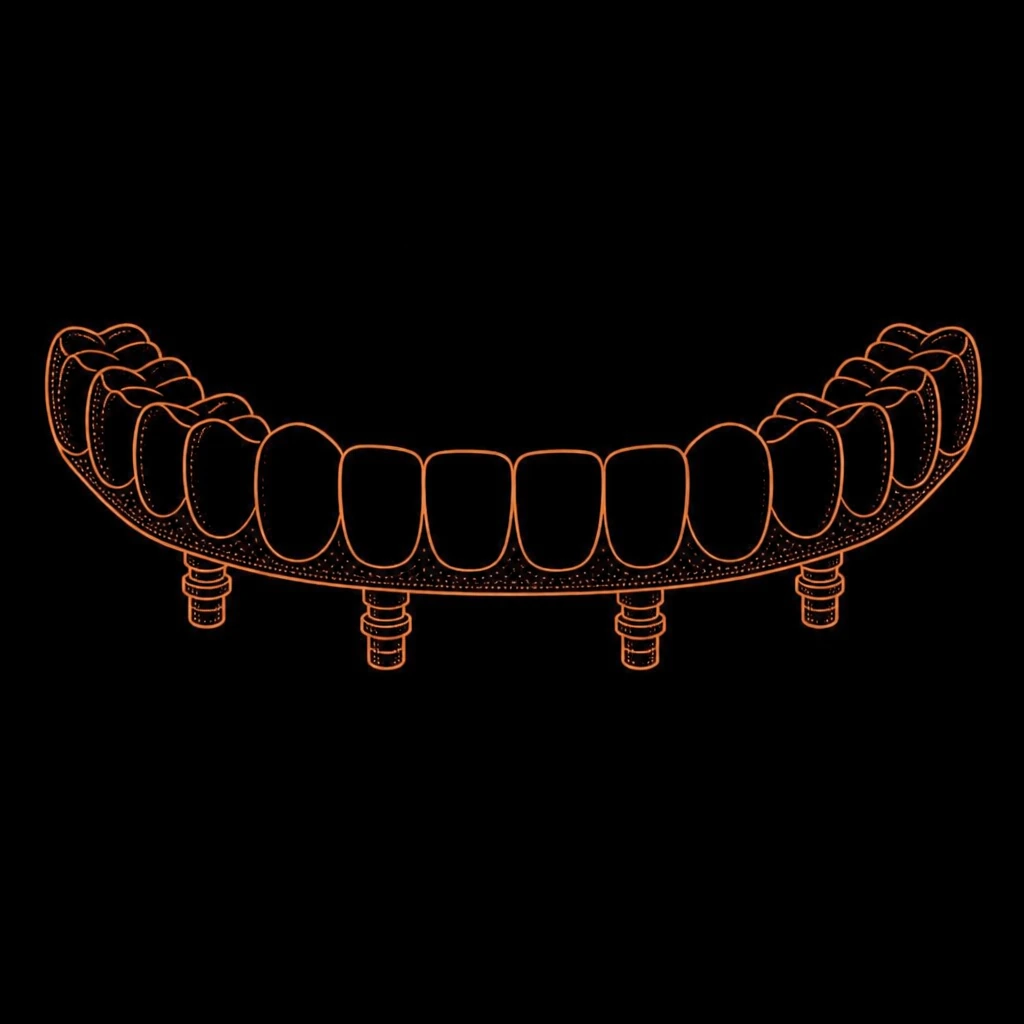
After the healing period, the final bridge is made according to the provisional restoration once you have adapted to it, in ceramic if you wish.
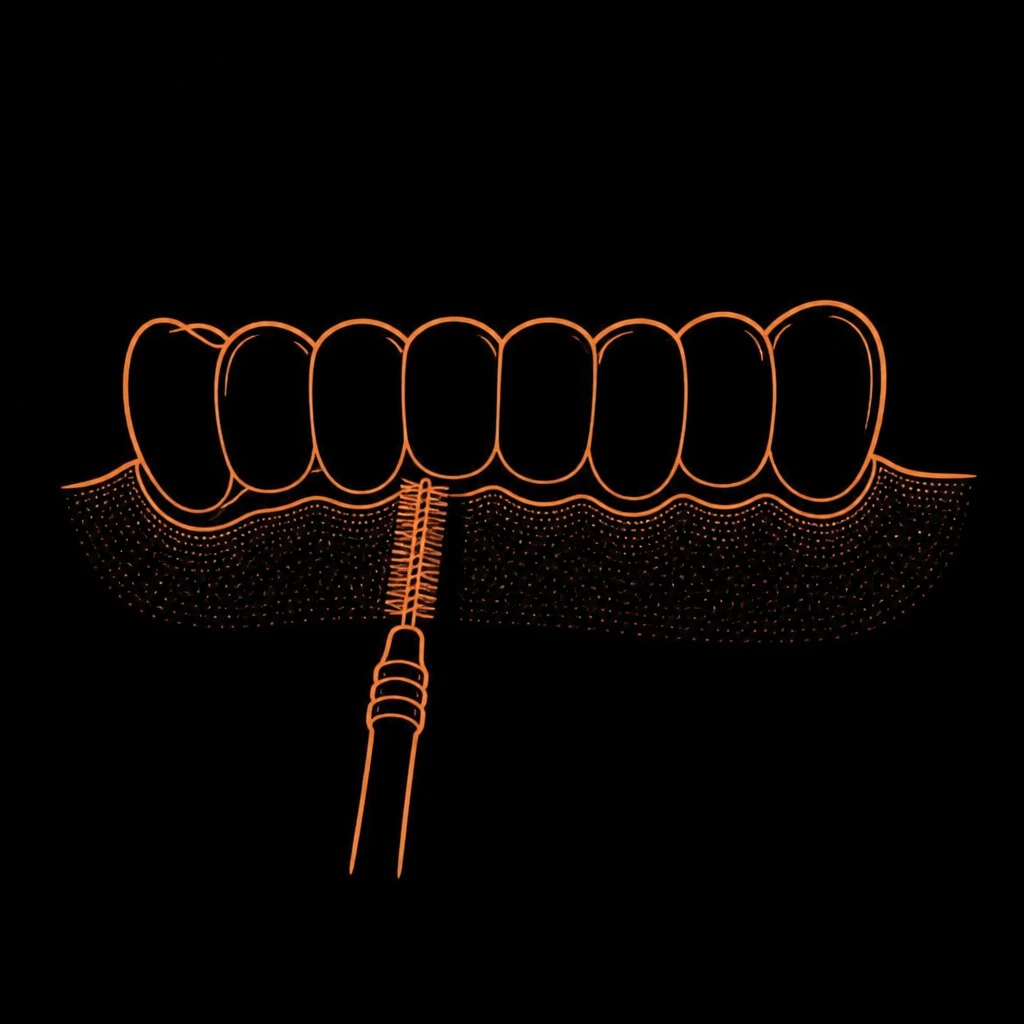
Checkups and professional cleaning at regular intervals; this is where it is decided how long the restoration lasts.
The day of surgery
Depending on the bone situation, the procedure takes about one to two hours per jaw and, after removal of any remaining teeth, consists of four steps. Whether the implants may be loaded on the same day is decided during surgery: the primary stability is measured, meaning how firmly each implant sits in the bone. Only when the values are right is the restoration screwed in place; if they are not, the plan agreed in advance applies, and the implants initially heal without load. Our page on fixed teeth in one day explains what such a Plan B looks like.
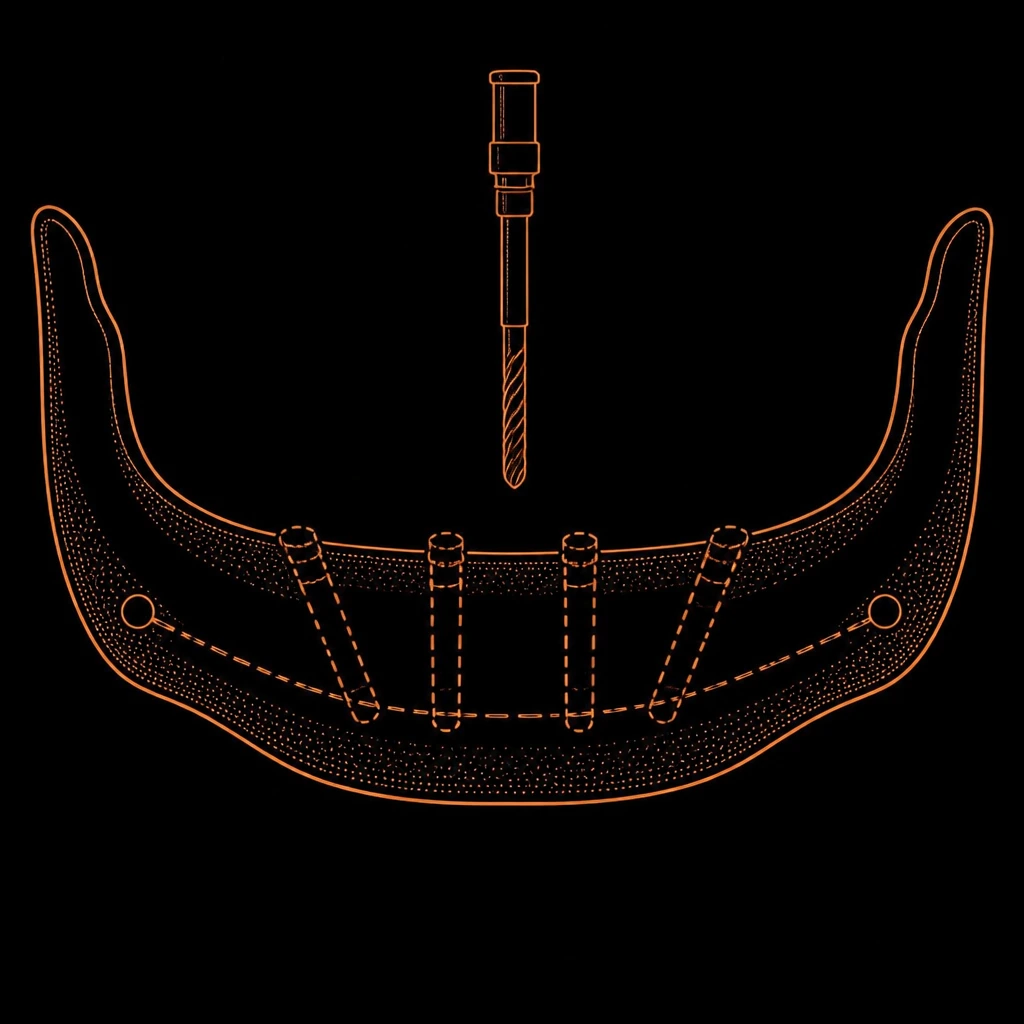
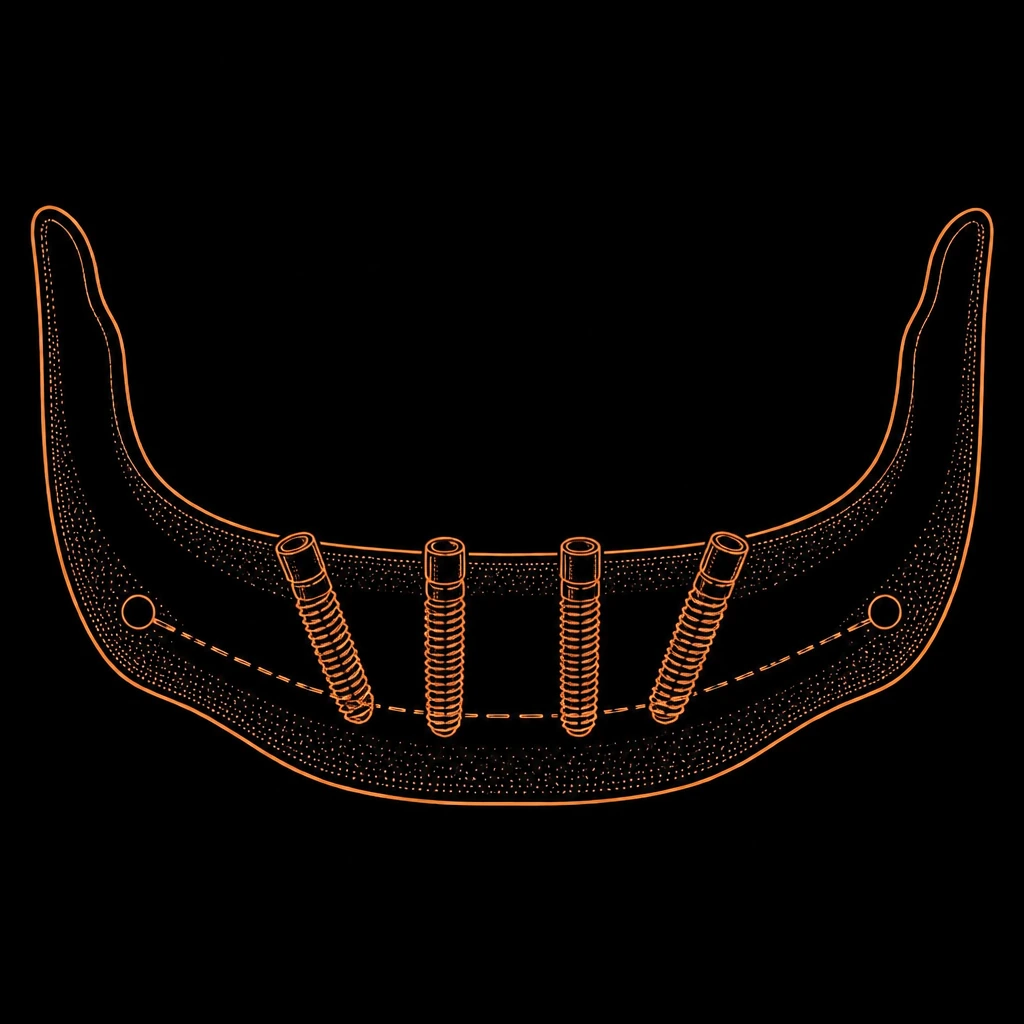
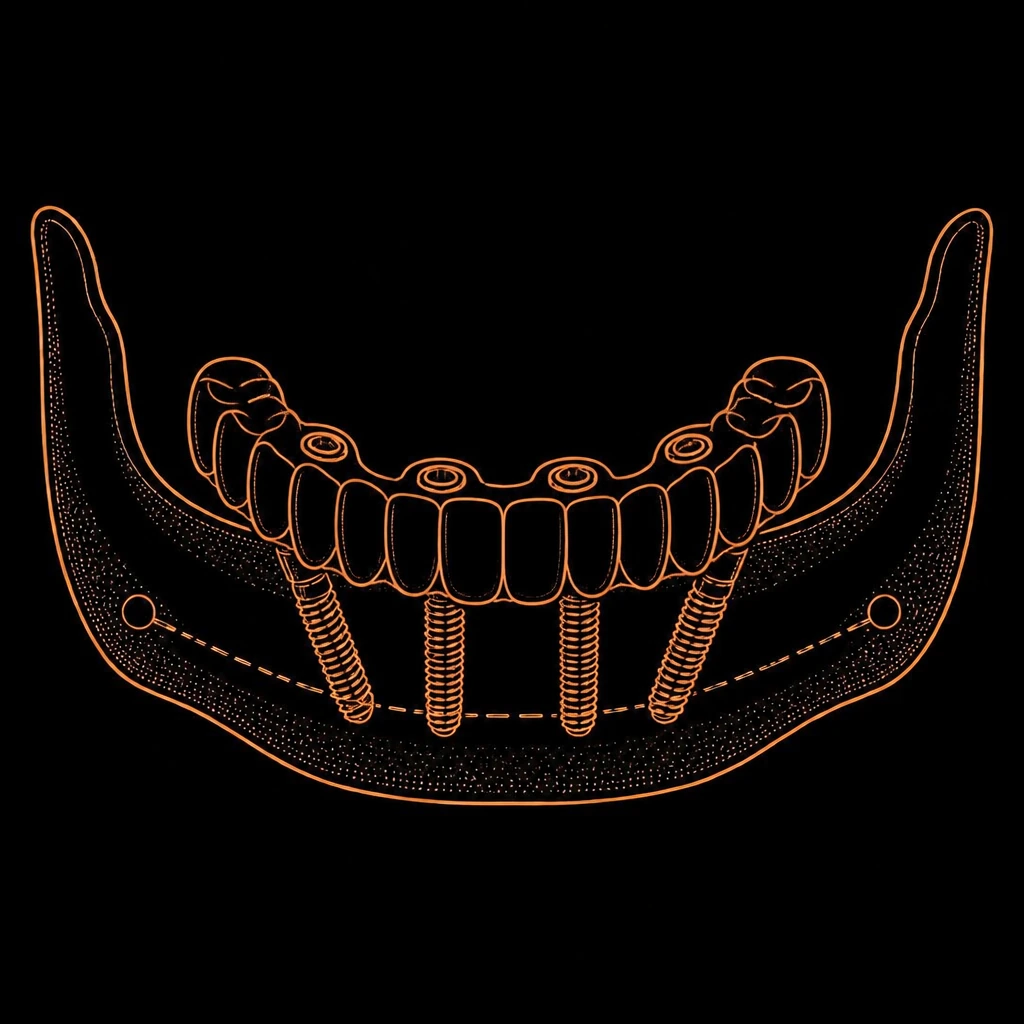
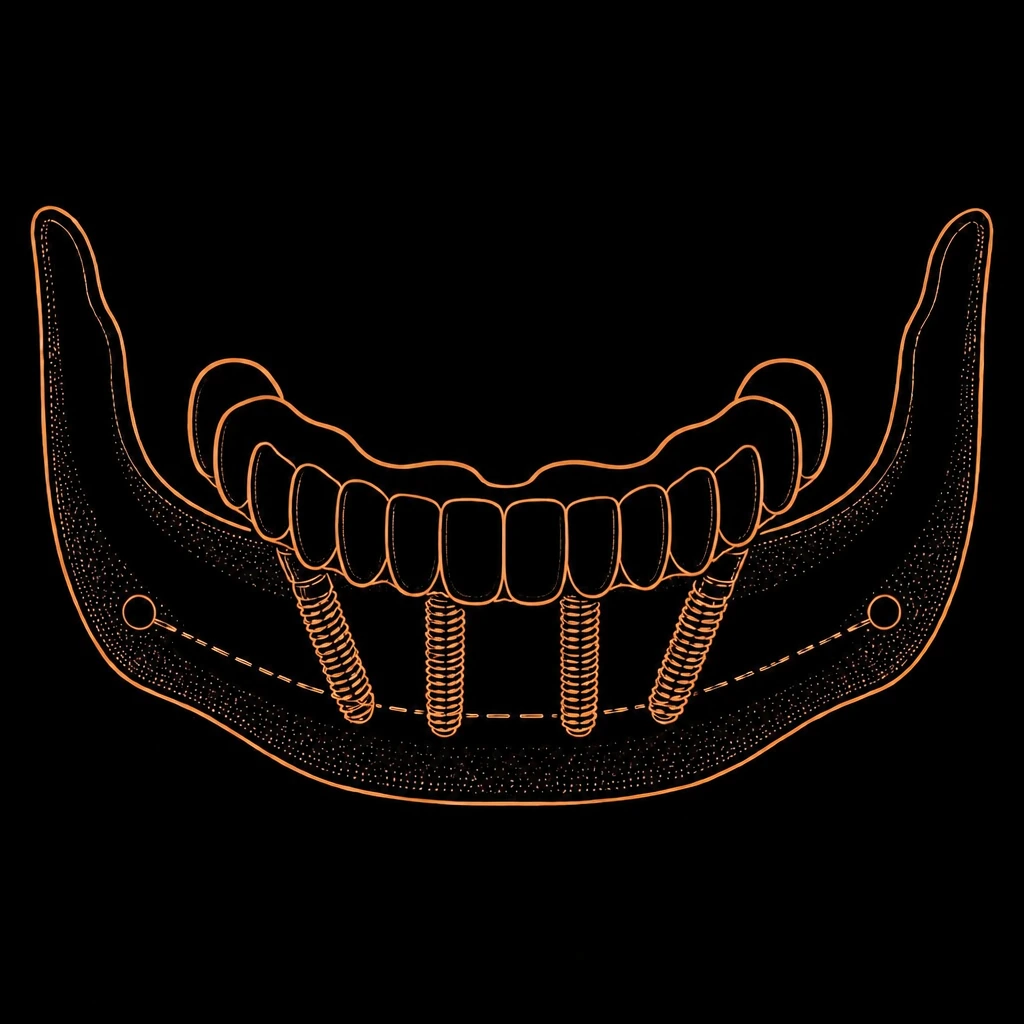
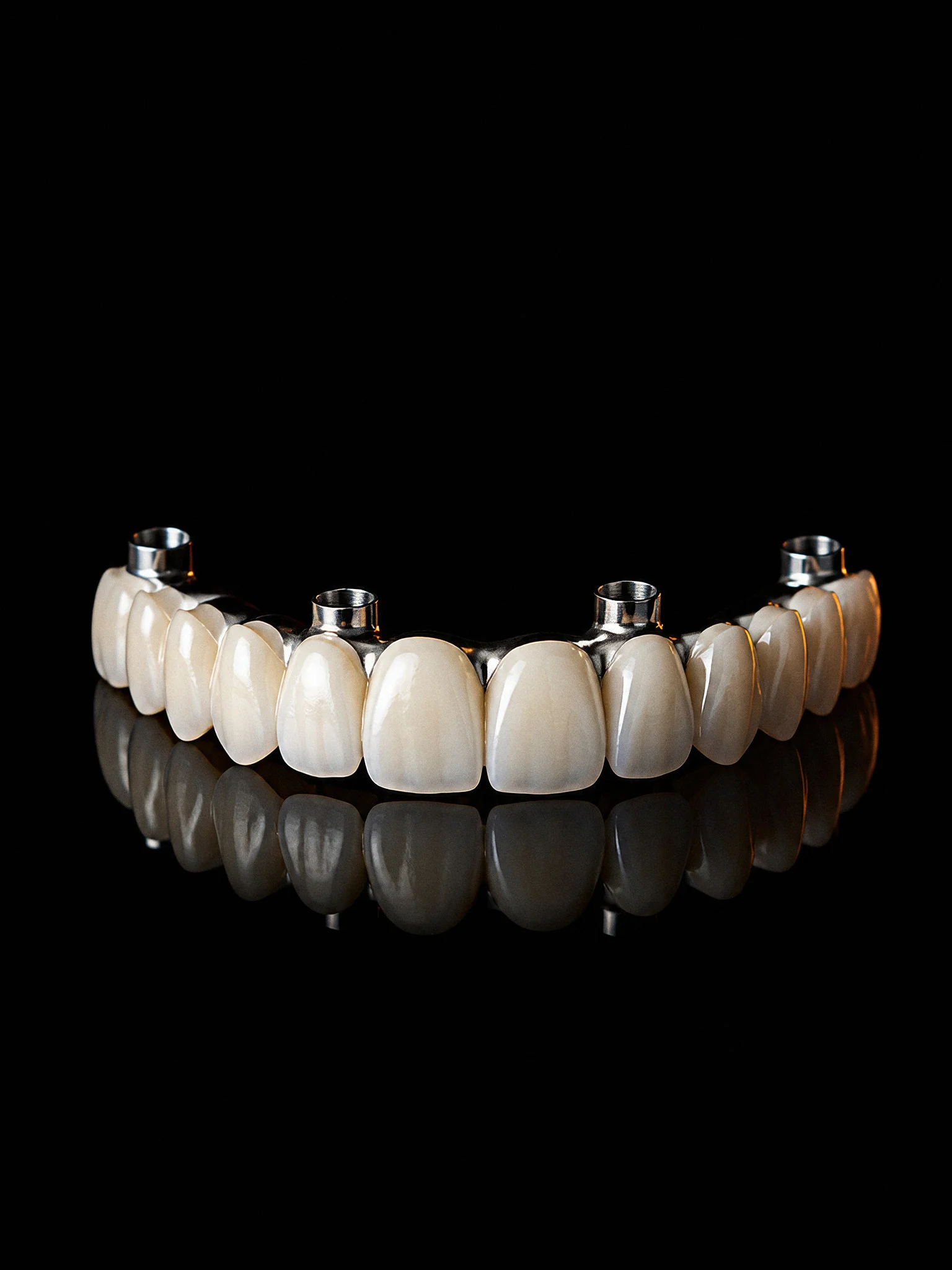
Directly after the implants are placed, our dental technicians adapt the provisional restoration to the new attachment points at the treatment chair; it is fabricated using computer-aided CAD/CAM technology.
The benefits
The concept has been in use since the 1990s and has advantages over a loose denture, but also compared with conventional implant restorations:



In an evaluation covering 10 to 18 years with 471 patients, 98.8 percent of the fixed lower-jaw bridges remained in function; at implant level, the survival rate was 93.0 percent. Smoking considerably increased the risk of bone loss.
Maló et al. 2019, Clinical Implant Dentistry and Related Research – PubMed 30924309. For the upper jaw, the same research group reports 99.2 percent prosthetic and 94.7 percent implant-level survival over 5 to 13 years (PubMed 30924250). In each case, a selected treatment group at a specialized clinic was observed; a study figure is not a promise for an individual case. Jaw, bite, smoking status, care and follow-up affect the prognosis.
What matters
The experience of the dentist and a well-coordinated surgical team are among the most important factors in implant treatment. All-on-4 demands a particular degree of precision, because only four implants support an entire dental arch; there is no room for error. At F80, Dr. Svetla Alpermann, the practice’s lead dentist, personally accompanies you through every step of treatment, from the consultation through the day of surgery to aftercare, without changing faces and without working against the clock.
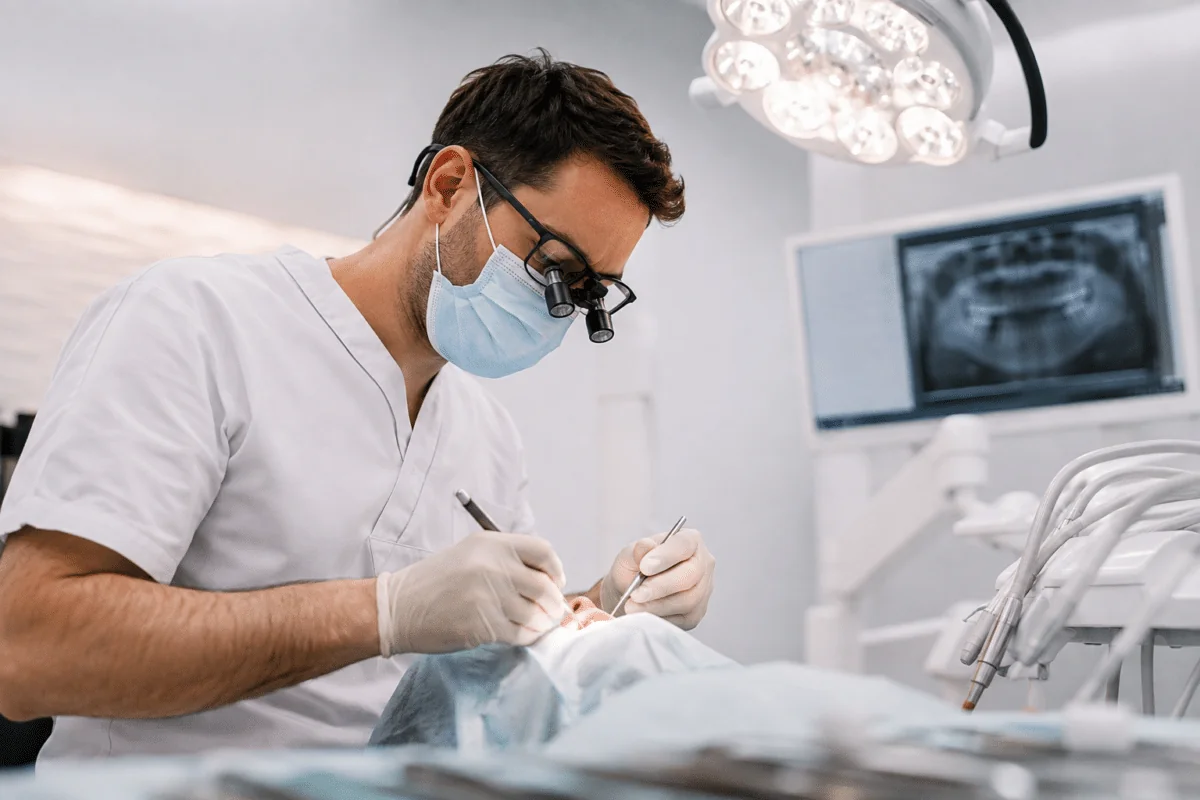
On top of that, the practice deliberately does not feel like a dental practice: its own architecture with a calm atmosphere instead of drilling noises and the smell of disinfectant. The practice is open seven days a week; implant procedures are also possible at the weekend.

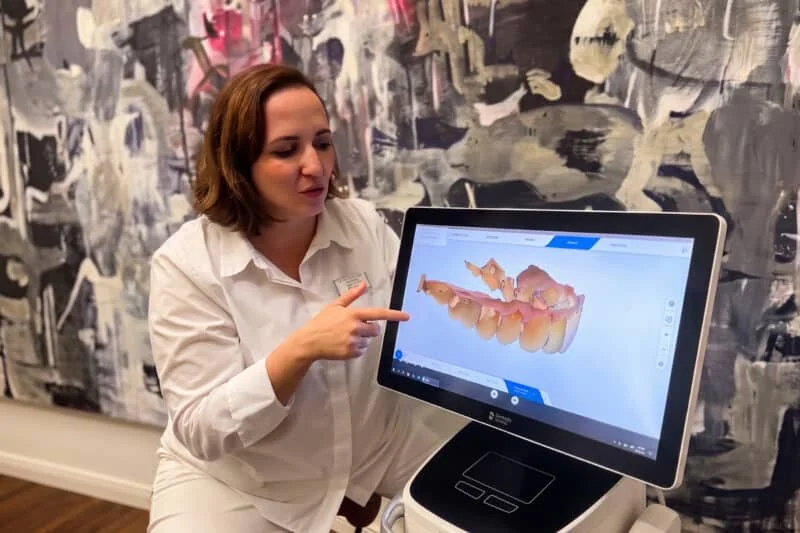

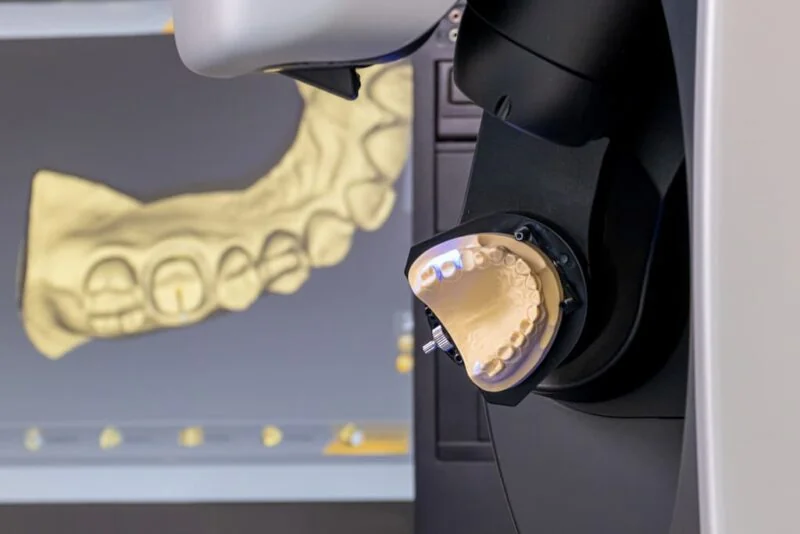
Precise surgery is the foundation; what you wear every day is the work of dental technology. Our All-on-4 restorations are made in well-practiced collaboration with experienced dental technicians who adapt the restoration to your jaw right at the treatment chair, on the day of surgery and at every follow-up appointment afterward. Computer-aided CAD/CAM processes are used for an accurate fit; during the healing phase, the provisional restoration is repeatedly adapted to the changing gums until it serves as the template for the final bridge.
Costs
An All-on-4 restoration costs more than a removable denture, but is often less expensive than a conventional implant restoration with six to eight implants: fewer implants are placed, and fewer procedures and appointments are needed. 3D diagnostics determine what the treatment will cost in your case; before treatment begins, you receive a written, transparent Heil- und Kostenplan (treatment and cost plan), which we go through together.
3D diagnostics and digital surgical planning, the surgical procedure, high-quality special implants from the Swiss manufacturer Straumann, and the provisional restoration including adjustments.
the procedure is surgically more complex, the bone situation requires six implants instead of four, you would like twilight sleep or general anesthesia, or the final bridge is to be made of ceramic.
After the 3D diagnostics and a discussion of your wishes, we draw up a detailed cost plan and answer any open questions before you decide. Throughout the entire treatment, a personal assistant is at your side: they take care of preparing and submitting the Heil- und Kostenplan and handle communication with your health insurer. After the healing period, the provisional restoration is replaced by the final bridge, which is billed separately; its price depends on material and design.

Service
Variants
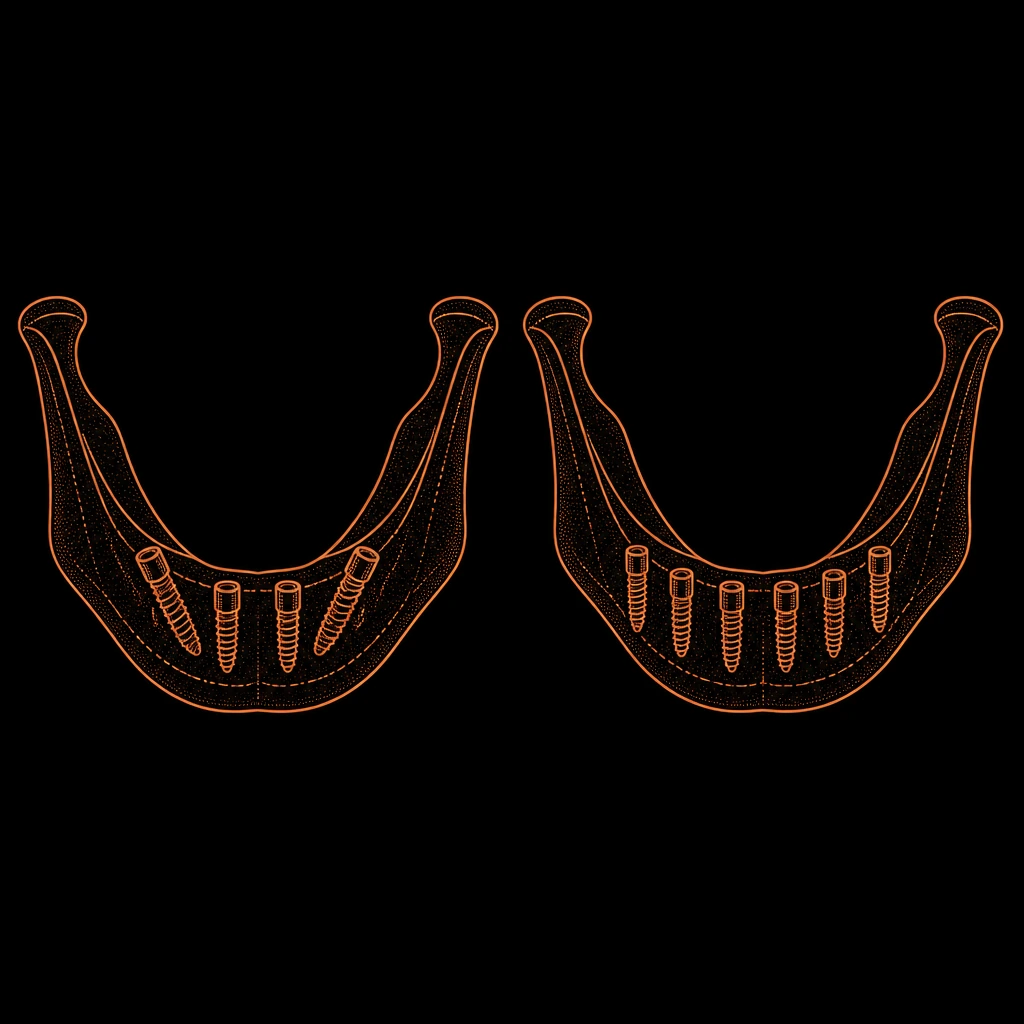
As the names suggest, All-on-6 stands for a restoration on six implants and All-on-8 for restorations on eight implants. As a general rule, the more implants that can be placed without falling below the minimum spacing, the more stably the arch is supported. Still, more is not automatically better.
What matters is the condition of the jawbone: if it is too thin or has receded severely in certain areas, additional implants find no anchorage. More implants also mean a larger procedure with a greater burden. For younger patients with well-preserved bone, six implants can be appropriate, especially in the softer upper jaw; with advanced bone loss, the four-implant solution is often the less invasive approach. The decision is made on the 3D model, not on the name of the concept; our page on fixed teeth in one day explains how it is reached.
Questions
The most important questions from our patients, grouped into five topics:
When all teeth are missing or have to be removed, there are two options: a complete denture supported by the mucosa, or an implant-supported solution such as All-on-4. The implant-supported restoration is fixed, needs no palatal plate and stimulates the jawbone.
Usually a ceramic restoration on implants: a fixed restoration on implants generally comes closer to natural teeth in function and how it feels in the mouth than a removable denture. Ceramic is more resistant than acrylic, well tolerated and can be finely matched in shape and color.
Conventional implants heal over several months and are then exposed in a further procedure before a fixed restoration is attached. With All-on-4, both steps are eliminated: in suitable cases, the implants are loaded with a fixed provisional restoration directly after surgery, remaining teeth can be removed on the same day, and bone augmentation is usually not necessary.
That depends on your bone situation. If there is sufficient bone, more implants offer more stability; with receded bone, the four-implant solution is often the less invasive approach. The decision is made during 3D planning, not on the basis of the name.
The concept is suitable for many people whose jaw is toothless or whose remaining teeth cannot be preserved. For younger patients, a solution with more implants is more likely to be planned. Only rarely is the bone insufficient even for angled implants; in that case, bone augmentation is needed first. Acute inflammation must heal before the procedure.
Implants can also be placed in smokers, but the risk of healing problems and inflammation (peri-implantitis) is increased, and wound healing often takes longer. We recommend significantly reducing smoking, at least during the healing phase, and we address this openly in the consultation.
Often, yes. The procedure itself is relatively short, bone augmentation is usually not necessary, and especially for people who have worn dentures for many years, the firm fit is often an important difference. Pre-existing conditions and medications are carefully recorded beforehand.
As a rule, yes. Before treatment, inform us fully about any pre-existing conditions and all medications; this information is essential for the implant dentist and the anesthesiologist. Depending on your health, preparation includes a current blood count and an ECG, and if necessary we consult your treating physicians. Treatment is usually also possible while you are taking blood thinners; your medication may be adjusted for this.
Yes, that is exactly what the concept is based on: all implants are placed in one day, and in suitable cases you go home the same day with a fixed, functional restoration.
Yes. Remaining teeth that cannot be preserved are removed on the day of surgery, directly before implant placement.
The procedure itself takes about one to two hours per jaw; in addition, there are preliminary examinations, consultation and follow-up checks. After a healing period of a few months, you receive the final restoration.
The provisional restoration is made of acrylic on the day of surgery and adjusted immediately; during healing, it is readjusted at the follow-up appointments to the changing gums. In the end, it serves as the template for the final bridge, which can be made of high-quality ceramic if you wish; its fabrication takes a few weeks.
Dr. Svetla Alpermann discusses this with you personally, together with the anesthesiologist, in the informed consent consultation, because it depends on your health, medications and the extent of treatment.
Unlike with conventional implants, only in exceptional cases: specially shaped implants placed at an angle find anchorage even in jaws with advanced bone loss. 3D diagnostics show whether this applies to you.
No, that is what distinguishes the concept: in suitable cases, you receive a fixed restoration on the day of surgery and do not have to wear a removable denture at any point. Only if an implant does not achieve the necessary stability does the transition plan discussed in advance apply.
Take it easy for a few days, as this is a surgical procedure: the wound has to heal, and the implants begin to fuse with the bone. Most patients return to their daily routine after about a week and eat soft food at first.
The gums usually heal within ten to fourteen days; bone healing, the osseointegration of the implants, takes about eight to twelve weeks.
The procedure itself is not painful thanks to local anesthesia, twilight sleep or general anesthesia. When the anesthesia wears off, wound pain, swelling and bruising may occur; as a rule, they can be managed well with the prescribed painkillers.
Many people get used to the feel of their new teeth in the first few weeks. After that, the fixed restoration can be used in everyday life much like natural teeth; anything that still feels unfamiliar to you, we discuss at the follow-up appointments.
Yes, once the implants have fully healed. In the first eight to twelve weeks, you should prefer soft food; after that, you can usually eat normally again. As with natural teeth, you should chew very hard foods with care.
Like natural teeth: several times a day with a toothbrush and toothpaste, plus interdental brushes and floss for the transitions at the gums.
If there are no complaints, it is sufficient to have the implants checked once or twice a year and to have professional teeth cleaning carried out at the same interval.
Discoloration caused by coffee, tea or smoking is removed during professional cleaning. With ceramic restorations it hardly occurs, because the material is very hard, dense and smooth.
With good care, a restoration can last many years; you will find long-term studies in the evidence section. What matters are oral hygiene, regular checkups and professional cleaning, so that inflammation is detected early. Smoking and untreated conditions such as diabetes considerably shorten its lifespan.
In rare cases, an implant can be lost, for example due to peri-implantitis. The site is then treated, the restoration adjusted, and we check where a new implant can be placed. With All-on-4, the fourth implant is replaced so that the bridge remains evenly loaded; an All-on-6 restoration can usually also bear a loss with five implants.
Getting here
You will find us at Friedrichstraße 80, 10117 Berlin-Mitte, a few minutes’ walk from Friedrichstraße and Brandenburger Tor stations: buses 100, 300 and N5 (Unter den Linden/Friedrichstraße), buses 200 and M48 (Stadtmitte/Leipziger Straße), S-Bahn lines S1, S2, S25, S26, S3, S5, S7 and S9, and U5 and U6. We treat both privately and statutorily insured patients.
Come with your story, your questions and, if you like, any existing records. We listen, examine thoroughly and then tell you what is possible in your jaw, with a written plan instead of a blanket promise. Appointments online or by phone: seven days a week, Monday to Friday until 8 p.m.